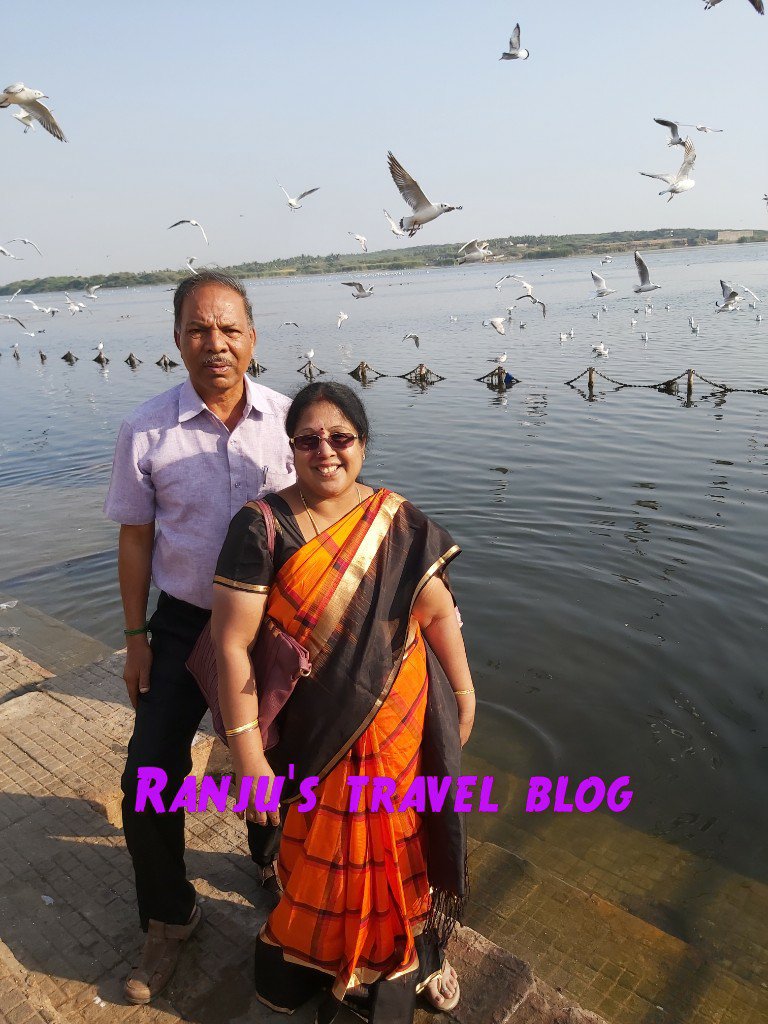
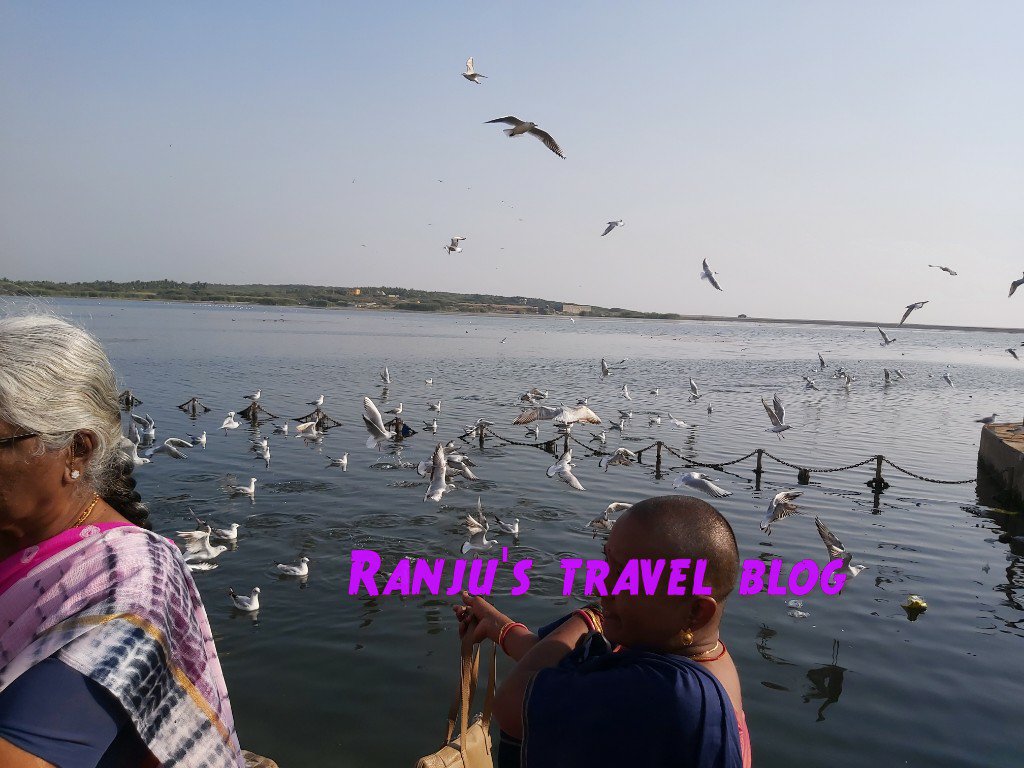
Triveni ghat in Somnath deserves special mention as a holy place as per Indian mythology since it finds mention even in epics such as the Ramayana and the Mahabharata. This is the meeting place of three important rivers i.e. Hiran, Kapila and Saraswati before they finally empty themselves out in the Arabian Sea. It is believed that Lord Krishna bathed at this place just before his journey towards Goloka Dham and hence it is a spot for many to take a dip for purifying themselves. Several ghats and changing rooms have been made to provide assistance in bathing. People who have ‘Pitrudosha’ regularly come here to perform shraddh tarpan or ancenstral worship. Due to the scarcity of water, a small dam has been built which makes this river bank perennial. Don’t miss an opportunity to take a boat ride to the confluence of the three rivers and feed the pigeons, also a special draw for kids.
Sudama is also known as Kuchela, mostly in southern India was a Brahmin childhood friend of Hindu deity Krishna from Mathura, the story of whose visit to Dwaraka to meet Krishna is mentioned in the Bhagavata Purana. He was born as a poor man in order to enjoy the transcendental pastimes.
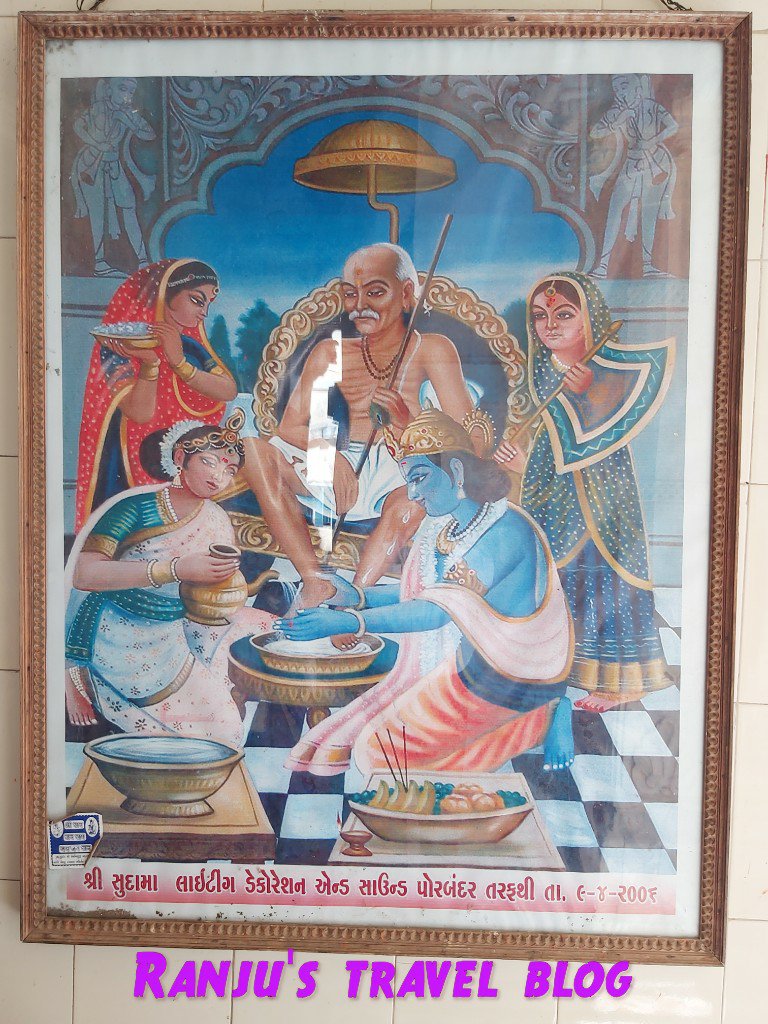
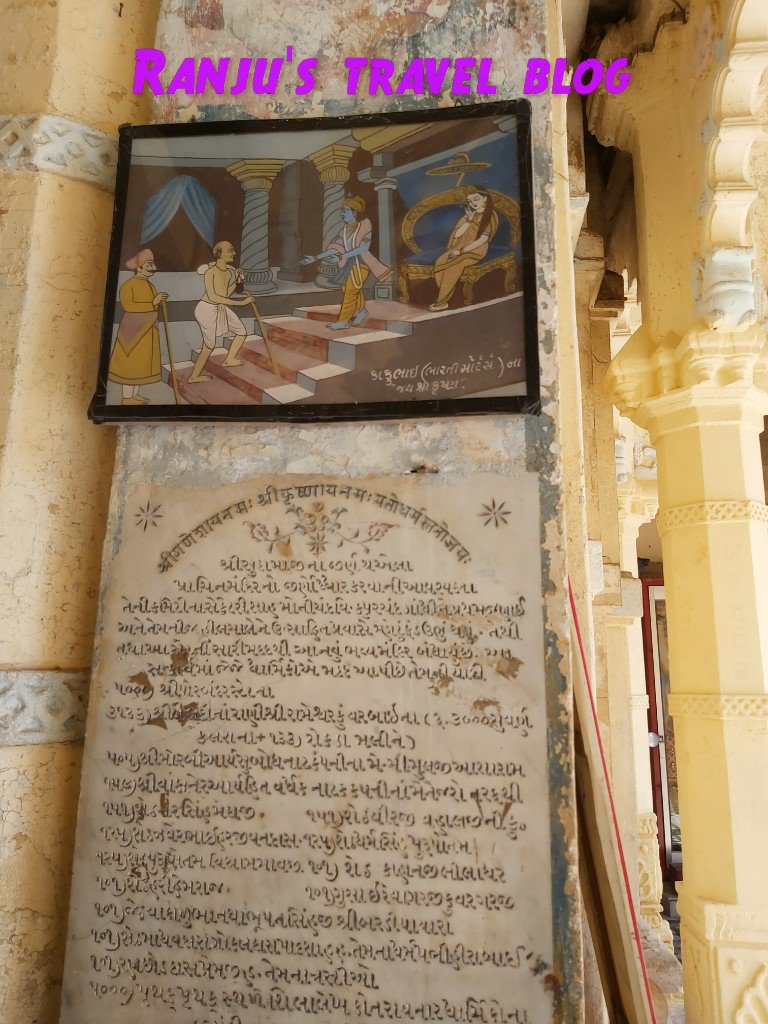
As an avatar of Lord Vishnu he is worshipped by millions of devotees. Mathura, his birthplace is one pilgrimage spot and Dwarka, the place he made his home and kingdom, is another. The Jagat Mandir also happens to be one of the major char dham pilgrimage spots in India. When one thinks of Lord Krishna then one also thinks of Sudama, his childhood friend who travelled from Mathura to Dwarka at his wife’s behest. Sudama entered the court and on seeing him, Lord Krishna rushed to meet him, washed his feet and welcomed him. Sudama actually wanted to ask for Lord Krishna’s help but he forgot and returned home, only to find it transformed with riches. Such is the goodness of Lord Krishna who understands and grants. Dwarka is where pilgrims go with prayers in their hearts.
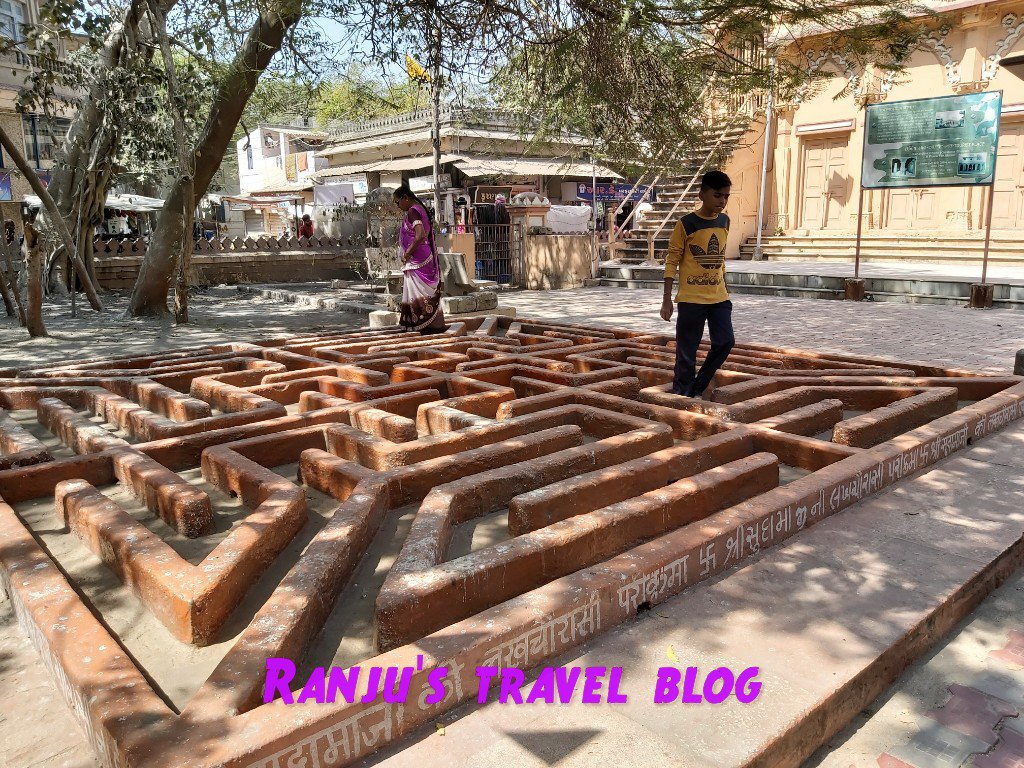
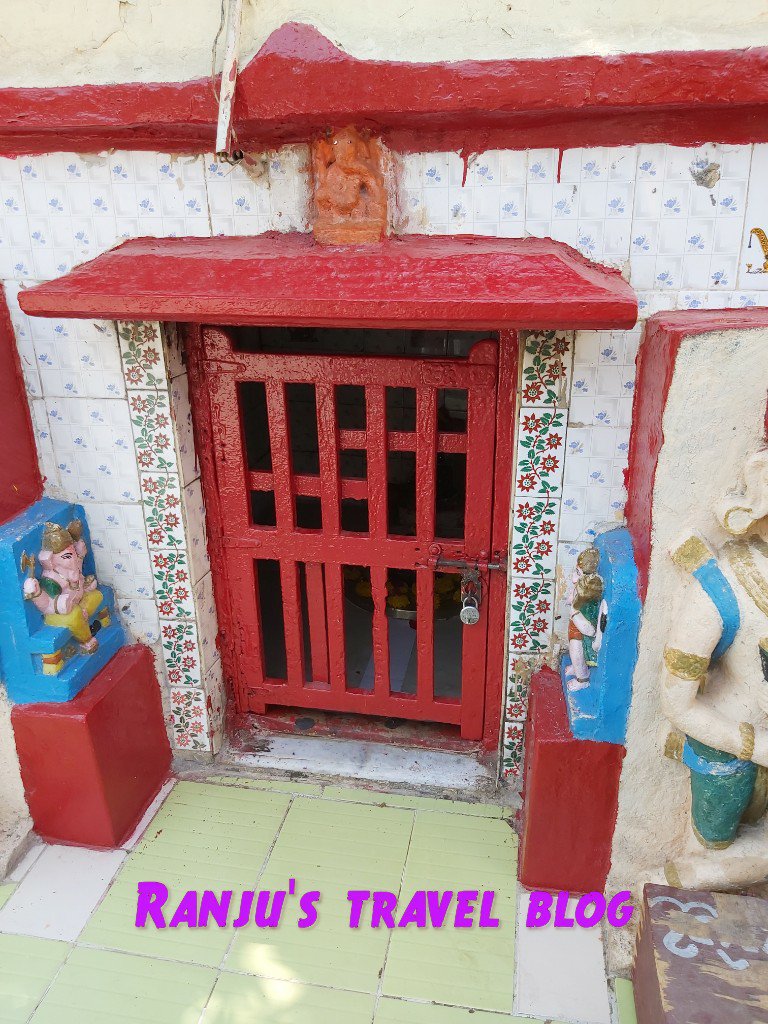
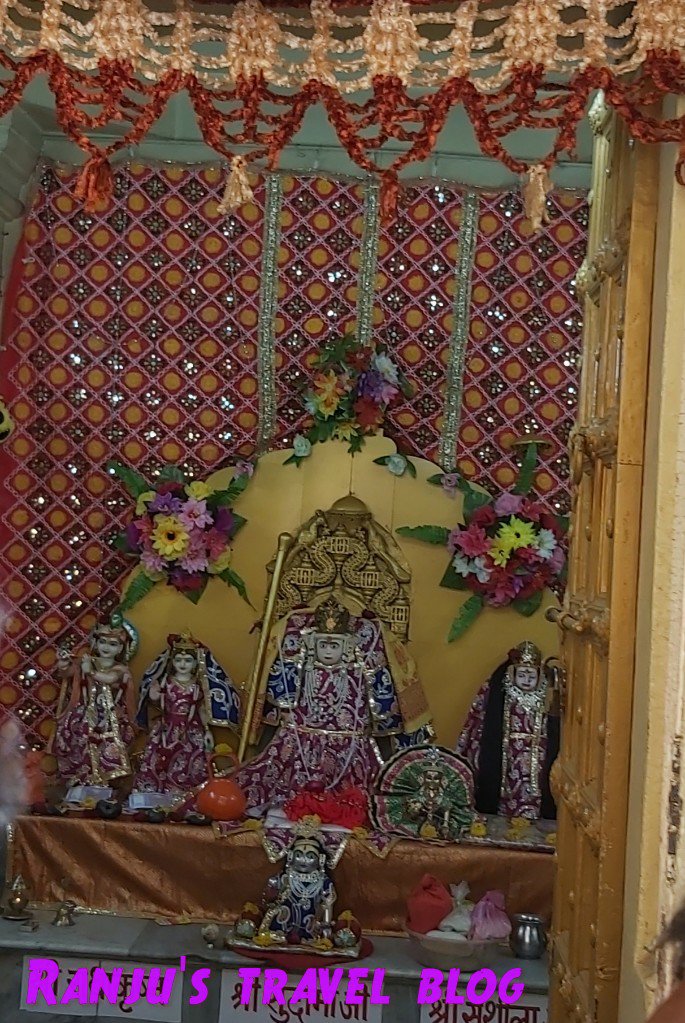
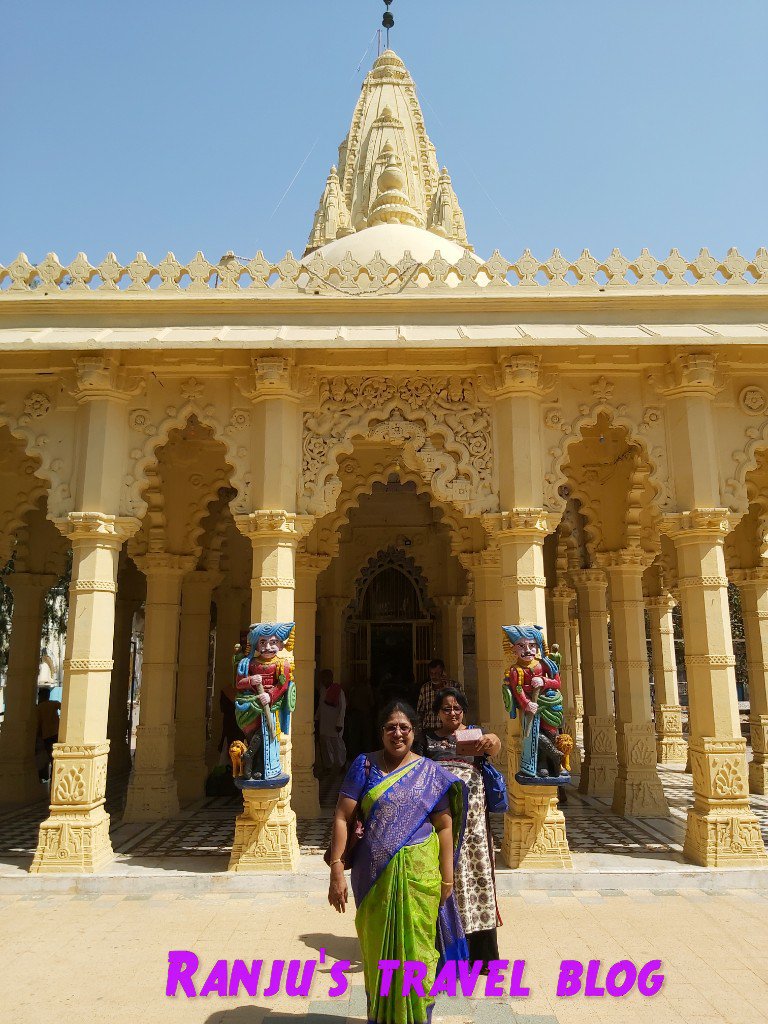
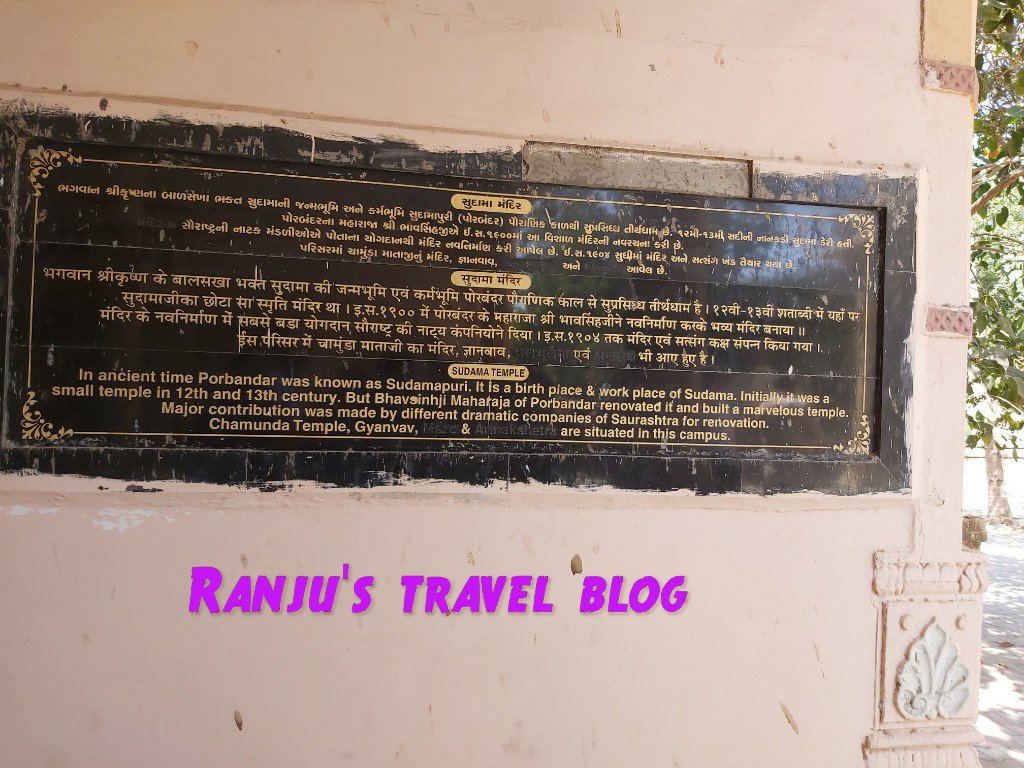
The temple main deities are Lord krishna with his consort Goddess Rukmani and Sudama with his consort Susheela. At the entrance is a maze and a kund named Sudama kund . Seperate shrines for Lord Ganesha and Lord Anjineyar . Paintings of Radha and Lord Krishna doing padha pooja to Kuselar are present on the walls of the temple . This place was anciently known as Sudama Puri .
The main archMazeSudama kundLord Ganesha temple The main deities Lord Hanuman Paintings Lord Krishna receives SudamaThe temple corridor The main entrance Sudama Dwaraka
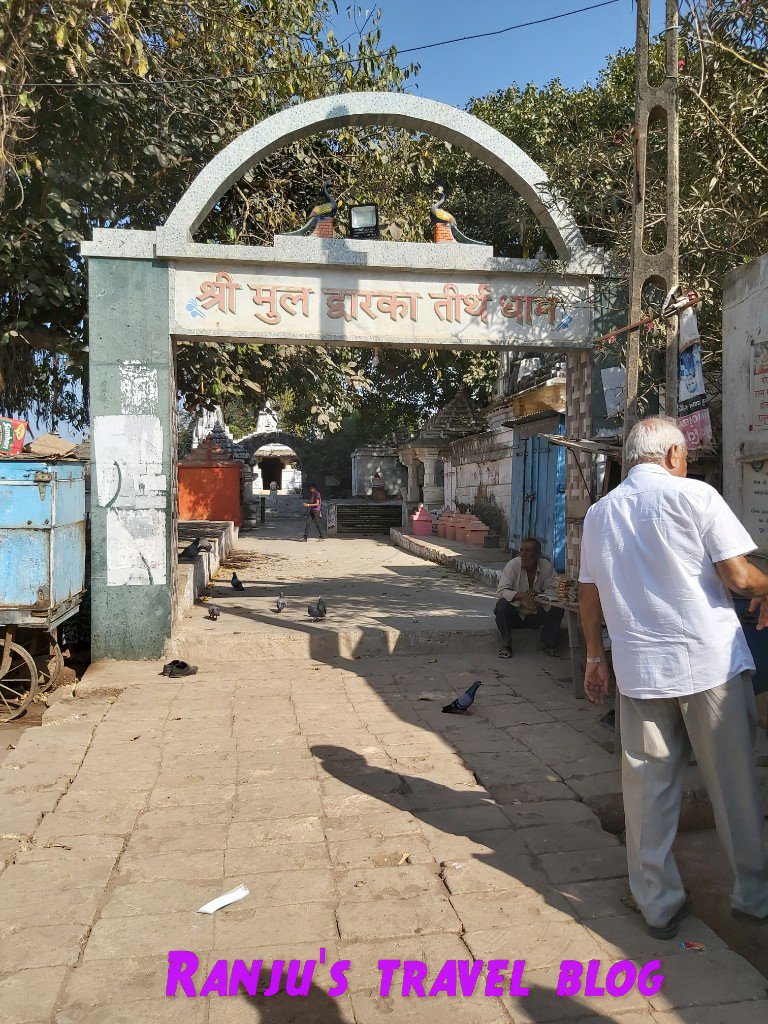
Mool means root or origin. It is believed when Lord Krishna travelled from Mathura to Dwaraka he first established himself in Mool Dwaraka.
According to legend King Jarasandha vowed to wreak vengeance on Krishna for killing his sons and waged a war but always lost. However, Krishna never killed him because it was decreed by fate that Jarasandha would die at the hands of Bhima and he went on to Dwaraka. He came to Moola Dwaraka, a stone slab commemorating his arrival here.
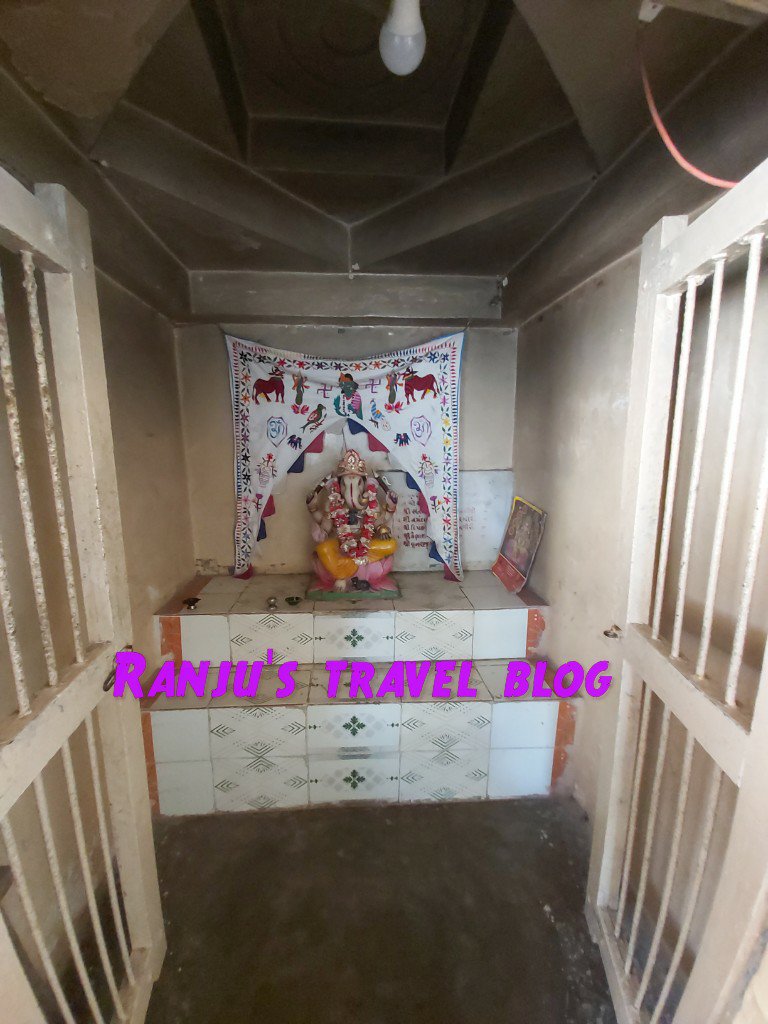
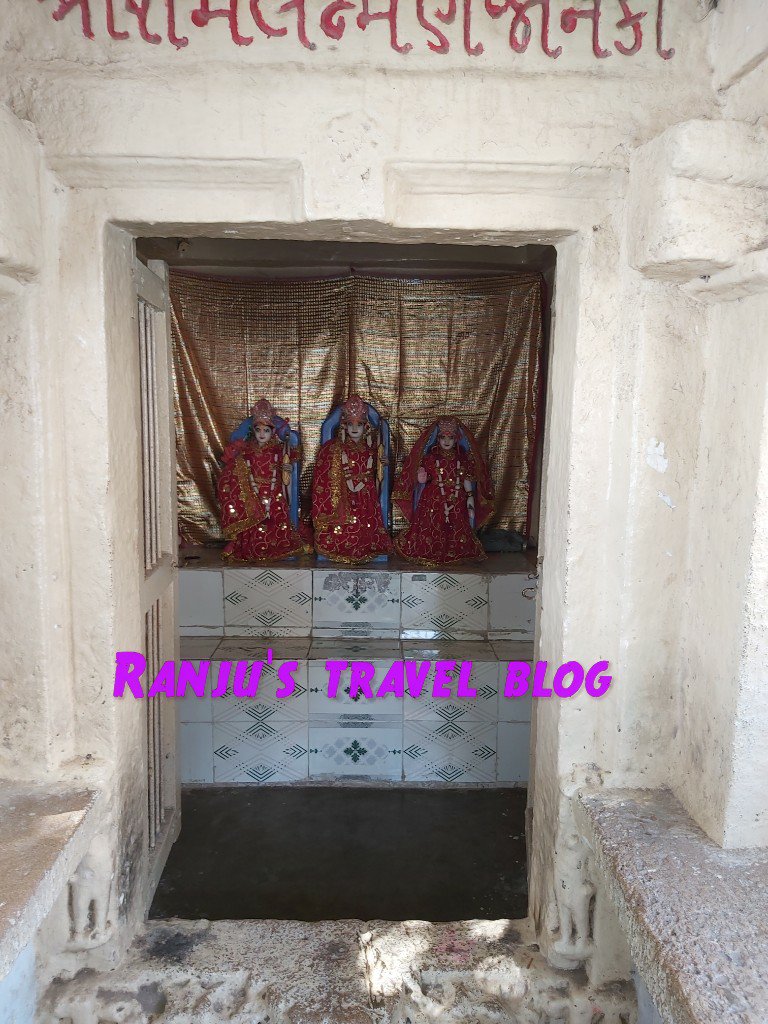
It is believed that the site here dates back to the times of the Mahabharata and that it was a flourishing port. Lord Krishna and his brother Balaram stayed here before settling down at Dwaraka. There is a temple here in a dilapidated condition and a deep well nearby from where Lord Krishna is said to have had his bath. The temple houses idols of Radha Krishna, Rama Sita and Lakshmi Narayan Lord Ganesha Lord Shiva in addition to shrines dedicated to lesser gods.
The ancient coastal village of Mul-Dwarka, near Kodinar, is known for a temple dedicated to Lord Vishnu and Lord Krishna. According to legend, Lord Krishna had stopped in Porbandar at the village of Visaavda on his way to Dwarka . In its remembrance in Visavda (Mul Dwarka) Lord Krishna’s “paduka” (footprint) can be seen in this temple. A grand fair is organised every year in the village on the special occasion of Janamashtmi. Mul-Dwarka is located around 45 km from Somnath and 175 km from the city of Porbandar.
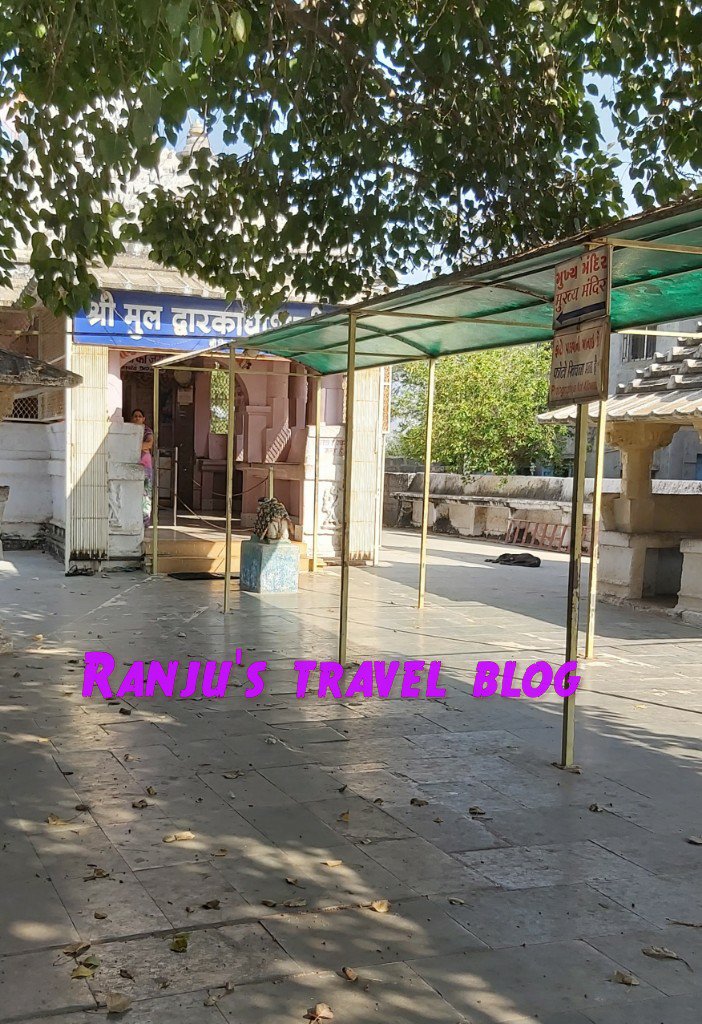
Entrance of Mool Dwaraka Lord Ganesha The main deity Lord Ram Seetha and LakshmanThe main entrance Lord Shiva The temple shikar
This is the Lord Krishna temple . We were lucky to have the arathy dharshan. Here too ladies and gents are allowed in different queues .
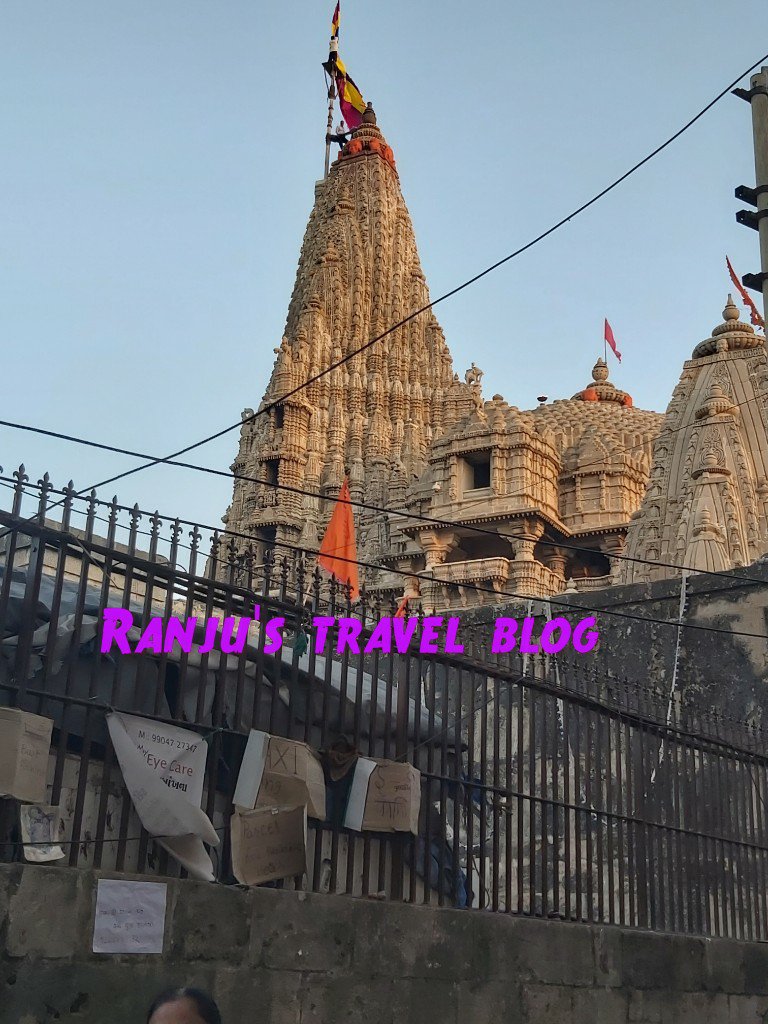
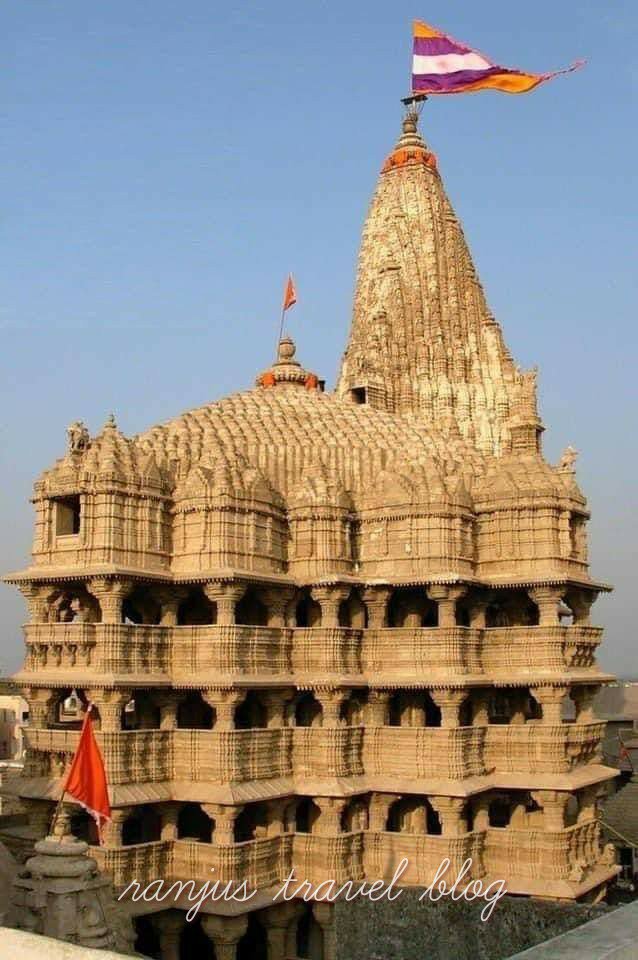
Dwarkadheesh temple that draws millions of pilgrims. Seven storeys high and constructed of sandstone without any metal or wood, it is about 43 metres tall. It sits at the tip of the Arabian Peninsula where the Gomati River flows into the sea. The temple complex houses shrines dedicated to Devaki ji, Kusheshwar Mahadev, Sharda Peeth and Pradyumnaji. The temple dedicated to Samudra Narayan, the sea God who granted land to Lord Krishna for Dwarka, is also located nearby. The temple opens at 6.30 AM with mangla aarti and ceremonies proceed till 1 PM when it closes. Evening rituals start at 5 PM and go on till 9.30 PM. While the temple and the idol inside are worshipped, the Dhwaja or flag atop the shikhar also has its own significance. It is 52 yards long and there is a reason for its length. It binds together 52 different Yadav sects and represents the 52 Yadav administrators who worked under Lord Krishna. The 52 yards also signify the 50 doors with the two extra for entrance and exit to the personal abode of Lord Shriji known as Moksha Dwar and Swarg Dwar. The Sun and Moon symbol on the flag represent incarnation of Shriji. The red, green, yellow, blue, pink, white and saffron colors too have special significance.
Dwarkadish Temple is also called as Jagat Mandir or Trilok Sunder Temple in Gujarat. The amazing architecture and history make it one of the top Krishna temples in India.
Dwarkadhish Temple is a Chalukya styled architecture, dedicated to Lord Krishna. The town of Dwarka has its history dated back to the Kingdom of Dwaraka in Mahabharata. The five storied main shrine is grand and marvelous in itself constructed of limestone and sand. The 2200-year-old architecture, is believed to be built by Vajranabha, who constructed it over the land reclaimed from the sea by Lord Krishna.
The black magnificent idol of Lord Krishna appears to be so appealing that devotees feel the presence of the lord before them. The temple showcases intricate sculptural detailing done by the ancestral dynasties that ruled the region. There are other shrines within the temple which are devoted to Subhadra, Balarama opposite to Lord Balarama is Lord Ganesha with sithi puthi and Goddess Lakshmi on one side and Garuda the vahana of Lord Vishnu on the other side . There is a seperate shrine of Radhe krishna . A mantap with Adi Shankaracharya then to its side a few step upstairs is a 5 stepped kolu all silver cow calf and Lord Krishna ‘s favourite things were kept . There were seperate shrines for Vasudeva, Devaki matha and an underground Lord Shiva with his consort Parvathi many others. Durvasa Maharishi has a seperate shrine in this temple. The devotees are expected to take a dip in the Gomti river before proceeding into the temple through the Swarg Dwar. The eve of Janmashtmi is the most special occasion in any Krishna temple, the Dwarkadhish temple is adorned by thousands of devotees chanting prayers and rituals. The shrine is a hive of colours, voices and faith transforming itself into inner silence and sanctity.
The flag of the temple is hoisted on top of the Shikar 5 times a day 3 times in the morning and 2 times in the evening session. We were lucky enough to witness it .
There are many mythical tales woven around the city of Dwarka. The most prominent myth is associated with the ‘hero of the Dwapara’; Lord Krishna who is believed to have held his kingdom here. Dwarka in the ancient times was known as Anarta which had been Lord Krishna’s terrestrial empire. Dwarka consisted in islands like Antar dwipa, Dwarka Island and the mainland of Dwarka. The city had been the capital city of the Yadava clan which ruled over the place since many years. In the great epic Mahabharata Dwarka is mentioned as Yadavas’ capital city consisting in many other neighboring states such as Vrishnis, Andhakas, Bhojas within its jurisdiction. The most important chiefs of Yadava clan inhabiting Dwarka included Lord Krishna, who was the king of Dwarka, then Balarama, Kritavarma, Satyaki, Akrura, Kritavarma, Uddhava and Ugrasena. According to the most popular legendary tale, Lord Krishna migrated to Kusasthali; the name by which Dwarka was known in the ancient times in order to evade the continual harassing raids done on Mahura by Jarasandha; Kansa’s father in law. Jarasandha wanted to avenge the death of Kansa, the wicked cruel uncle of Krishna whom the lord had killed and thus was attacking Mathura time and again.
According to legendary, Kusasthali had been Lord Krishna’s ancestral native on his maternal side. The city is said to have been set up a Yadava ancestor of Lord Krishna; Raivata after he got defeated battle with Punyajanas and lost his kingdom to the latter. After the defeat, Raivata fled to Mathura in order to keep himself and his clan members safe. Later on he returned to establish the city of Kusasthali or Dwarka. This tale indicates that lord Krishna’s shifting to Dwarka from Mathura took place in reverse order.
When he came back to Dwarka along with his clan of Yadavas, he ordered Lord Vishwakarma to build a city for his kingdom. Answering his order, Lord Vishwakarma told that the city can be built only if Lord Samudradevi offered them some land. Lord Krishna then prayed to Samudradeva who responding to the prayer providing them with land up to 12 Yojna and soon after the celestial constructor Vishwakarma built the city of Dwarka in a short span of only 2 days. The city was called ‘Suvarna Dwarka’ because it was all clad in gold, emeralds and jewels which were used to construct the houses in lord Krishna’s ‘Suvarna Dwarka’. It is believed that Lord Krishna’s original residence was at Bet Dwarka from he administered the entire Dwarka kingdom. Legend further adds that after Lord Krishna departed from his mortal body, the city went under the sea with Samudradeva taking back what he had given once upon a time.
The Temple of Dwarkadhish is believed to have been set by Vajranabha; grandson of Lord Krishna, in order to pay tribute to the great lord. The religious significance of Dwarka is associated with other myths too. One such myth points out the Dwarka is the spot where Lord Vishnu had demolished the demon Shankhasura.
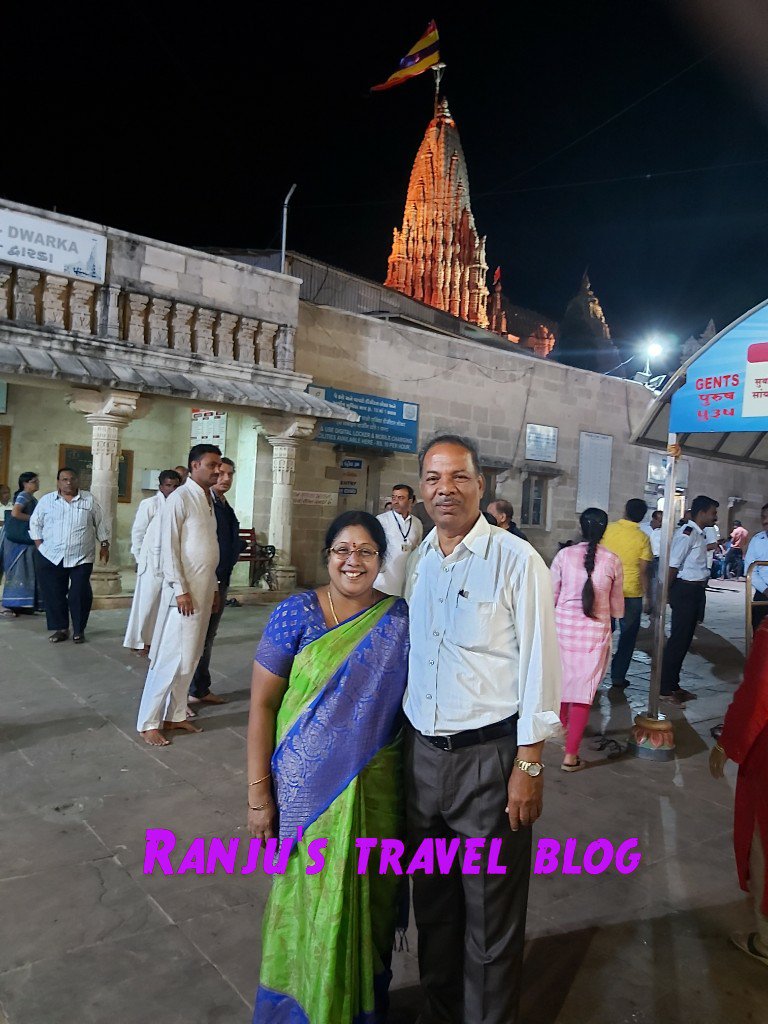
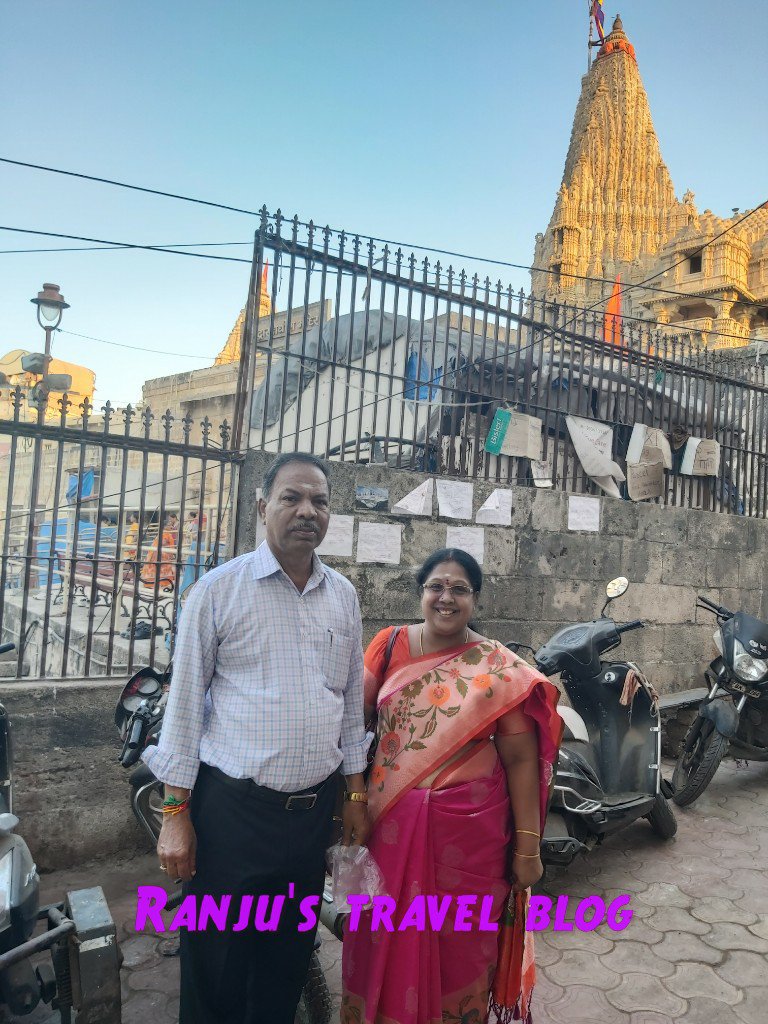
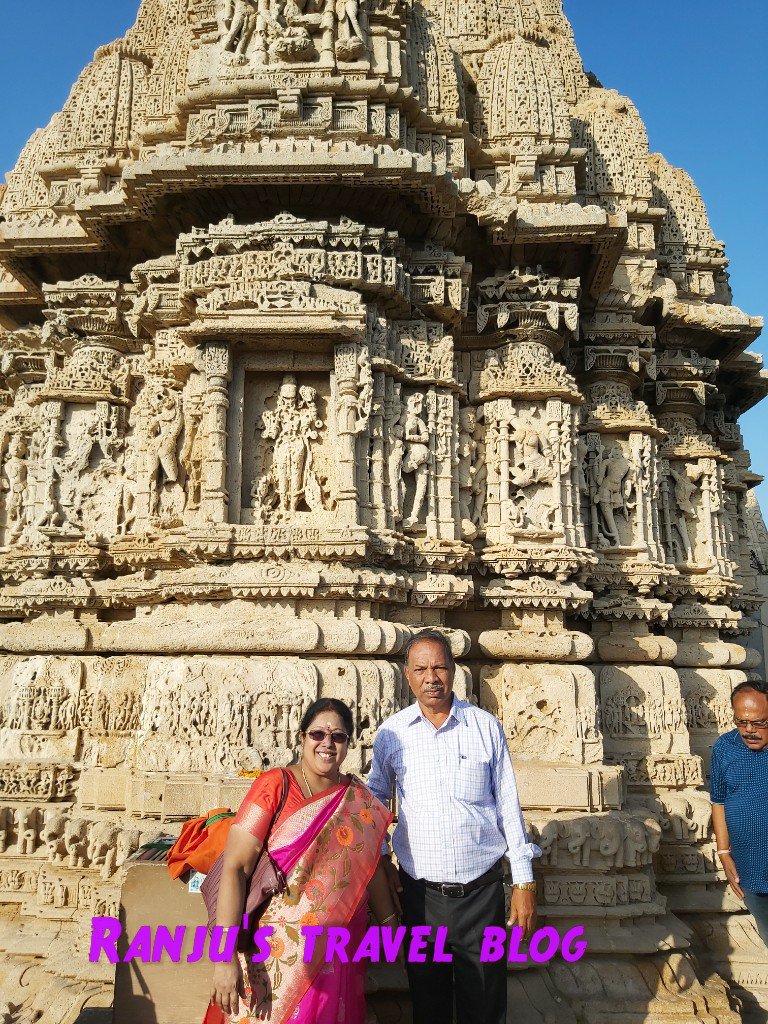
Bags camera mobiles and photography are prohibited . We took photos outside the temple by the istant photographers there .
In front of the temple From the adjacent road the temple viewFlag hoisting Side view of the temple Dwarakadesh picture
This 2500 year old temple, located at a distance of 2 kms away from Dwarkadhish Temple, is dedicated to Rukmini, one of the wives of Lord Krishna and an incarnation of Goddess Lakshmi.
Rukmini is Lakshmi incarnate, a symbol of love and devotion to Krishna, a symbol of purity and humility as well. Visiting the temple and praying to her is a must if you visit Dwarkadheesh .
There is a very interesting legend that explains why Rukmini is not worshipped in Dwarkadhish Mandir along with the other wives of Lord Krishna but separately in a temple solely dedicated to her. Long ago Krishna and Rukmini went to sage Durvasa to invite him to Dwarka. He agreed to come on the condition that his chariot would be pulled by none other than Krishna and Rukmini, to this, they readily agreed. Just before reaching Dwarka, Rukmini became very thirsty. To quench her thirst Lord Krishna pressed the ground and Ganga waters started streaming from here. A thirsty Rukmini took a sip without offering it to Durvasa and this annoyed him, thus followed a curse that she would be separated from her husband. Rukmini’s temple stands on very arid land, completely isolated with not a single building or house besides it. The temple’s spellbinding architecture with minute carvings and paintings depicts various stories that draw tourists from all over the world. Every devotee who visits this temple is made to sit in the Sabha Mandap and listen to the local priest’s narration of the legend associated with this shrine. Your pilgrimage to Dwarka is incomplete if you don’t offer prayers at Rukmini Temple.
It is believed that there is no good edible water in the surroundings of Rukmani mandir except inside this mandir and we were given water to drink if we pay Rs. 10 . The water we tasted was not salty .
In front of Rukmani temple Intricate carvings Side viewGomathi river
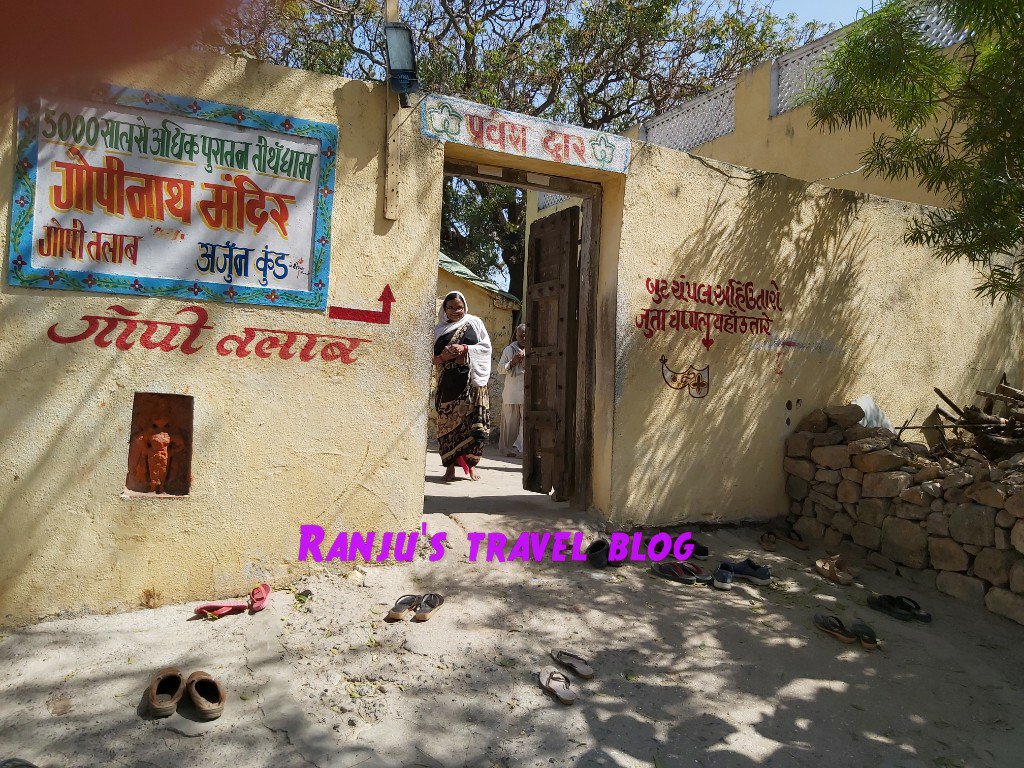
Gopi Talav is a mid size lake located around 20 kms from Dwarka on the way to Beyt Dwarka. The story behind the lake takes us back to Lord Krishna’s childhood when he was revered by the gopis of Vrindavan. When Krishna shifted his capital to Dwarka, the gopis couldn’t bear his estrangement. They came to meet him in Dwarka and performed raas on the day of sharad poornima. After the raas, they offered their lives to the soil of this land and merged with Lord Krishna. The soil here is fine and smooth bearing a yellow color and is believed to have divine properties that can cure many diseases, especially those related to skin. Today, many tourists purchase this soil, popularly known as Gopi Chandan, as a token of their visit.
There is a mandir of Lord Krishna, Lord Shiva, Lord Ganesha and Lord Hanuman .
The whole area around Gopi Talav is made up of ghats for bathing with many shrines peppered around them. Many species of fishes and birds are found .
There are shops selling gopi chandan and pooja articles on one side of the passage to this lake .
Entrance of Gopi TalavLord ShivaLord Ganesha Lord Krishna Lord Hanuman In front of Gopi Talav Gopi Talav
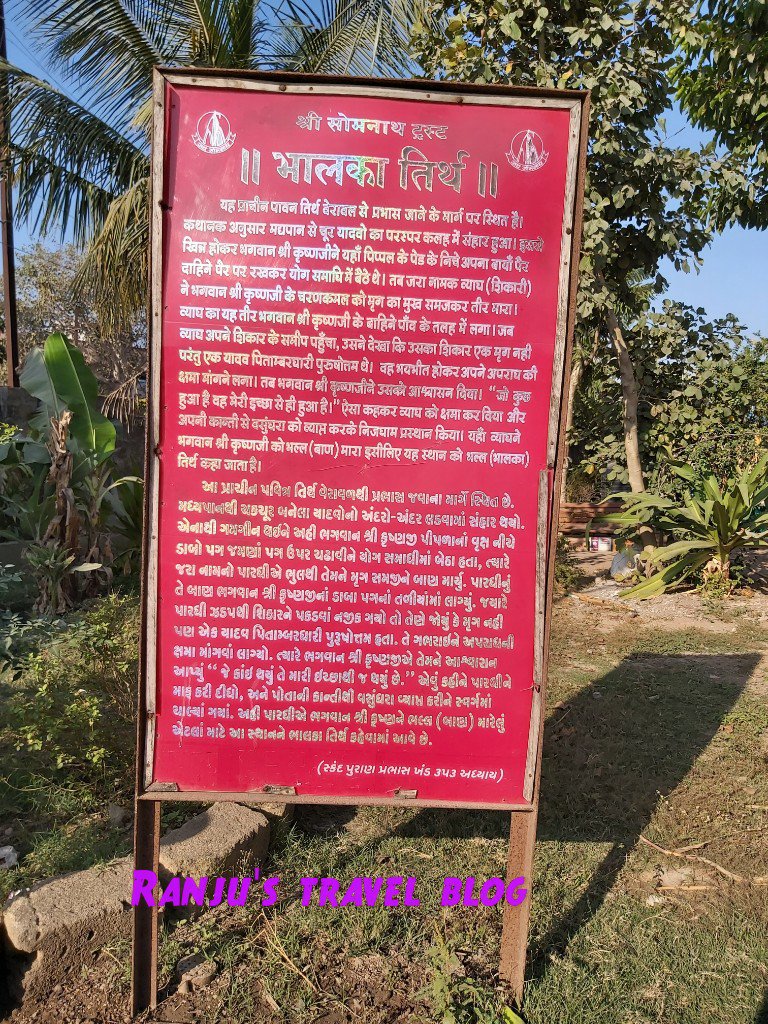
This sacred teerth is located 5 km on Prabhas Veraval highway.
This place is called “Bana Teertha” in Sanskrit and colloquially called Bhalka Teerth.
This is the very place where Lord Krishna ended His incarnation.
It is mentioned in the Bhagavata purana that a hunter named Jara mistakenly throws an arrow at Krishna which hits His feet thinking it to be a deer . Lord Krishna then throws away the arrow and Ganga emerges out from the spot where the arrow hits the ground. Hence the name bana (arrow) teertha. There is a modern temple with a marble idol of Krishna marking the spot where He rested. The stump of the ancient tree is still preserved in the temple.
The holy pond is seen next to the main Krishna temple. There is also a small shiva temple in the vicinity.
There is a Lord Shiva shrine with his consort Parvathi within this temple .
Devotees sitting and doing bhajans in front of the Lord Krishna.
Main entrance Balka theerth mandir Main entrance Lord Krishna along with the hunter and the peepal tree
Dakore is a Small City and a Municipality in Kheda district in the state of Gujarat, India. It is prominent for its grand temple of Shree Ranchodraiji.
This temple has 4 entrance Simha dwar, ghode dwar , tiger dwar and elephant dwar . All are allowed through Simha dwar .
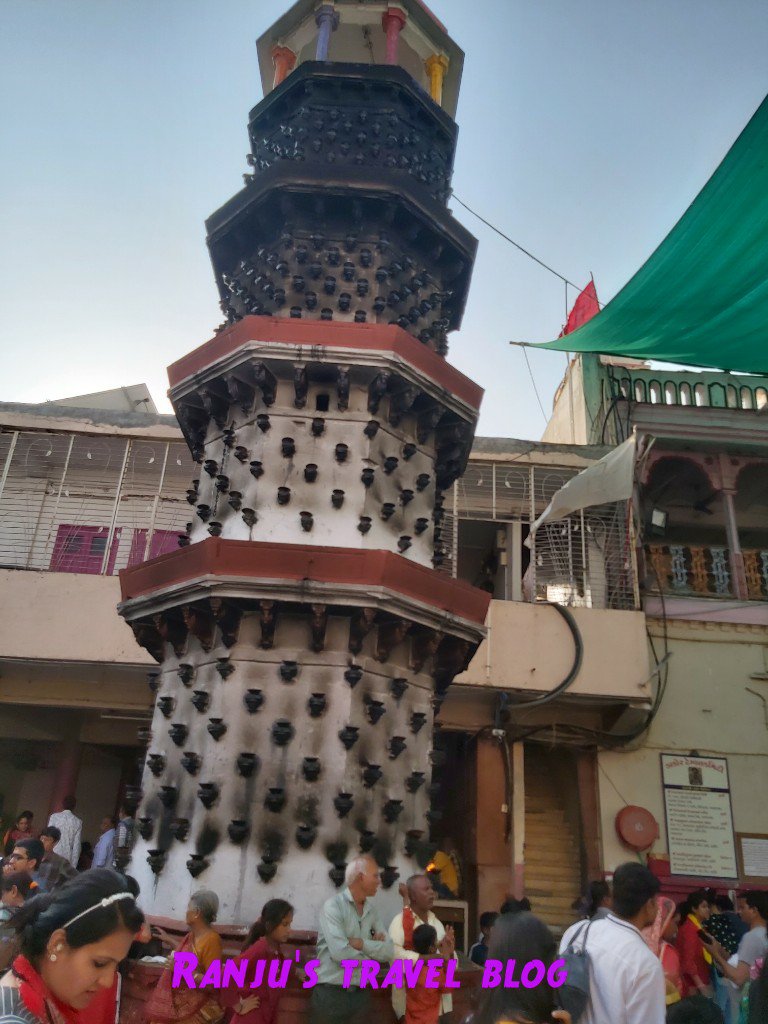
This temple in Gujarat , like those 2 ( kankroli Dwarakadesh and Nathdwara Srinathji ) temples of Rajasthan , we need not hurry to this temple as it is open from morning till 7.30 pm in the evening . We reached by 5 pm and had the divine dharshan of the Lord, ladies were sent near the main deity. Men’s queue are backside of the ladies . Outside is a Thulabharam ( balance ) where we were asked to place tulsi leaves . There were 2 huge tomb like structures for lighting lamps during the festivities .
The form of Lord Ranchodrai is that of the Lord Vishnu with four arms. As is usual with Lord Vishnu, he bears the conch, lotus, discus and the mace in his hands. The lower right arm is held up in the abhaya mudra – giving protection to all those who come to Him. There may be a lotus imprinted on the hand, but it is impossible to confirm that without getting really close to the Lord. As the Lord here is worshipped more as Krishna than Dwarkadhish, i.e. younger and freer than the mature Lord of Dwaraka, His right hand is often shown to hold a flute – a favorite instrument of the Lord in His younger days. The upper right hand holds the mace, the upper left hand holds the discus and the lower left hand holds the conch. Ordinarily, it is difficult to see these “ayudhas” of the Lord in His hands. During festivals, the hands encased in gloves of gold studded with gems.
Near by is a Goddess Mahalakshmi temple. Inside the pragharam there were Lord Hanuman shrine and Lord Shiva shrines too . We had the divine dharshan of the Goddess.
Then we had to walk a few distance from Dakore dwaraka to the Gomathi ghat caught a boat and went to see Dhatatreyar temple . The Dhatareyar temple too there were shrines for Lord Shiva Anjineyar and Saibaba. Boating was so awesome in the chill breeze after dharshan we went on a chariot driven by a horse it was so much fun . The chariot drivers had much fun than and they were laughing at us as we were afraid to climb on the chariot . Again by boat we reached the Gomathi ghat did some shopping and reached room .
Entrance of Ranchodraiji mandir Inside of Ranchodraiji mandir Lamp tomb of Ranchodraiji mandirEntrance of Mahalakshmi mandir Roof of Mahalakshmi mandir Lord Shiva and Goddess Parvathi in Mahalakshmi mandir Gomathi ghat Boating to Dhatatreyar temple Dhatatreyar temple Entire viewHanuman temple in Dhatatreyar temple View from Dhatatreyar temple Chariot horse riding Look at usHorse riding boy making fun of usSo much fun
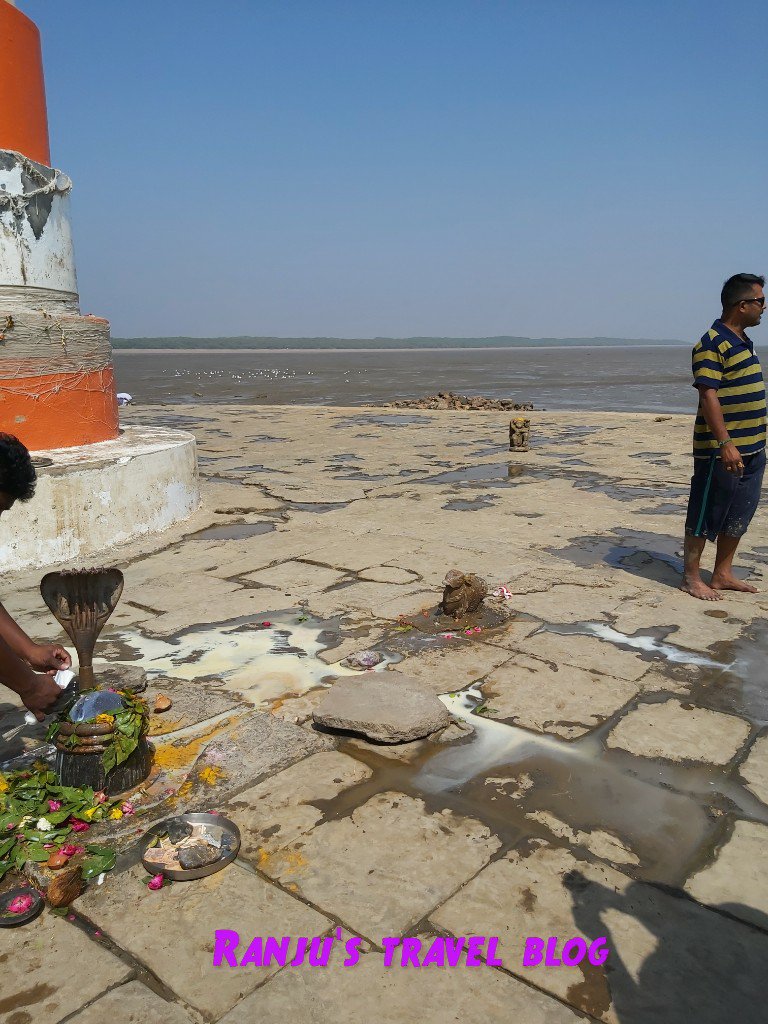
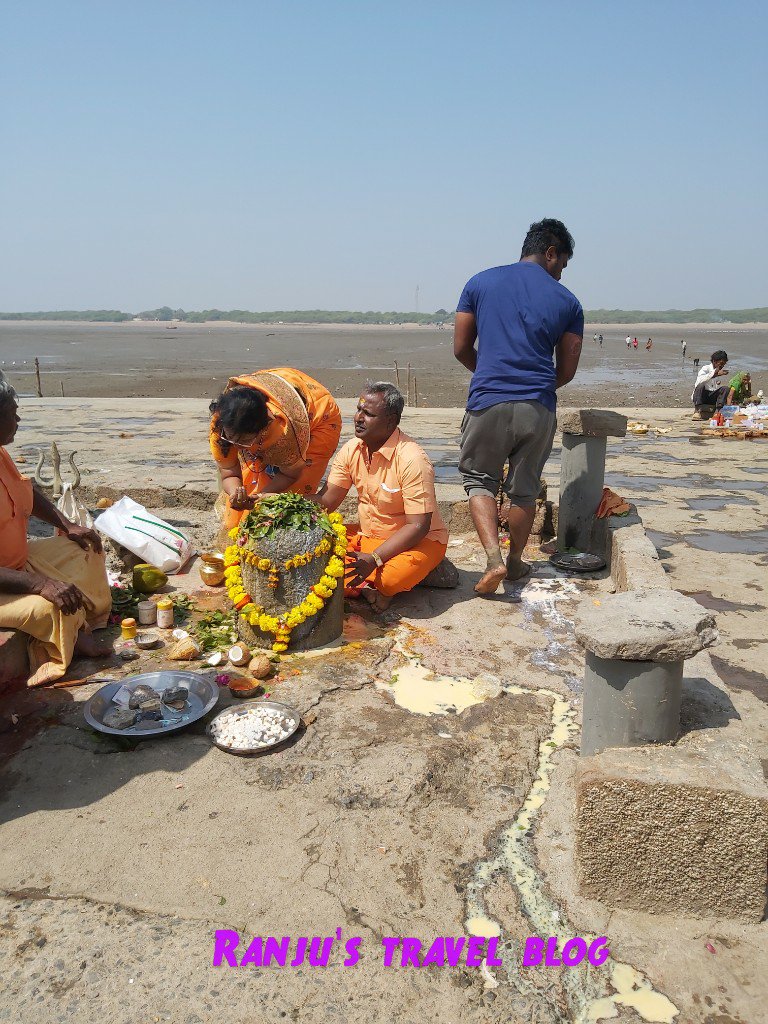
This ancient Hindu Temple is located 3 km away from Diu in the Fudam Village of Gujarat. Believed to have been built by the Pandavas, this temple is famous for its five Shiva Lingas, i.e. rocks in the shape of Lord Shiva which are present in the middle of the sea. Only the tip of these rocks can be seen whenever there is a high tide because the sea water submerges them.
The Pandava brothers were the ones to install the five Shiva Lingas at Gangeshwar Mahadev during the period of their exile from the kingdom of Hastinapur. Bounded by a serene atmosphere, this cave temple radiates such powerful energy which is honoured by the devotees of Lord Shiva all over the world. If you are planning a trip to Gujarat, this is one place you would not like to miss out on for the beauty along with the peace that this place offers to you away from the busy and fast-moving life. It is a perfect getaway.
Legend of Gangeshwar Temple
Legend has it that while the Pandavas were serving their exile when they were banished from the kingdom of Hastinapur for 12 years, they worshipped Lord Shiva who was present in this temple. This temple is also known as ‘Seashore Temple’ since it is situated near the seashore. During their exile period, when the Pandavas visited this place in search for a place to worship before having their food, they installed five Shivalingas along the edge of the water and considered it to be the true form of Lord Shiva.
On the rock above the Shiva Linga is a Seshanag which was carved to look out for the Shiva Linga. Lord Ganesha, Lord Vishnu, and Goddess Lakshmi can be found at the entrance of the Gangeshwar temple. At the time of high tide rise, the crystal clear water of the tidal waves cleans the whole temple along with the Lingas. It appears as though the waves of the sea are paying respect to the deity residing in this place. It has become one of the major pilgrimage sites for worshipping Lord Shiva due to its serenity and beauty.
Main entrance archWe both on the main entrance Lord Ganesha at the entrance of the steps Nandi facing the 5 Lingams Goddess Lakshmi Ganesha Sani mahadev All 5 lingas
This is an ancient temple in the koliyac beach in Bavnagar , Gujarat .
The unique significance of this temple is the sea allows only certain timings to reach the temple and worship . The timings vary according to the thithi and its confirmed by the priests of this temple .
This temple in Gujarat has a story related to Mahabharata. After winning the battle in Kurushetra war , the Pandavas felt guiltness for killing their own cousins and relatives to get rid of this sin they asked Lord Krishna to help them to come out of this situation. Lord Krishna offers them a black cow and a black flag and asks to take them and pray to Lord Shiva saying , where the black cow and flag turns white they will be relieved from their sins .Roaming about to different places with the cow and flag days months passed by . Finally they found the cow and flag turned white in Koliyac Bavnagar beach . So they did deep penance worshipping Lord Shiva .
Lord Shiva appeared before each of them as a swayambu lingam form on a Amavasai day as per Indian calendar a new moon day . Together the 5 lingams the Pandavas named it as Nishkalang mahadev .
There are 5 lingas with nandi opposite to each of it . One can worship the Nishkalang mahadev when the tides are sunken inside the sea and gives us way to enter the temple. About 1 to 2 kms one has to walk to have the dharshan of the 5 lingas . Nishkalang means purity guiltless and innocence . Walking in the slush of the sea bed is a great task on the way they sell sandal powder milk coconut to offer to God . There is a priest to do the rituals like arathy and archanai .
Once u reach the temple there is a well where u should wash ur feet and then worship the lingams .
We were blessed enough to do milk abhishegam (abulation of milk on the Lingam) coconut water abhishegam and offered vilvam leaves to the 5 lingams .
The suction of the sea water differs on each day as per the thithi of the day and maintains the same for 2 to 4 hours after that the sea level rises and only the quater of the tomb with a flag hoisted is seen whereas during we did pooja to the 5 lingas the entire tomb with the flag hoisted was visible .
Along with these 5 lingams there is a Goddess Parvathi shrine in one end .
This is a great wonder as after we did pooja we came back for lunch and again went and saw the sea water level rising above submerging the 5 lingas Nandi and the 3/4 of the tomb . One should definitely visit this temple atleast once in their lifetime as Nishkalang Mahadev is believed to relieve us from sins and gives us peace .
We were blessed to have the divine dharshan on a Somawaram (Monday) 23rd of February 2020 as it is considered worshipping Lord Shiva on Somavaram is very auspicious .
Yudhistra lingamBhima lingamArjun lingamSahadev lingam Nakulan lingam Bavnagar Nishkalang Mahadev temple Sunken sea Almost submerged The sunken sea Bavnagar Goddess Parvathi shrine We doing pooja We doing abhishegam We had to walk through this slush
This temple is in Rajasthan just a 18 kms from Kankroli Dwaraka .
Vehicles are not allowed only we had to take a share auto as the roads are very narrow . Both sides of the narrow roads are shops . We couldn’t find the main entrance . When we found a chappel stand we put our chappels there and that man guided us with the main entrance . Mobiles handbags are not allowed cloak rooms are there to keep it . Took tokens for our slippers bags and mobiles then entered the temple .
In this temple there is seperate queue for ladies and men . As it was overcrowded we went in by paying Rs.150 per person . Luckily we were left near the main sanctum, where we waited for the doors to get opened . Just in few seconds the doors where opened and we were allowed inside .
This temple also maintains the same Shyam bogh dharshan as in Kankroli .We were lucky to have the arathy dharshan of the Lord Dwarakadesh .
Oh my goodness cant believe of the crowd from where they came , started pushing as iam little short got admist of the crowd and got suffocated and exhausted. If allowed I would have returned back , the crowd pushed and pushed finally I was in front of the Lord Krishna , this Lord idol is little bigger in the size of the idol we saw in Kankroli Dwarakadesh, the minute I saw Him my suffocation exhaustion everything dissapeared only joy filled my mind and tears in my eyes was such a divine feeling . The Lord Krishna was in dancing posture and they showed deepam arathy (waving of diyas) . In the exit of the main sanctum there is a room closed it is said that Lord Krishna played in this place . The door of this room is made of wood with silver carvings on it and locked . Then to a crawling posture Lord Krishna in the same temple named as BalaKrishna .
Took rest within the temple complex for a while and came out and collected our mobiles bags and chappels and took pics near the exit entrance . Did shopping for almost an hour and returned to our room . Idols of Lord fancy jewellery bags and sarees meenakari works in bangles are all sold here .
Though ladies in seperate queue and gents un seperate queue they send near the main sanctum is becomes a mess and overcrowded pushing and pulling of each other , I beg the temple authorities to regulate this in a much disciplined manner as a elderly woman fell down in this chaos .
The temple has a story behind its establishment. According to the legend, the image of Lord Shrinath ji was enshrined in Vrindavan (land of Lord Krishna), but to protect the idol from the destructive rage of Aurangzeb. In 1672, Rana Raj Singh was the only gallant, who made an effort to rescue the idol from the domain of Aurangzeb . It is said that when the image was being shifted to an impervious place then at a particular place, the wheel of vehicle sank deep down in mud. The image refused to move further, so the escorting priest apprehended that this was Lord’s chosen spot. Thus, a temple was built on the same spot.
This is the exit entrance of Srinath Dwaraka As we placed mobiles in locker we took photo only on the exit entrance
My recent trip with Sanjay tours was Nava Dwaraka and Somnath Nageshwar Jyothirlingams and Nishkalang mahadev temple in Bavnagar and Gangeshwar temple in Diu and Daman .
I will be writing one by one about the temples I visited during this trip .
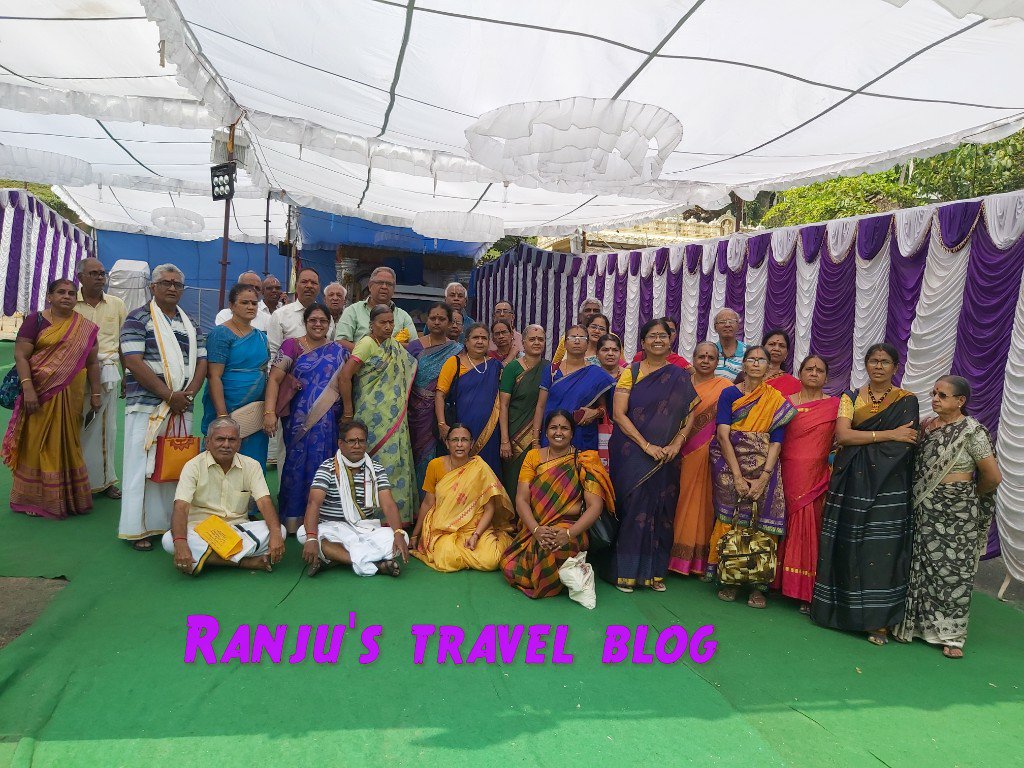
We along with 30 members from Chennai reached Ahmedabad had breakfast and travelled almost 280 kms to reach Udaipur.
Devotees of Bhakti Marg of the Vallabhacharya sect worship Lord Krishna in his many forms and from Mathura to Dwarka and other spots in Western India, there are Lord Krishna temples known as Dwarkadheesh temples. Dwarkadheesh is one of the titles of Lord Krishna meaning Lord of Dwarka. Dwarka is the top pilgrimage spot but there are also other Dwarkas, one of which is in Kankroli in Rajsamand District in Rajasthan.
This is one of the abodes of Lord krishna in Udaipur . Kankroli is situated at 65kms north of Udaipur in Rajasthan . Hence the Lord here is named as Kankroli Dwarakadesh .
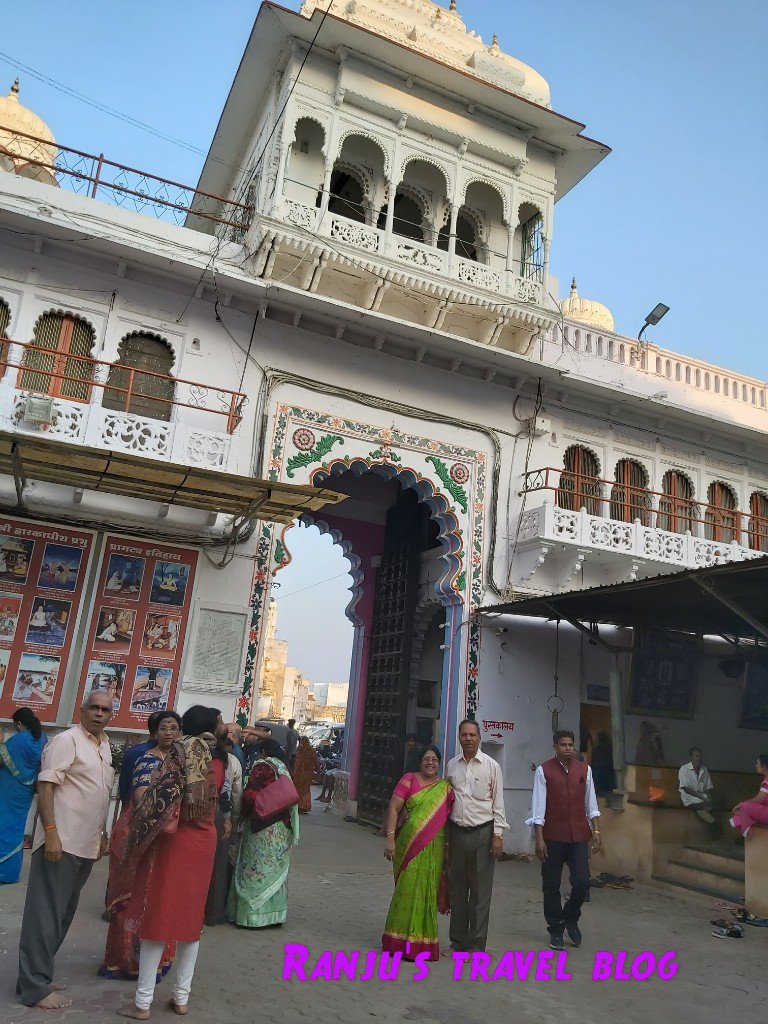
Though it comes under one of the divyadeshams the way to this temple is very narrow and we went to the temple from the bus stop in a share auto as other vehicles couldn’t reach there . They charge Rs. 30 per person . Only one vehicle can go at a time . They drop us on the main arch of the temple .
It is a entrance arch where vehicles are parked and then has a steps of 15 to reach the main entrance and its decorated with flowers of different colours .
After entering the main arch is a set of steps . We were asked to wait about 15 minutes for the dharshan. Here the dharshan is called as Shyam bogh dharshan , which means they take 15 minutes to decorate the Lord with flowers and ornaments and leave it for 55 minutes for dharshan again the dharshan is stopped again and they take another 15 minutes to decorate the Lord .
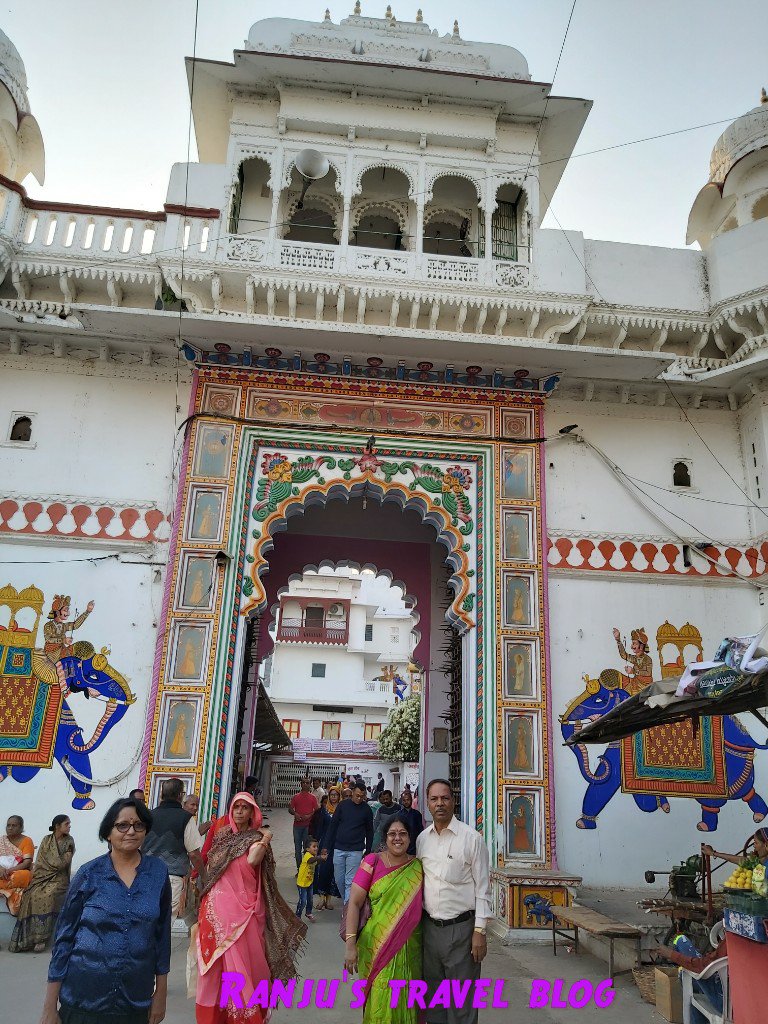
This is a 3 storied mandir with a open space in the middle mural paintings on the wall of elephants with men on it and horses and bhajans were taking place by ladies .
When they opened the main diety door after decoration , all rushed as well as we too but waited in one corner and had the divine dharshan of Lord Dwarakadesh . The Lord here is just a feet height well decorated with flowers. There were steps in which cow and calf idol made of silver and Lords favourite things were kept .There were bhajans going on sung by ladies in the temple.
It is believed during winter they put campfire to soothen the chillness to the Lord and cover the idol with thermalwear . It was a eternal bliss . When the crowd was disbursed we once again had the dharshan of the Lord without much chaos this time .
Then we went to another shrine inside this temple complex itself with the idol of Radha and Lord Krishna . Here they gave milk offered to the Lord as prasadham to all . Then the next shrine which was the miniature of the main deity called as Mayuranathji .
Photography is prohibited allowed outside entrance of the temple . In the ground floor there is a temple office where we can pay donations and for other enquiries .
Legend of Kankroli Dwarka: According to legend the idol of this temple is very old and worshipped by king Ambareesha in the Treta Yuga. The idol was worshipped in Mathura in a temple built by king Vikramaditya till 1670 AD. When Aurangzeb attacked Vraja Bhoomi in 1670 AD, many temple idols were moved to safer places. Srinathji was moved to Nathdwara and Dwarkadheesh to Kankroli. Maharana Raj Singh is said to have built this temple in around 1676 AD. The temple located on the bank of the Rajsamand lake has a very soothing ambience .
The main arch The main entrance The view of the arch from inside the temple
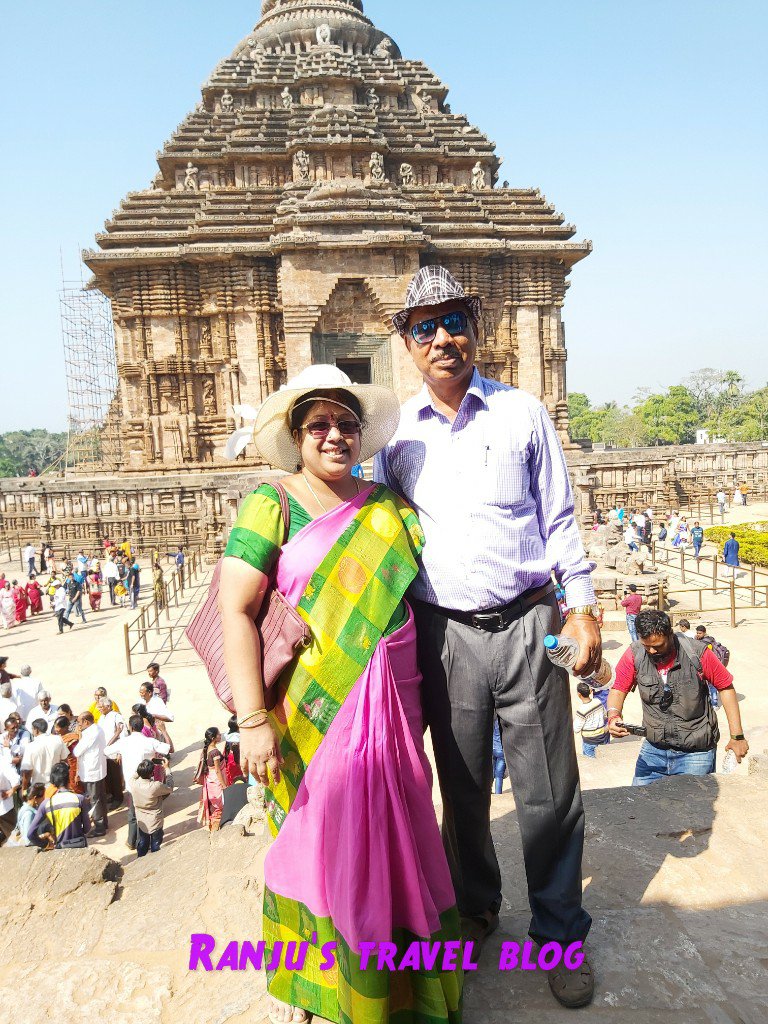
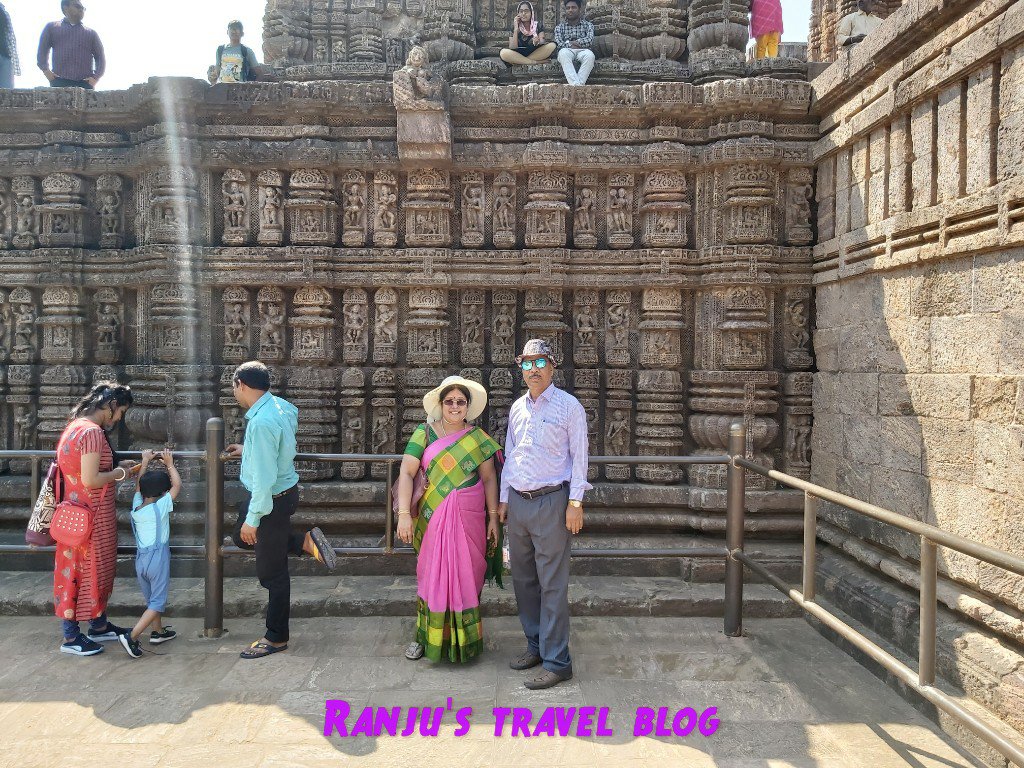
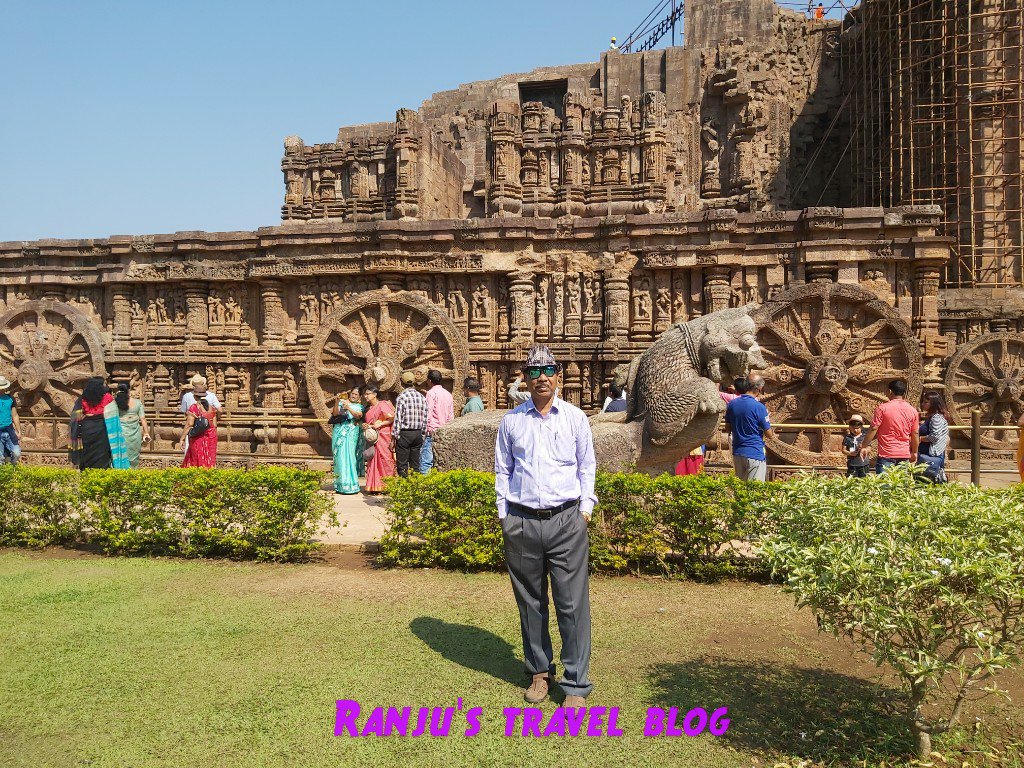
The present Sun temple in Konark is also known as ” Black pagoda “. Its 36 kms from Puri in Odisha . Kona means corner and arka means Sun .
The height of the temple is 228 feet . The temple is fitted with 24 wheels and 7 horses in the form of a chariot of Sun God . Its architecture and sculptures are a sheer poetry on stone . The Bengali poet Rabindranath Tagore was so moved by its beauty and said “Here the language of man is defeated by the language of the stone “.
There are 3 forms of Sun God . The Southern side God called ” Mithra ” is described as the Rising sun is in 8’3″ in height . The western side is called ” Punsan ” is described as Mid ‐ day Sun its height is 9’6″ and the Northern side God is described as ” Haritasva ” is described as setting Sun , its height is 3.58 metres .
The Sun temple was constructed as Chariot of Sun God . 24 wheels have been affixed to the platform. Each wheel 9’9″ in diameter having 8 spokes . The entire wheel is full of fine art works. The 24 wheels signifies 24 hours and 8 spokes signifies 8 Prahars ( 3 hour period ) of a day .
There are 2 gorgeously caparisoned War Horses in front of the Southern side of Konark temple . They are each 10 feet long and 7 feet high . The sculptures depicts each of them with its massive strength and vigour tramping down a warrior. The figure of War Horse of Konark has been accepted as the symbol of the Odisha state government and her erstwhile martial glory .
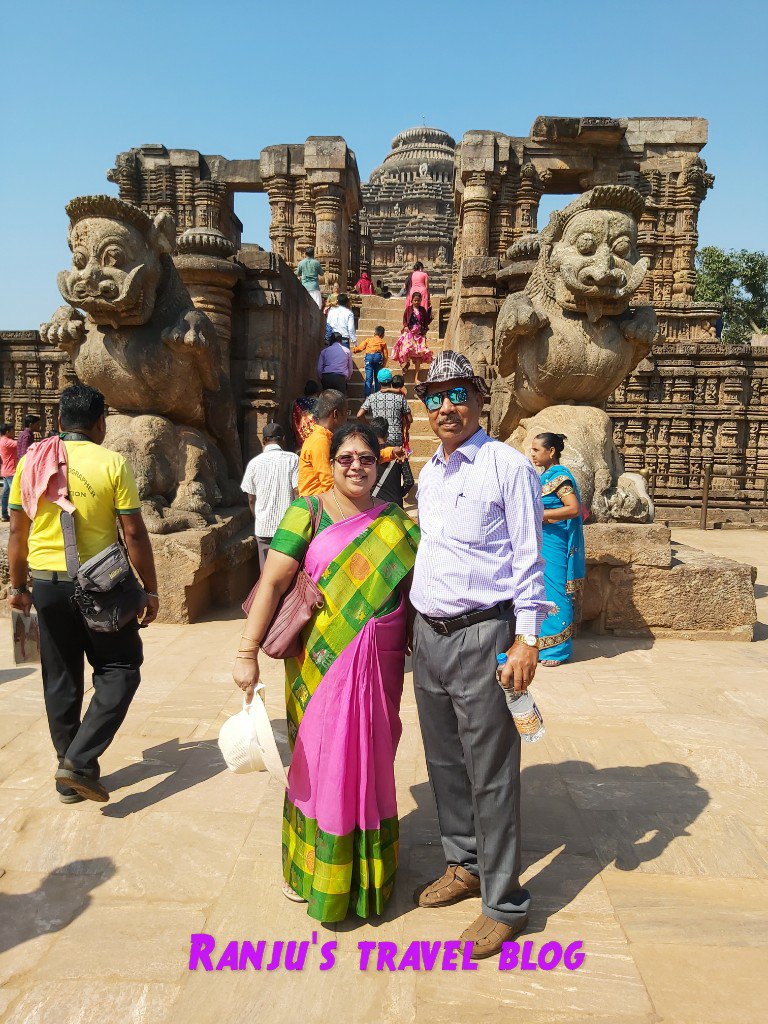
There are 2 majestic Lions in front of the Eastern door which is the main gate of the Konark Sun temple. The Lion is seen pressing down a big elephant which has caught hold of a man in its trunk . The entire block is made up of a single stone . The image is of 8’4″ length 4’9″ in breadth and its height is of 9’2″ and its said to weigh 27 .48 tonnes .
Though this temple is not under worship now it has worshipped as Lord Suryanarayana temple in ancient times and the main deity is now installed in Jaganath temple Puri in the pragharas .
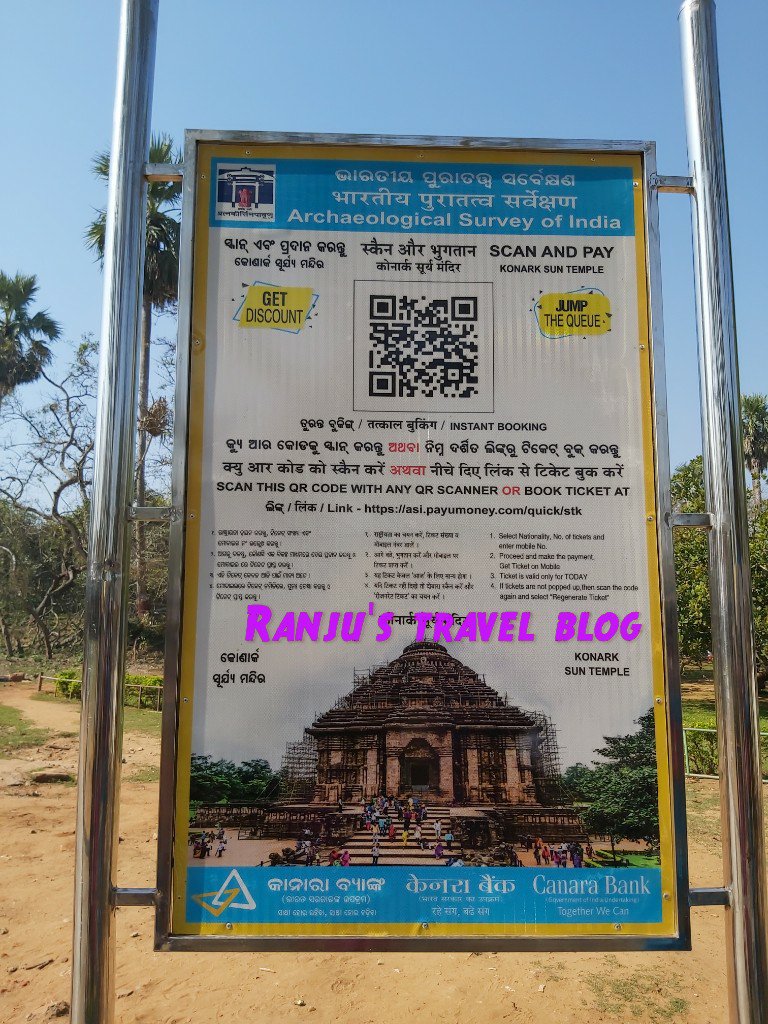
They collect Rs. 40 as tickets per person and a garden is maintained within the complex and some renovation works are being done. Our vehicles are stopped at the parallel road itself and we had to walk both sides are shops with Odishan art works pipli applique and miniature of Jaganath idol and Konark wheel .
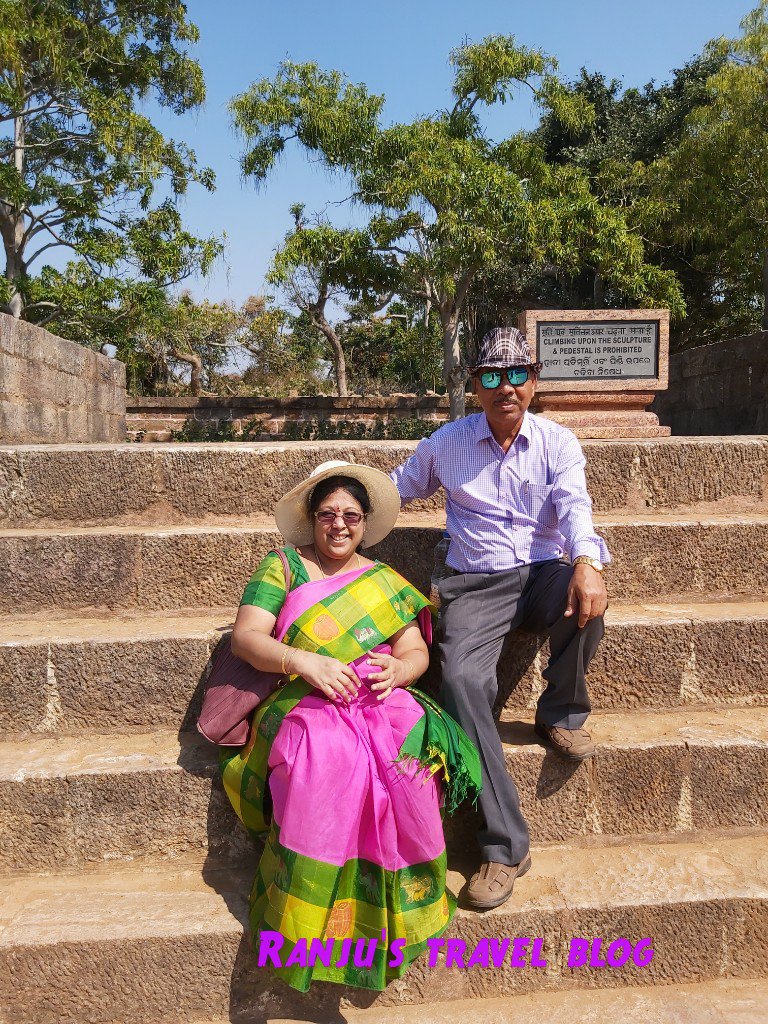
It takes about 2 hours to see the complete structure and steps are too high for old peoples , they could not climb , wheel chair are provided for them for that they charge extra . We as a group spent almost 3 hours and took as much as photos we could . Photography is allowed inside .
The archeological department of India has taken this place . They are collecting funds to renovate . Light and sound shows are exhibited in the evening section and they collect a certain amount for tickets per head .
Light and sound show Fund raising for renovation Shops on either side
Sri Kurmam : The temple is in Srikakulam district and dedicated to Sri Kurmanatha which is second avatara of Lord Vishnu. The moolasthanam is considered as large Saligrama ( black coloured fossil ) .The image is fossil of an big turtle and the head of the deity is Kurma (tortoise ) form ,which is represented by Vishnunamam , tail is represented by saligrama , presented by Adi Shankaracharya .
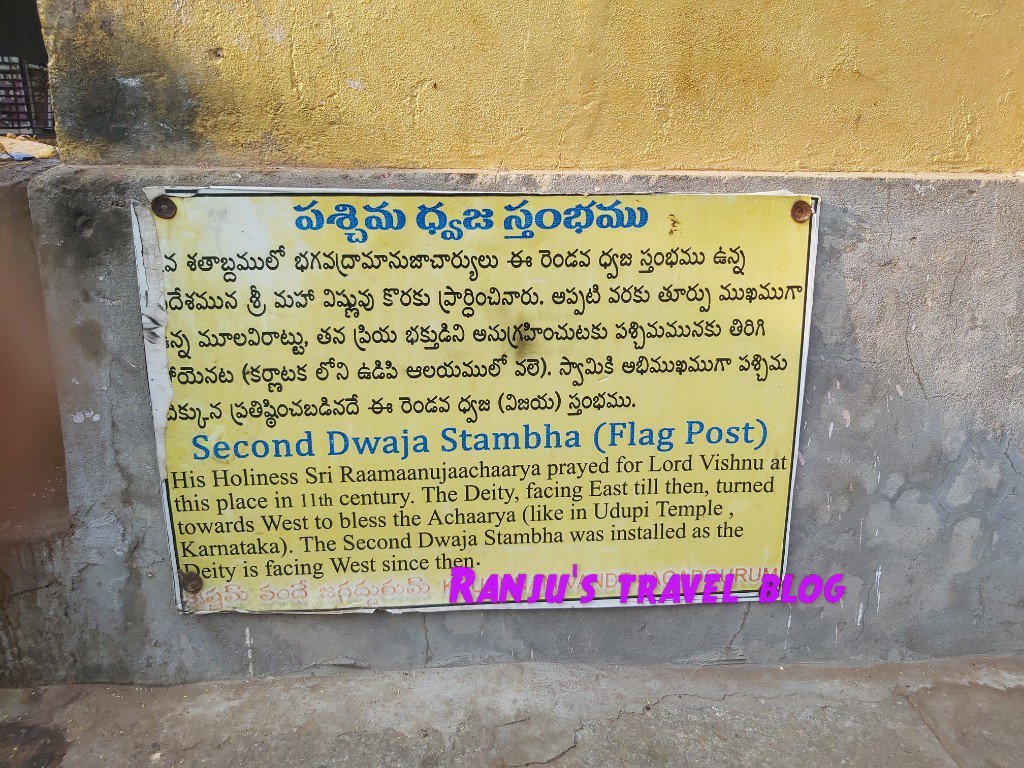
The unique feature of this temple is that it has 2 dwajastambhas , one at front and one at back as Lord faces the back of the temple . The temple constructed in Orissan style .
The presiding Deity, Lord Kurma is self-manifest, or swayambhu . He is about 70 cm long , shaped like the shell of a turtle.
During the reign of King Swetha Chakravarthi, this area was referred to as Swetha Giri . Swetha Chakravarthi’s wife Vishnu Priya was a devotee of Vishnu .When she was observing a fast on an Ekadashi day, Swetha Chakravarthi approached her with the intention of making love. When she refused, saying the time was not ideal, the king became adamant. She prayed to Vishnu, who created a stream of water, separating the couple. Swetha Chakravarthi was carried away in the ensuing flood and Vishnu Priya followed him to the hilly terrains of Swetha Giri . The sage Narada initiated an upadesam of the Kurma Narayana mantra and asked the king to pray to Vishnu using it. By the time Vishnu appeared in the form of the Kurma (tortoise) avatar, the king’s health had deteriorated. Vishnu then made his Sudarshana Chakra make an impression in the nearby land , forming a lake . Swetha Chakravarthi bathed in the lake and regained his health , after which it was referred to as Swetha Pushkarani . Sri Ramanujar has visited this place during his visit the dwajasthambam turned towards Him in order to recieve Him . Later another Dwajasthambam was installed in front of the main temple.
There are seperate shrines of Goddess Lakshmi Lord Anjineyar.
Inside the temple there is a tomb under which Lord Vishnu has been installed.
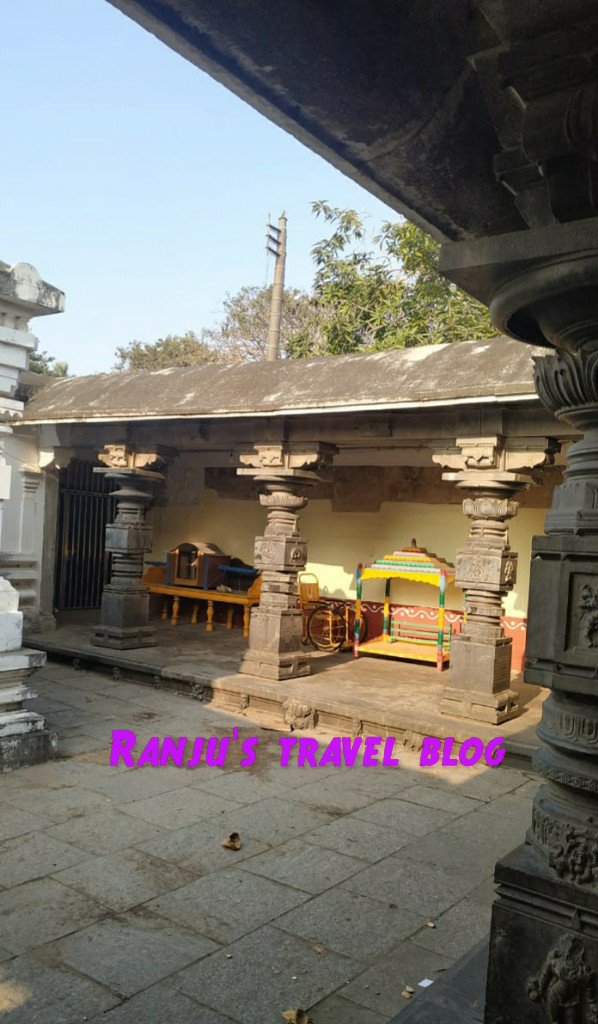
There were corridor in the sides of the temples where the Lords Palanquin and Vahanas has been kept .
At the entrance is the Swetha Pushkarani many people take a holy dip before entering the temple.
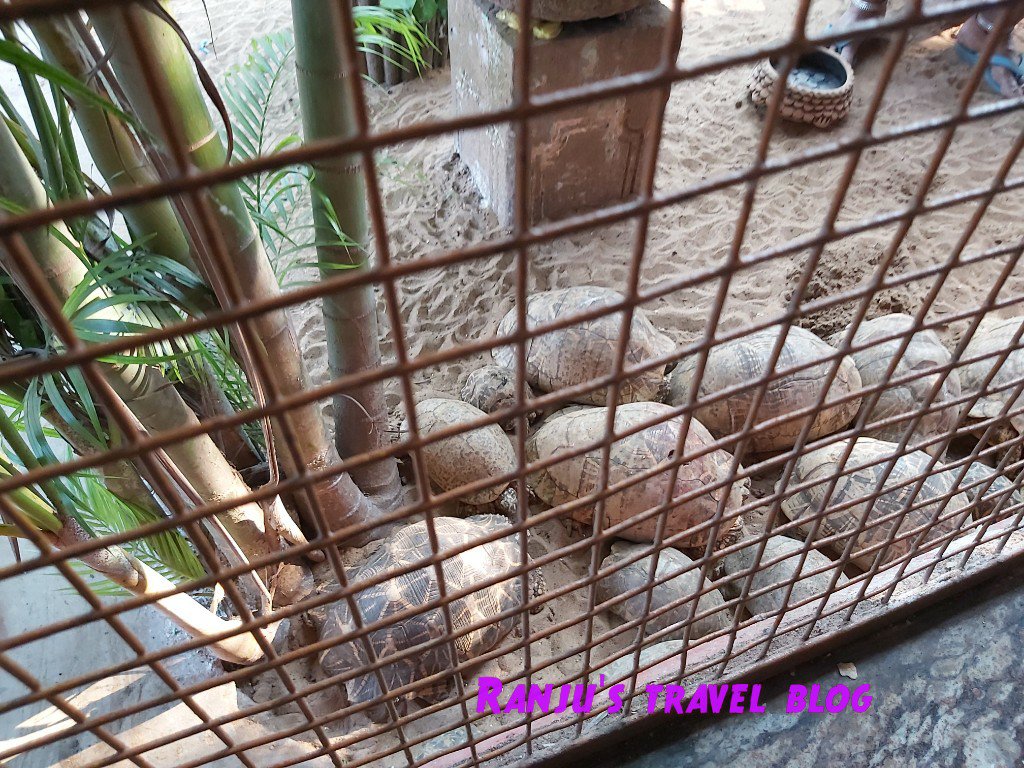
In the outside exit of the temple many Tortoises are being kept and looked after as this is the only place where Lord Vishnu is worshipped in Kurmanantha avatar .
The arch of the temple is themed as Thiruparkadal churning with Mount Meru as the stick (mathu) on back of the Kurma avatar (Lord Vishnu) and Serpent Vasuki being the rope with asuras on one side and Devas on the other .
Visit of Adi Sankaracharya and Sri Ramanujar has been written in the temple .
This temple was crowded as people visited here and went to Arasavalli Suryanarayanan temple . Jathra special buses were flying to and fro . We went in Rs. 500 tickets and had the divine dharshan of the Lord Vishnu as Kurma avatar .
The main arch Entrance to the temple In front of Swetha Pushkarani Inside the temple one can see the Dwajasthambam This is the second Dwajasthambam outside the temple facing the main sanctum Legends of the temple Visits of Adi Sankaracharya krishna chaitanya and sri Ramanujar Side corridor where Palanquin and Vahanam of the Lord is kept Reason for 2 Dwajasthambam Tortoises in the temple
This temple of Lord Krishna is in Odisha about 20kms from Puri jaganath temple. This temple was initially at Puri Jaganath temple and later was installed here . The Lord krishna is in standing posture with his one leg crossed and hands pretending to have a flute . There is Venumadhav and Rukmini the procession diety in a seperate shrine . There is a seperate shrines of Lord Ganesha and Lord Anjineyar too .
One of the sacred tourist destination of Odisha, Sakhigopal (alternatively spelt as Sakhigopala or Sakshi Gopal) is a village of historical importance which is situated 19 kms. north of Puri on the way to Bhuvaneswar. It is the most famous spot of Odisha for coconut industry. The singular national importance of the place is the famous Sakhigopal temple. It is one of the top calibrekrishna temple of the country. It is a saying that unless Sakhigopal is visited the piligrimage to Puri is not complete. There is a large influx of piligrims on festive days like AnlaNabami, Dolapurnima,ChandanYatra, KartikaPurnami, etc. Sakhigopal means witness Gopal.
There is very popular legend behind the name Sakhigopal. Two brahmins of Vidyanagar of south India went Brindaban on piligrimage. There the elderly one fell ill and was attened very sincerely by the younger. The elderly one promise the other keeping Lord Krishna as witness that on reaching their native place he would offer his beautiful daughter to the younger in term of marriage. Unfortunately when both of them reached their native place the elderly one expressed evasive replies. The younger one was assured that due to low status of brahmin caste he was misfit for his lovely daughter. Without delay he again went to brindaban and worshipped Lord Krishna. However in the long run Krishna agreed but he told that the brahmin would walk ahead and he would follow him, but the strict instruction was the brahmin should not look back , otherwise he(Lord Krishna) would remain then and there .Lord assured that the brahmin would hear the sound of Nupura( sweet sound producing bracelet used by dancers around ankel ) . Lord followed the brahmin to vidyanagar. On the way they were to cross the river Godavari .Due to sand the feet of Lord were dipped and no sound from Nupura was heard.The brahmin was too restless and apprehensive to look back . Lord stood on sand and did not move . The brahmin immediately ran to Vidyanagar and called the local people in good numbers all were stunned to see the statue of Lord Krishna of Brindavan .The elderly brahmin repented and attested his promise by giving his daughter in marriage to the younger one .The local king developed great devotion and constructed one temple then come there at the spot and designated as ‘SAKHIGOPAL’. Goddess Rukmani made of gold was then installed by the King .
Sakhi Gopal with Goddess Rukmani made of goldEntrance of Sakhi Gopal temple Inside the temple Side entrance Entrance of Lord Ramar temple adjacent to Sakhi Gopal temple
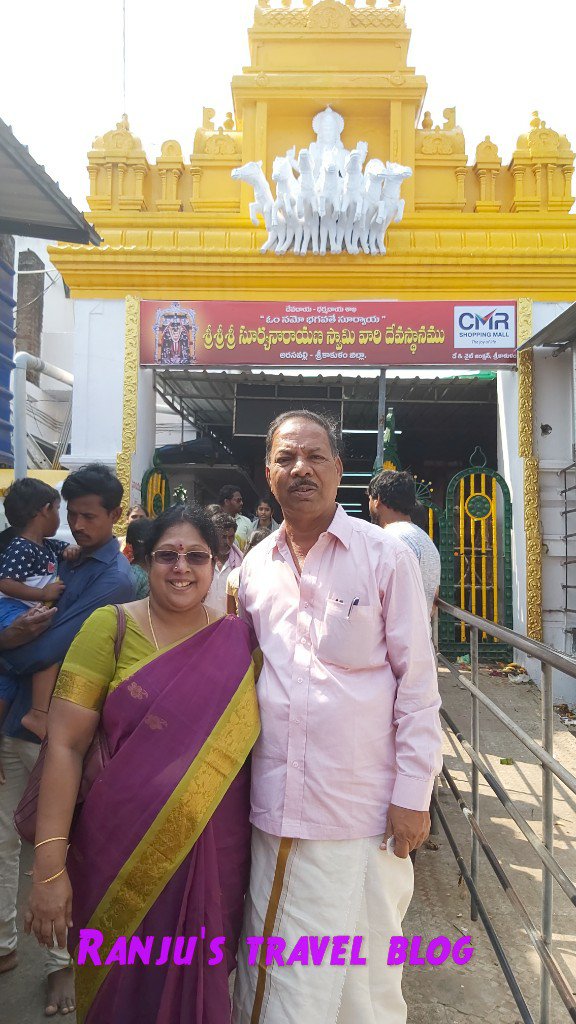
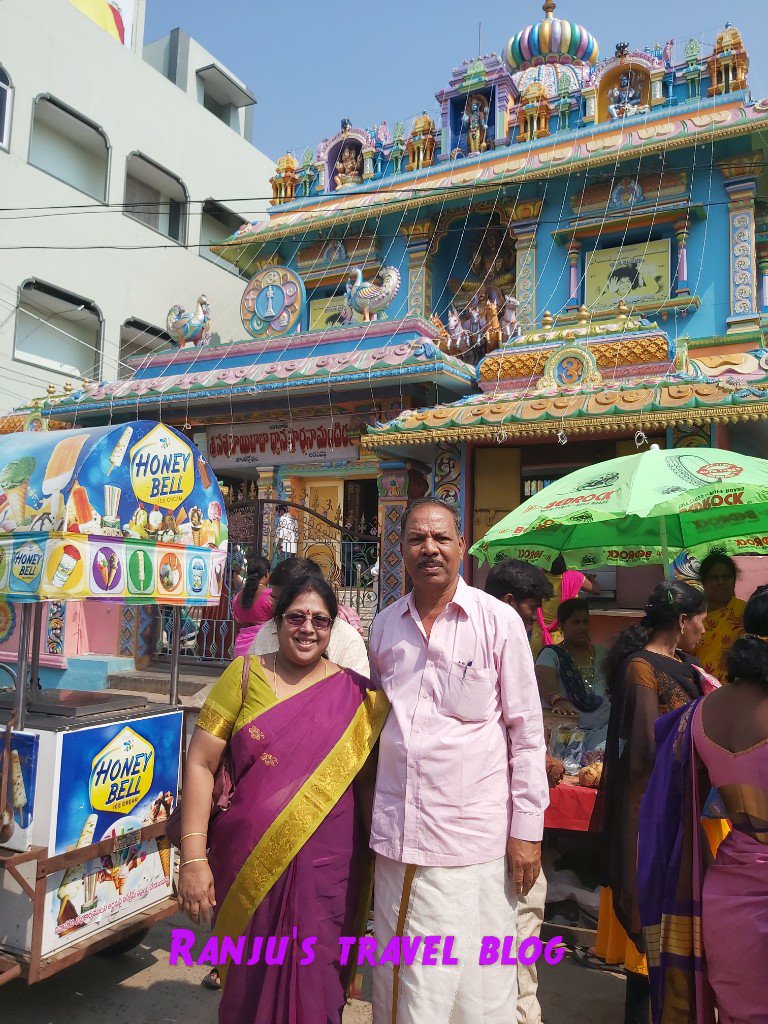
The Ancient Hindu Temple of Sun God – “Lord Suryanaryana Swamy Temple” located at Arasavalli in Srikakulam Town, Andhra Pradesh, India. This is one of unique and most visited Pilgrimage Temples in India. The Original name is Harshavalli which means Abode of Joy.
As we went on 3rd week of Maasi maasam (mid February) month being it a Sunday the temple was overcrowded . Some said jathra, a temple official told us as the Lord gave dharshan at this place on that auspicious day .We took Rs. 500 ticket per couple for quick dharshan .
Legend says that one day Indra, celestial Lord , came to worship Lord Shiva in the ancient Uma Rudra Koteswara Swamy Temple near Srikakulam, a sub Temple of the famous Srikurmam Shrine. He came in very late and Since it was in- approppriate to seek Darshan after the closure of the Temple, he was refused to get an entry by Nandeeswara, guarding the Shiva Temple. Filled with Arrogance and being ignorant of the supreme Power of Lord Shiva, Indra began arguing with Nandeeswara for an entry , resulting in a scuffle. Angered at this, Nandeeswara pricked up Indra in his horns and threw him away.
Indra fell unconscious at a distance of 2 yojanas to the east of Uma Rudra Koteswara Temple . After awakening, Indra realized the Supreme Power of Lord Shiva . To get relief from his Sins, He consulted the Sages and was told about possible Planetary related Evil influences behind the Wrong doing. So, to get relieved, he prayed the Chief Planet of Nava Grahaas, The sun God – Another Hindu Mythological Demi God, for relieving him of the sins. Sun God appeared before him and advised Indra to construct a Temple for him , by digging at the place where he fell. He did the same and found an Idol of Sun God, which he installed in the Temple at Arasavalli . Later Indra performed all the Rituals related to relief from Planet related Evil Effects (Graha Shanthi) and thereafter went to the Temple of Uma Rudra Koteswara Swamy to have the Darshan of Lord Shiva and attained Peace Of Mind. This Temple is now the famous Sun God Temple at Arasavalli (Previously known as Harshavalli, meaning Pleasure) . The Pond which was formed at this area, eventually came to be known as Indra Pushkarini .
In this temple the main diety is Lord Surya Narayana along with His consorts Usha chaya and Padmini . Mathara and Pingala the Dwarapalakas in sitting posture on the each side little downwards to the main diety and high up are the two divine saints , sanaka and sanadana holding ‘Chamaram'( manual fan ). The Sun God is depicted as riding over a chariot with 7 horses , drawn by Anura, the Radhasarathy . All these figures are exquisitely carved out of a single black finely polished granite stone.
There is also Lord Shiva with his consort Goddess Parvathi with one side Lord Vinayagar and other side Goddess Mahisasuramardini within and Navagrahas in the outer pragharam .
The pillars of the temple are being painted pink . The entrance Gopuram is like more of a Buddhist temple.
In front of the main entrance This is the exit and being the entrance of the pink corridor On the way to our bus The pink corridor of the temple
We stayed in Vizag in Lakshmi residency near railway station . Simmachalam is about 10 kms from this Hotel .
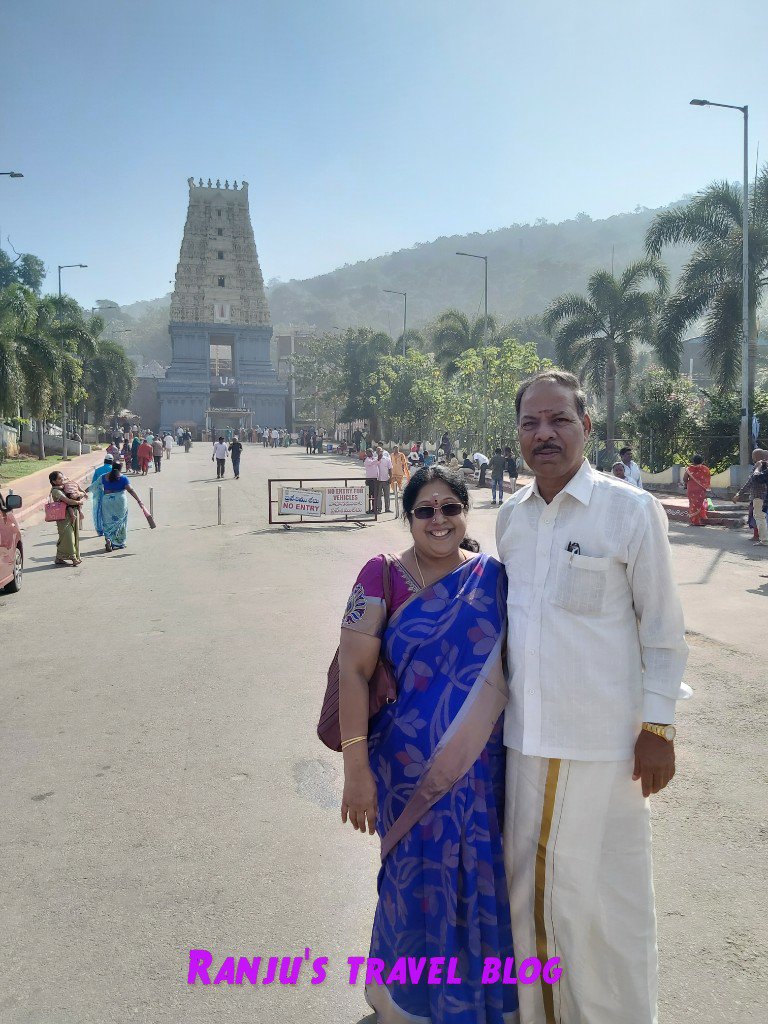
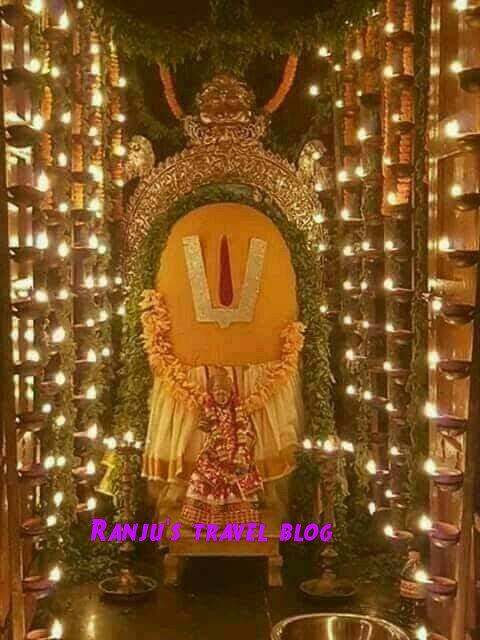
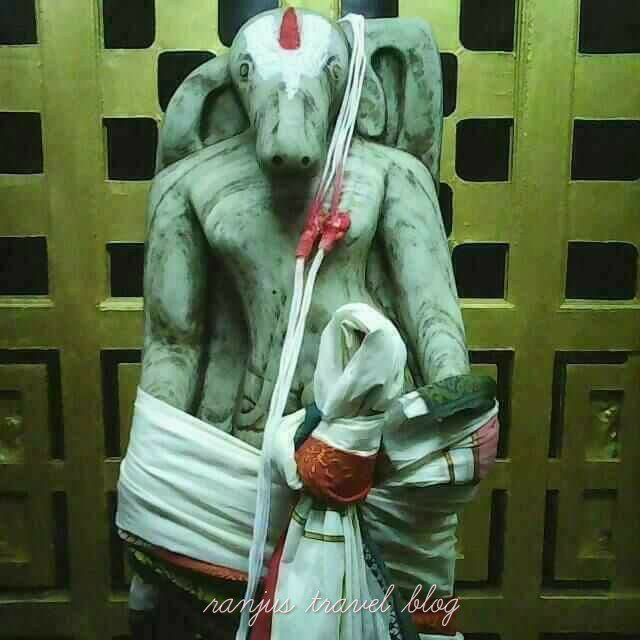
Simhachalam : Simhachalam is called “Hill of Lion “ . ( simha means lion , achala means hill ) , It is near Vishakhapatnam in present Andhra Pradesh Its presiding deity is Lord Varaha Lakshmi Narasimha combining the features of Varaha and Narasimha .
As the idol is ferocious , it is covered with sandalwood (chandanam ) to look like Shivalinga and once in year on akshaya thrithai day the sandalpaste is removed (chandana visarjana ) . Pilgrims visit the temple mostly on that day .
The temple was built by Kalinga kings , which has orissan and chalukyan features . As we went on a Swathi Nakshatram day as well as it was a Saturday the temple was crowded .There is a temple pond near by and people take holy dip in that pond and come to have the dharshan of the Lord .
We took Rs.20 ticket per person this is for entrance, free dharshan is available as it will take time , we opted this and there is rs.100 tickets too , we have to climb about 50 steps while climbing the steps one side is fully covered with dense forest and other side beautiful and colourfull carvings of Narasimhar in standing sitting postures .
Once we enter inside we can see the lotus feet of Krishna chaitanyas small mantapa it is closed in glass and we can look through the glass .When we enter inside the temple we could see 6 × 10 beautifully carved pillared mandapam were Gods thirukalyanam are being done . The Vahanas of the Lord such as naga vahanam gaja vahanam and horse are being kept in this mantapa and palanquin made out of wood with Garudan was also kept . As it was a auspicious day , some function was being held in this mantapa . Opposite to this is the main sanctum pragharam. Then on the entrance of the main sanctum we paid rs .200 this is for archana and we are allowed inside the main sanctum. The main sanctum is fully made of gold pillars and silver gopuram is a divine sight with Sudarshana chakra on top of it .We can come around it . In the center is kept the main deity Varagha Narasimhar with sandal paste applied on it and a ornamental thirunamam on it .
The main deity is Lord Varagha Narasimhar applied with sandal paste and looks round like a Saligrahma Namam which Vaishnavaites keep on their forehead has been placed on Lord as an ornament in gold . The outer pragharam of the main deity is fully carved with the idols of Varaghar on one side Narasimhar on one side and Thiruvikraman on the other side .
There is a pillar when we come out of the main sanctum called Kappasthambam it is believed that it has a miraculous power because of the yantra kept beneath it and those who hugs and worships it vil get their desires fullfilled .They collect rs. 25 per person to hug this pillar .
Behind this pillar is the shrine of the Thayar named Simhavalli .
There are seperate shrines for Lakshmi Narayanan and Goddess Andal .
When we come out side the pragharam they give free prasadham as well as laddu for those who did archanai we have to hand over the rs. 200 tickets for entry to main sanctum .
Opposite to it is a hall where Gods ornaments jewels are kept . Those who want can see by buying the tickets alloted to it . We took pics only outside the temple as photography is prohibited inside the temple.
At the entrance of the Simmachalam temple At Simmachalam Our tour group at Simmachalam Amidst of dense forest Simmachalam temple viewImage from Facebook Temple Connect page Picture of Varagha Narasimhar without sandal paste
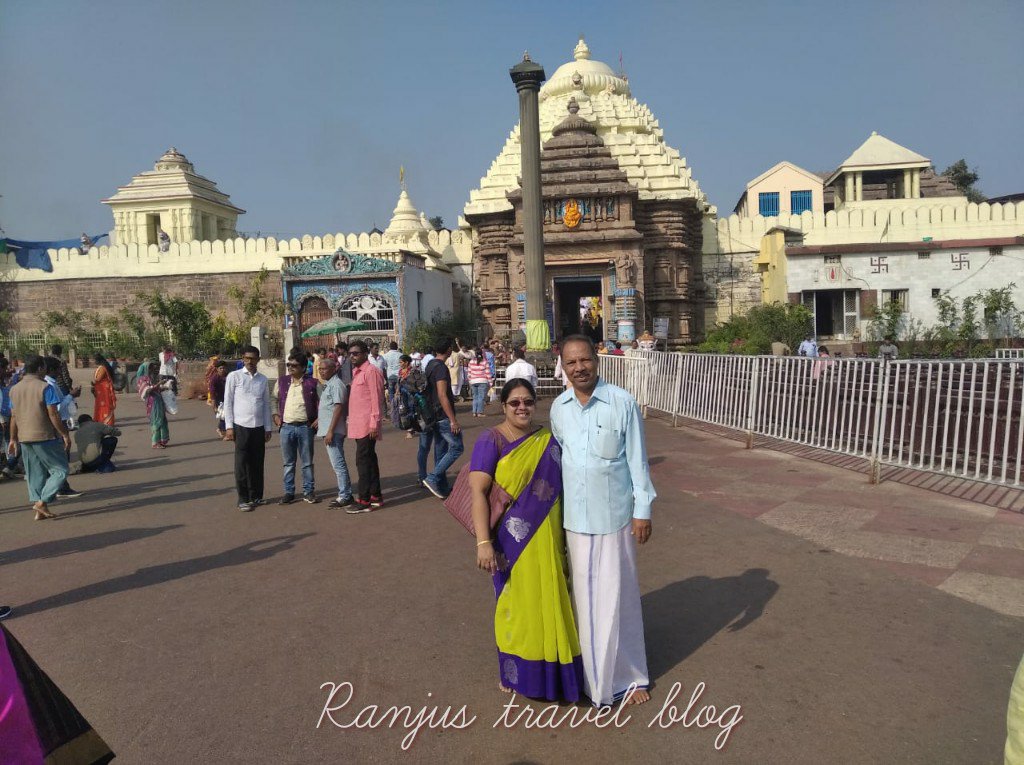
The holy land of Odisha is divided into four kshetras. These kshetras are named after the four names of weapons of Lord Vishnu such as sankha (conch shell), chakra (disc), gada (mace) and padma (lotus). Puri Dham is known as SankhaKshetra.
This temple is one among the chardham kshethram. This temple is in Odisha . Others being Rameswaram , Badrinath and Dwaraka .This temple is being referred as Bhojan dham (food) .
There’s is a dwajasthambam at the entrance of the temple which was in Konark before, it is said King Chatrapathi Shivaji brought it from Konark and installed here .
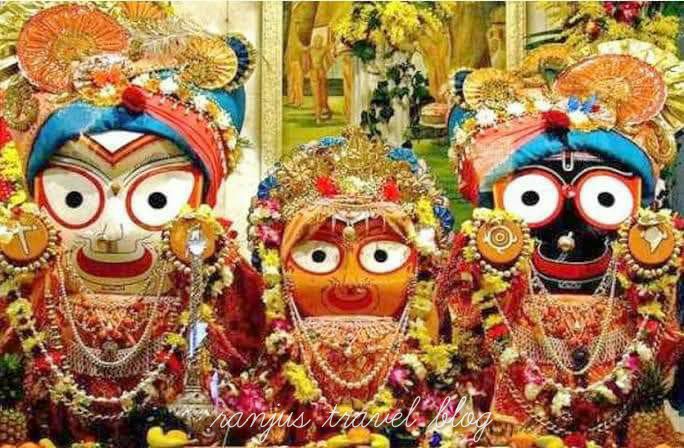
The main dwara consists of 22 steps which represents 18 puranas and 4 vedas . Here the main deity is Lord Jaganath along with Subhatra His sister and Balarama His brother .
This temple has 4 entrance simham dwar elephant dwar, horse dwar and tiger dwar named also named as dharma artha kama moksha dwaram through dharma dwar general peoples are allowed , through artha dwar King and his officials are allowed , through kama saints Maharishi are allowed and through moksha God himself enters this temple .
Similarly there are 4 gopurams bhoja geetha nata and the main sanctum . When we enter the main entrance there is a dwajasthambam named Garuda sthamba , people touch this sthamba and offer their prayers .
It is believed the main diety sanctum was built by Viswakarma himself ( the God of architects) and there is a seperate shrine for him in the pragharam.
The main deities are Subhatra in the centre painted yellow, Balaramar to Her right painted white and Jaganath painted black these deities are made up of neem tree (margosa), once in 12 years . The Ratha yatra (chariot festival) is very famous in this temple and people from all over will come to watch it as in other temples urtsavar will go on the procession here the main deities themselves are taken during the Ratha yatra procession. The back side of the main sanctum itself is a shrine of Lord Narasimhar to have the dharshan one has to climb a few steps . The inner pragharam consists of Goddess Vimala mandir it’s one of the sakthi peedams . Next to it is Sakshi Gopal shrine , the God of witness , which means those who go to Puri Jaganath must have the dharshan of him as he is the witness of our visit to Puri .
Then seperate shrines of Goddesses Saraswathi Gayathri Sasti Mansi Bhuvaneswari and Lakshmi . There is seperate shrines for Lord Anjineyar at the entrance of this temple . There is a seperate shrine for Lord Surya Narayanan which was before worshipped in Konark sun temple as it’s under renovation now it has been installed inside this temple .
This temple has a magnanimous kitchen where its cooked for lakhs and lakhs of people daily . For cooking they use only mud utensils and pots , the mud pots once used are not used again for the next day they use a new sets of mud pots and utensils . Instead of stove they use wood for fire and water is dragged from a well named Ganges inside the temple . Though Puri is surrounded by sea the water inside the temple is sweet not salty the other side well is known as Yamuna . No modern equipments for grinding masalas are used and rice is powdered by manual pounding . It’s a vast area with cooking pounding with both the wells rice sacks and mud pots all over .Daily about 56 dishes are cooked here and offered as Prasadham to the Lord Jaganath. The offered Prasadhams are distributed to devotees as annadhan .
The chakra on the top of the main sanctum is called Neel chakra and the chakra looks facing us from wherever we see it . A flag is hoisted everyday by 4pm the flag floats in the opposite direction of the air as this temple is near Puri beach .
Astapadi is a sacred hymn was written by Jayadevar in this place only .
There is a kalpavristcham where people tie a thread and make their desire and its believed to become true .
Once in 12 years the idols of Lord Jaganath ,Subhatra and Balaramar are burried and new one are made and the soul of the Lord is installed in it by the priests . The burried place are within the temple complex and they collect Rs. 5 to visit it and flowers are offered daily to the burried place . This signifies that once born death is definite even if its God .
It is said Sri Ramanujar had visited this temple .On reaching Puri, Sri Ramanujacharya began to interact with the local priests and scholars. His natural brilliance attracted people and soon he found a crowd of devotees following in his foot steps. He decided to establish a monastery to be headed by Sri Govinda (his cousin). Govinda was also fondly called Embar by Emperumaanar, hence the mutt came to be known as ‘Embar mutt’.
Today the monastery is known simply as ‘Embar mutt’. The Embar mutt is located right outside the Puri Jagannath temple.
Photography and non Hindus are prohibited no cameras allowed inside.
Entrance of Puri Jaganath temple Main diety picture
Gundicha Temple has some interesting legends related to it. One legend says that Gundicha was the queen of the King Indradyumna, the legendary founder of the 1st great Jagannath temple. It is because of the deep devotion of the queen Gundicha, Lord Jagannath prefers to pay a visit to her house for nine days during Car Festival. Another Legend says Gundicha Ghar is the house of Lord Krishna’s adoring aunt Gundicha. It is believed that their aunt gives a welcome to the three siblings with a special delicacy made of rice called ‘padoapitha’. This rice cake is also known as ‘Podapitha’ or ‘Porapitha’. This temple is regarded as equally holy as Jagannath temple as Lord Jagannth stays here for nine days during the annual car festival.
The temple built in typical Kalingan style . The temple is sorrounded by a wall and stands in the middle of a garden. The height of the wall is 20 feet and width is 5 feet. The length of the temple is 430 feet. The height of this temple is 75 feet. The temple consists of four parts connected with kitchen rooms by a narrow passage. All the four structures (Vimana, Jagamohana, Natamandapa and Bhogamandapa) bear the traces of several plasterings and are carved in places with obscene figures in mortar. The whole temple is built of light gray sand stone. There is a plain raised seat, 4 feet high and 19 feet long, made of chlorite and this is called the ‘Ratnavedi’, the throne on which the images are placed when brought to the temple. This temple has two gates. The western gate is the main gate and the eastern side gate. The eastern gate is also known as Nakachana gate. The deities enter to this temple through the west gate and come out by the east gate. The temple is under the care and maintenance of Jagannath Temple Administration, Puri.
This temple is on east Godavari district of Andrapradesh. The main deity is Veera Satya Narayana . It took 3 hours journey to reach this temple from the Hotel we stayed in Vizag .
The temple is on a small hillock named Ratnagiri . As we were on a spiritual tour to this temple as a member of 40 our bus were allowed only to a certain extent of the hill the rest we went by taking a share auto they collect rs.10 per person.
After reaching the main arch of the temple there is a set of steps nearly 20 .Then once again a set of steps to reach the main entrance . The temple is big with pragharas with carvings in the pillars.
As we reached by 7 pm we were informed for Rs.500 for a couple there is a pancha deeparadhanai (waving diyas in front of the Lord ) and we opted for it, we were allowed inside the main sanctum and allowed to see the naga deepam garuda deepam poorna kumba deepam and multiple step diyas deepa aradhanai followed by usual deeparadanai . It was a divine bliss and we were allowed inside the main sanctum .
The Lord Vishnu in the form of Veera Satya Narayana with mustache and Lord Shiva on one side and Goddess Lakshmi on the other . We said our name nakshatra n gothram and did archanai and then we were sent to see the paadham of the Lord as the main sanctum consists of only half of the Lord. The center part is like a sthamba (round pillar like structure)and it represents Lord Shiva and the paadham being Lord Brahma. To see the paadham we have get down a few steps.
Its said this temple is famous for Satya Narayana pooja people flock to this place to perform this pooja . As this God is said to be giving “anina”(what is said) “varam” (boons) .
Satya Narayana vratham a ritual done with fasting followed by a priest saying 6 stories of the people who were benefited by performing this pooja and vratham .
There is a koshala on the leftern side of the temple exit entrance. Lord Anjineyar is outside under a tree .
According to the Sthalapurana , sage Ratna son of Meru (mountain) and Menaka , (brother of sage Bhadra ) performed severe penance to have Lord Vishnu to recide on his head permanently as Lord Satya deva .
Here Lord blessed the devotees with anina ( wanted ) varam ( boon ) . Hence the place is called Annavaram . Here the temple is based on the shilpashastra , which reminds Prakriti –Universe .
The front side of the temple was constructed in the form of chariot with four wheels at each of the four corners , The Meru on the floor with the pillar at the centre and wheels depicting the sun and the moon , reminds the Juggernaut moves on the wheels of the time forever . The idol is 13ft high in the cylindrical form , the base being in the lower sanctorium representing Lord Brahma ( the feet of the idol ) , top of the idol is in the upper sanctorium and represents Lord Vishnu , the middle portion represents Lord Shiva ( the base of the upper sanctorium ) .The idol of Lord representing ‘TRIMURTHI’ is a unique attraction here ( Lord Brahma denied worship everywhere ) . Here Lord is prayed by this sloka , MULATO BRAHMA RUPAYA , MADYATASCHA VISHNU ROOPINE AGATHA SHIVA RUPAYA , TRAIKARUPAAYATE NAMAH .
Entrance first 20 stepsNext entrance 20 steps The main deity Anjineyar at the entrance
The holy land of Odisha is divided into four kshetras. These kshetras are named after the four names of weapons of Lord Vishnu such as sankha (conch shell) chakra (disc) gada (mace) and padma (lotus). Puri Dham is known as Sankha Kshetra.
This is a small temple with the main diety as the same as Puri jaganath temple. Lord Balaramar Subhatra and Lord Jaganath .
Inside the main sanctum there is a chakra on the floor . This place is considered as Jal dham . The priest there said us that , this temple is older than Puri Jaganath temple.
Though this temple is near the sea the water inside is sweet .
This is a mukthi sthalam. We were asked to do abhishegam (ablution of water) to the Chakra . Those who visit Puri Jaganath temple visit this temple too .
Inside the chakra thirtha temple with our tour organizer Vijiyalakshmi Sundar
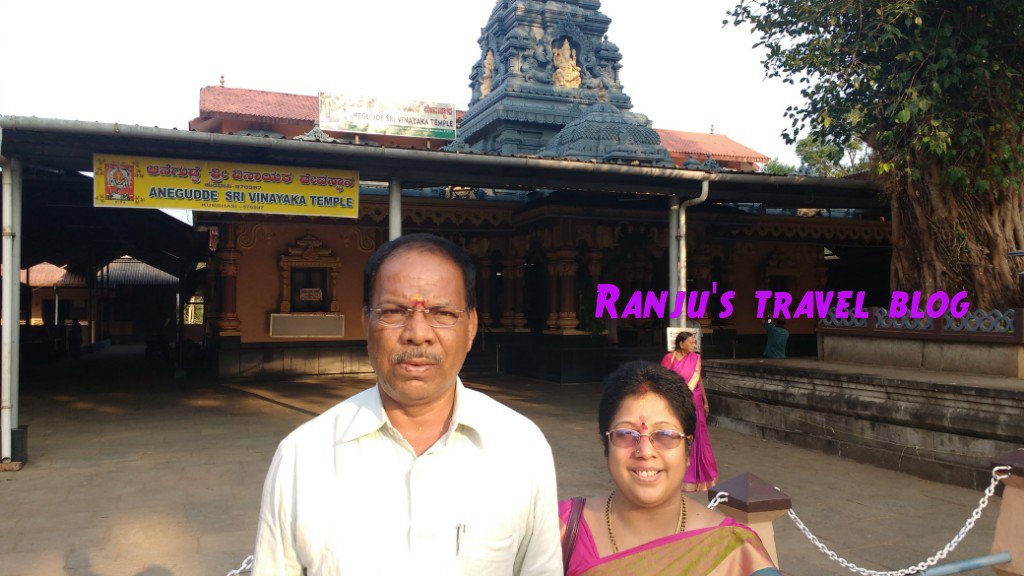
Anegudde Sri Vinayaka Temple, Kumbashi is in Kundapur taluk, Udupi District, Karnataka.
From Gokarna Mahabaleshwar temple we reached this temple by 3 pm as there was a special pooja being performed the temple was opened.
Kumbashi is a small village situated in kundapur (32 km from Udupi). As per the legend when there was a drought in this place Sage Gowthama (some references say Agasthya) was doing varuna yagna to appease the rain Gods at that time a demon named Kumbasura used to trouble him. In the same time Pandavas were passing by this place. Sage asks for help from Pandavas. Yudhistira asks Bheema to kill the demon.
Bheema fights with demon but fails as the demon was very powerful. At that time a heavenly voice informs Bheema that Kumbasura can be killed only by asi (sword) obtained from Ganesha. Bheema worships lord Ganesha and Ganesha appears in the form of an Elephant and gives him the sword with which Bheema kills Kumbasura . Hence this place was called Kumbashi.
The temple is situated on a hill which was previously called as Nagachala. It is believed that lord Ganesha in the form of Elephant gave darshan to Bheema in this place. Hence it was later became popular as Anegudde (In kannada Aane means Elephant and Gudde means hill).
There is Mahalingeshwara temple at the base of Anegudde. Vinayaka temple shares a close connection with this temple. The water of Mahalingeshwara temple (believed to be Ganga) is used for the Abhisheka of Vinayka of Anegudde.
According to legend Ganesha was given a task by Parvathi to find a place for the flow of Ganga in south. He comes to this place in the form of a Novice with a cow. Sage Gowthamas ashram was here. The cow dies in front ashram.
Pained by the incidence Gowthama prays to lord Shiva to send holy Ganga from his matted hair. Shiva sends holy Ganga and Gowthama collects the Ganga in his Kamandal (A type of vessel carried by sages) Gowthama sprinkles holy water on the cow and gives life to it. Ganesha’s purpose is also served . A small kumba shaped well is found in Mahalingeshwara temple.
As per devotees the idol of Ganesha is the same one which was worshipped by Bheema. But the present temple is only around 150 years old. And there is a very interesting legend about the same.
A Brahmin named Vishweshwara Upadhyaya lived in Korgi village five miles away from Kumbashi. He used to visit Mahalingeshwara temple (Anegudde) every day and take holy dip in the temple pushkarni. One day a young boy appeared in his dream and told him that he is hungry. He led him to Anegudde (his regular path) and disappeared near a stone.
Next day when Vishweshwara Upadhyaya visited the temple he saw the same stone and saw that the flowers were falling on the stone and cows were emptying their udder on the stone. He started worshipping the stone by doing Abhisheka from the water of Mahalingeshwara temple pushkarni (which is still followed).
Seeing his devotion people of Kumbashi gave him a place to live and he constructed a small shrine made up of muli (hay) and installed the stone deity and continued his worship. The temple took the present form after the death of Vishweshwara Upadyaya. His decedents are the main Archakas (hereditary priests) of the temple.
The idol of the deity is Swayambu (appeared on its own) and neerakara (without any definite shape). According to some devotees the stone has the features of Ganesh’s trunk.
You can see this form only at dawn before Abhisheka and in noon around 11.30 before Mahapooja (I was lucky today to have seen this form of lord) .Usually we see Vinayaka in this temple with golden face and silver body parts .
There is one more interesting observation is that till 11 o clock in the morning the Gods idol is decorated and you see him in standing posture and after that throughout the day the deity is decorated and seen in a sitting posture
Vinayaka of Anegudde is considered as Sarva Siddhi Pradhayaka (provider of all boons). Devotees flock this temple. Ganahoma and Rangapooja are offered by the devotees to the God.
Swamimalai Swaminathaswamy Temple is a Hindu temple dedicated to god Murugan. It is located in Swamimalai, 5 km from Kumbakonam, on the banks of a tributary of river Cauvery, 250 km from Chennai, the capital of Tamil Nadu, India.
The temple is one of the six holy shrines of Murugan called Arupadaiveedu.
The shrine of the presiding deity, Swaminathaswamy is located at the top of 60 ft (18 m) hillock and the shrine of his mother Meenakshi (Parvathi) and father Shiva (Sundareswarar) is located downhill.
The deities of the Tamil years are praying to Lord Muruga in the form of steps. Hence, the Padi Puja (puja for the steps) is conducted on Tamil and English New Year days with coconuts, fruits and singing hymns.The temple has three gopuram (gateway towers), three precincts and sixty steps and each one is named after the sixty Tamil years.
The temple has six daily rituals at various times from 5:30 a.m. to 9 p.m, and three yearly festivals on its calendar. The annual Vaikasi Visagam festival is attended by thousands of devotees from far and near.
As per Hindu legend, Muruga, the son of Shiva, extolled the meaning of the Pranava Mantra (OM) to his father at this place and hence attained the name Swaminathaswamy. The temple is believed to be in existence from the Sangam period from 2nd century BC and was believed to have been modified by Parantaka Chola I
Swami malai is also called as “Kattu malai ” as it is a artificially made Hill .
As per Hindu legend, Brahma, the Hindu god of creation, disrespected Muruga (the son of Shiva) at the time of visiting Mount Kailash, the abode of Shiva. The child Muruga got angry with Brahma and asked him how he was creating living beings. Brahma said that he was creating living beings with the help of the Vedas (Hindu scriptures). On hearing the reply, Muruga asked Brahma to recite the texts from Vedas. Brahma started to recite the text with the holy word called Pranava Mantra, “Om”. At that time Muruga stopped Brahma and asked him to explain the meaning of the Pranava Mantra. Brahma could not reply and hence Muruga knocked Brahma on his forehead with his clenched fists and punished him with imprisonment.
Muruga took up the role of the creator. The Devas (celestial deities) were surprised by the absence of Brahma and they requested Vishnu to negotiate with Muruga to release Brahma. Vishnu could not help and as the last resort, Shiva went to the rescue of Brahma. Shiva came to Muruga and asked him to release Brahma from imprisonment. Muruga refused to release him stating Brahma was unaware of the meaning of the Pranava Mantra (Om). Shiva asked Muruga to explain the meaning and Muruga extolled to Shiva the meaning of the Pranava Mantra. Shiva behaved like a student to a teacher, listening with rapt attention from his son, giving Muruga the name “Thagappan Swami”. The meaning of this name is “The Teacher of His Father Lord Shiva”. Following the legend, the shrine of the son Muruga is atop the hillock, while the father Shiva’s shrine is located at the basement.
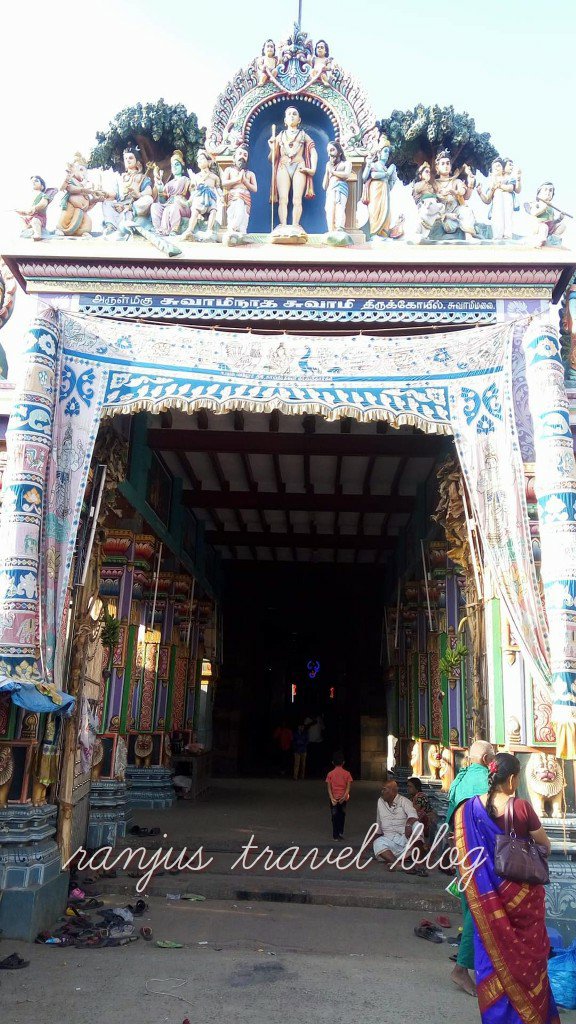
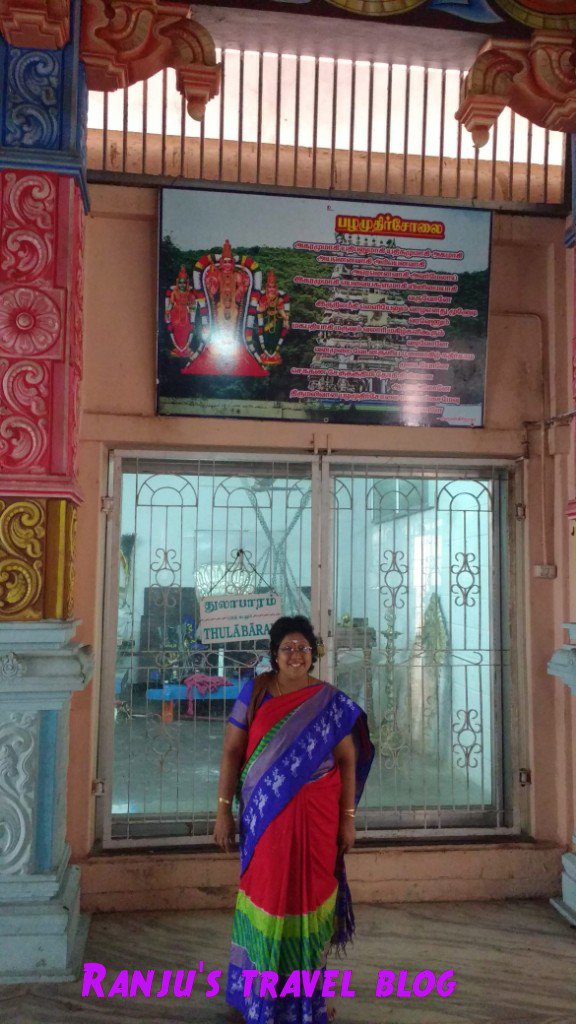
Located 25 km away from Madurai, Pazhamudhircholai is one among the 6 prominent abodes of Lord Muruga, called as Arupadaiveedu. Others important abodes of Lord Muruga are Thiruparankundram Subramanya Swamy Temple, Palani Dandayudhapani Swami Temple, Swamimalai Swaminatha Swami Temple, Tiruchendur Senthil Andavar Temple and Tiruttani Subramanya Swamy Temple. Its admist the dense forest very near to Kallazhaghar temple one of the Pandiyanadu divyadeshams of Lord Vishnu .
Lord Muruga is seen here with his two divine consorts Goddesses Valli and Deivayanai. Devotees visit here to seek lord’s blessings. Many devotees come here for wedding, child and even academic blessings. The scenic beauty of the place also attracts many visitors here.
A natural spring named Nupura Gangai flows at a walkable distance from this temple many people flock to this places to take bath and fill the water it in containers as it said to be a natural remedy for skin diseases .
There are lots of monkeys so must be carefull . We can spend a whole day here by seeing Padinettam padi karupanaswamy temple the guardian diety of Azhaghar koil , Azhaghar koil , Palamudhir cholai then to Nupura Gangai.
Legend of Pazhamudhir Solai near Madurai
According to a popular legend associated with this temple, a great Tamil poet Avvaiyar, who was also an ardent devotee of Lord Muruga was tested by Lord here under a tree near the temple. This tree is still being worshipped with the devotees who come to visit the temple.
As per the legend, Avvaiyar, while travelling under hot sun had taken refuge under a fruit tree. She didn’t have anything to eat or drink while she rested under this tree. It is then Lord Muruga, in the guise of a young boy, appeared in front of her and asked her if she wanted roasted or unroasted fruits (sutta pazham venduma sudatha pazham venduma). Being highly well-informed herself, Avvaiyar sneered at the idea of roasted fruits and asked the boy to just pick unroasted fruits for her. Later she picked up the fruits fallen out of the tree. As she was blowing off the dust from the fruits, young boy asked if she was cooling down her roasted fruits. Hearing such as intelligent play of words and poetic knowledge by a small village boy left her astonished. She when realising it is not something common, asked the boy to let her know his true identity. After her fervent pleading, Lord Muruga appeared and blessed her.
Sri Durga Parameshwari temple Kateel .The temple is around 25Km away from Mangalore . You can visit Nellithirtha and this temple together.
This temple does not close from morning to evening. You can still have the dharshan of the Goddess Durga Parameshwari in the afternoon.
We had visited this temple during my mangalore spiritual trip.The deity is very powerful and believed to full-fill your wishes. This temple is a great source of positive energy.
Kateel (Kati) means in the middle, as it is situated in the middle of Kanakagiri and Pavanje .
The river Nandini flows below the temple. It is also called as boat shaped temple. If you visit the temple in rainy season you will feel as if the temple is like a boat floating in the river Nandini .
As per legends demon Arunasura got the boon that he cannot be killed by man, Women, Trimurthi or any living being with two or four legs. He got this boon because he got upadesha of Gayathri mantra from Jabali Maharishi , since then he was constantly reciting Gayathri mantra, he became very powerful that no one could not touch him .
Jabali Maharishi asked Narada to find a solution to kill this demon . He did penance in Nellithirtha. Due to the boon even Lord Shiva was helpless . Lord Shiva suggested Jabali Maharishi to impress Goddess Parvathi as she can only solve the problem .
Jabali Maharishi does penance but Goddess Parvathi does not get impressed . Later, Jabali Maharishi on the advice of the gods conducts a Vishwachandika yaga .
Arunasura comes to know about it and comes to spoil the yaga , but fails. The Chandika yaga pleases Goddess Parvathi, she assures Jabali she will indeed end the life of the demon but, Arunasura has to stop chanting Gayathri mantra .
Deva guru Brahaspathi visits demon Arunasura and suggests him that he is too great to recite Gayathri mantra . Arunasura falls in the trap and stops chanting Gayathri mantra.
In the mean time Goddess Parvathi comes in the form of Mohini and entices Arunasura. When Arunasura follows her she runs and disappears inside a rock . Arunasura hits the rock and the rock opens and a sparm of bees come and chase him. Thus Goddess Parvathi takes the form of Brahmara (Bee) and kills the demon . Hence she is also called Brahmarambika .
After the end of Arunasura, all the gods ask goddess to take shantha Roopa and stay in this place to bless the devotees, She agrees and takes the shape of Durga parameshwari.
It is believed that Jabali Maharshi had cursed Nandini (The sacred cow) daughter of Kamadhenu to flow as a river, when she refused to come to earth with Jabali . When she repents , Jabali blessed her that Goddess Parvathi will come and stay at her shore and her curse will be cleared.
The Durga Parameshwari idol is made up of gold, it is very small in size and only oil lamps light the sanctum. There is no light in the sanctum. Having her divine darshan only in the light of lamps is magical moment.
When you enter the temple, on the left side you can see the rock from where Devi came as Brahmara . There is Naga deva and Ganapathi inside the temple premise.
Devi is considered to be very fond of mallige (jasmine) so devotees offer it with prayers.
This temple does not close from morning to evening. You can have the dharshan of the Goddess in the afternoon section too though we went in the morning.
This temple is a great source of positive energy. Visit the same to feel it.
Many devotees offer black bangles to the deity. The same are distributed to the other devotees as it keep negative energies away don’t forget to collect them. You can get it from priests who distribute Theertha and Prasada in the temple.
Please visit the official website of the temple for more details
Entrance of the temple backside are taps to wash our feetEntrance of the temple Main sanctum Durga Parameshwari
Thiruparankundram Murugan Temple or Subramanya Swamy Temple is one of the Six Abodes of Murugan, located at Thiruparankundram, Madurai , Tamil Nadu in India . The main deity being Lord Murugar with both his wives Valli and Deivayanai .The temple is built in rock-cut architecture and believed to have been built by the Pandyas during the 6th century. According to the legend it is where Murugan slayed the demon Surapadman and married Deivayanai, the divine daughter of the king of heaven , Indra, and he is said to have worshipped Lord Shiva here as Parangirinathar . Goddess Parvathi is named as Aavudai nayaki.
This temple, with its shrine carved out of a rock, has separate shrines for Lord Shiva, Lord Vishnu, Goddess Durga, Lord Vinayaka and of other prominent Hindu deities. This temple, which is also historically important, is known for a special feature. In this temple, idols of Lord Shiva and Lord Vishnu face each other, which is a unique aspect in a Hindu temple. From this temple, sun and moon can be seen together, which is a major attraction among devotees.
When visiting Tiruparankundram temple, if times permits devotees can also visit to other theerthams which are located nearby such as Sanyasi Kinaru, Saravana Poigai, Kasi Sunai, Sathiya Koopam and Lakshmi Theertham on their Madurai Tour.
In front of the temple Entrance Backside of the temple
After having dharshan at Hosanadu Annapurneswari went to Kollur Mookambika Temple – source of all powers .
Shri Mookambika is one of the most legendary shrines for Hindus in India. It is the only temple that is dedicated to Goddess Parvathi in the form of Mookambiga (as she slayed down demon Mookasura) and is believed to be created by Parashurama.
Goddess Mookambiga temple is located exactly on the banks of the perennial river Souparnika, that runs close to the foot hills of the Western Ghats. River Sauparnika has its attribute to the eagle called Suparna, that did penance in this bank and attained salvation.
The history of Kollur Mookambika temple states that, there lived a demon named Kaumasura who was unleashing a reign of terror upon all the gods with his special power given by Lord Shiva. When all the gods were trying their best to stay away from his vicinity, Guru Shukracharya brought good news to the gods, that this demon would face death by a woman, that is Goddess Parvathi Devi. Knowing this, Kaumasura undertook severe penance worshipping LordShiva , and Lord Shiva asked this demon for the boon, sensing grave danger that, if he offered the boon, this Goddess of speech (Saraswathi) would make Kaumasura dumb.
Hence this Kaumasura came to be known as Mookasura (mooka means to be dumb). Thereafter Devi mobilised all the powers of the gods and then this demon was killed by Kollur Devi Parvathi. She was hence called Mookambikai. This place where Devi killed Mookasura is known as Marana Katte.
The Kollur Devi thereafter became the deity of this place, offering her blessings to all who sought her. She poses with all her radiance along with the shank (conch)and chakra in both her hands sitting in the padmahasana posture.
Significance of Swayambhulinga
The Suyambulinga (self evolved Linga) at Shri Mookambika temple, is said to have come into existence when Parameshwara drew the chakra with his toe. This chakra is believed to be the Udhbava Linga, which has drawn its strength due to its proximity to all divine beings. It is also very sacred, since Kollur Devi is supposed to be merged with this Suyambulinga and that has made her acquire great power.
Here she is said to have formed, as a part of Linga along with Lakshmi and Saraswathi on one side and Lord Brahma, Vishnu and Parameshwara on the other side. Apart from this, there is also a carved image of Shiva believed to be injured, during the clash with Arjuna known as Kiratharjuna and this is on the right side of this Suyambulinga.
The history of idol installation at Kollur Mookambika temple is nearly 1200 years old. When Acharya Shri Sankara first came to this place, there was a Swaymabu Linga worshipped by Kola Maharshi. On close observation, Acharya Shri Sankara found that Ambica too was in the Linga invisibly. He mediated upon the Goddess sitting at a place close by. Mother Shri Mookambika appeared before Acharya and blessed. Mother Mookambika’s idol was made based on the picture that appeared in Shri Sankara’s mind. No abishek is performed to Mother but to Linga only. Other alankaras(decorations) are done to the Goddess. There is a golden line in the middle of the Linga, visible to the devotees only during abishek. With such divine features, the Shiva Linga grants huge benefits to the devotees, equivalent to worshipping millions of deities. The temple has also the Shri Chakra installed by Shri Adi Sankara. As Kola Maharshi worshipped here, the place came to be known as Kollur.
As a tradition, the doors of the temples are kept closed during the eclipse period, but this temple is an exception. Poojas continue even during eclipse times. Brahmmacharis are not allowed to perform poojas in the temple. As Mookambika is but mother Saraswathi, prayers are submitted by devotees for gaining knowledge, wisdom and excellence in educational pursuits.
Many of the local Kings have given lots of donations to this Temple. Prominent among them are the Kings of the “Keladi Dynasty”. They have been offering a variety of worships to the Goddess. Prominent Kings of the Keladi Dynasty, Sankanna Nayaka and Shivappa Nayaka had renovated the Temple and gave donations for the maintenance of the Temple. The Kings of keladi Nayak Dynasty had believed that the Goddess is the symbol of victory. As such whenever they would win a war or drive away their enemies they were devoting the victory and celebrating it before the Goddess.
Utsava Moorthi is placed at the Saraswathi Mantapa, and naivedya with Beaten rice, coconut. After that , Mangalarathi and Ashtavadana Seve Vedaghosha, Sangeetha, Shruthivadya, Sarvavadya. Once it is over Shree Devi will be taken inside the Temple .
Also, for nature lovers, the Aanejhari Butterfly camp 5 Km from the temple sounds to be an interesting place!
Many private lodges are also available
The temple offers free food to everyone who visits the temple. Free food is served both during lunch and at night. The food is very tasty and a must have for everyone. Apart from the temple food, you can also find some small budget hotels which offer decent food
The nearest city is Mangalore, which is 140 Km away. Udupi is 80 Km away.















































 Ranjus travel blog
You must be logged in to post a comment.