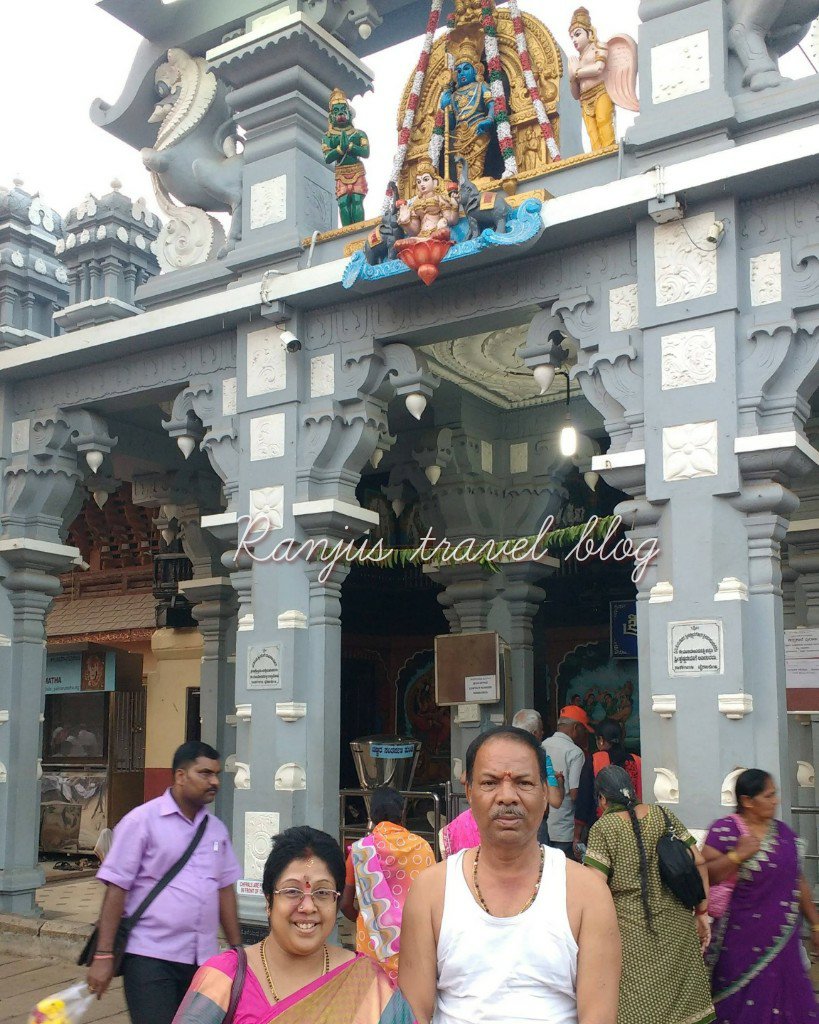
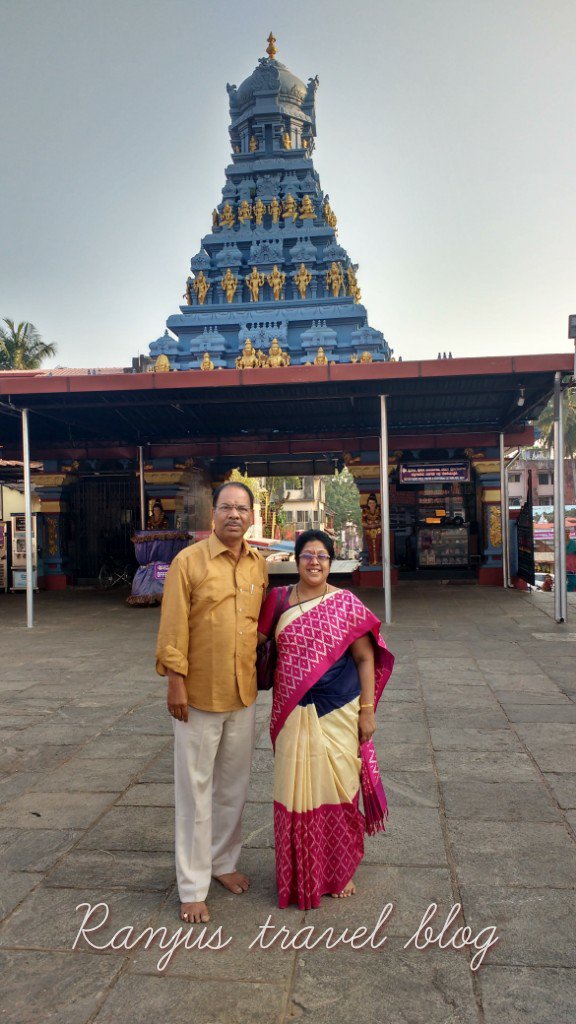
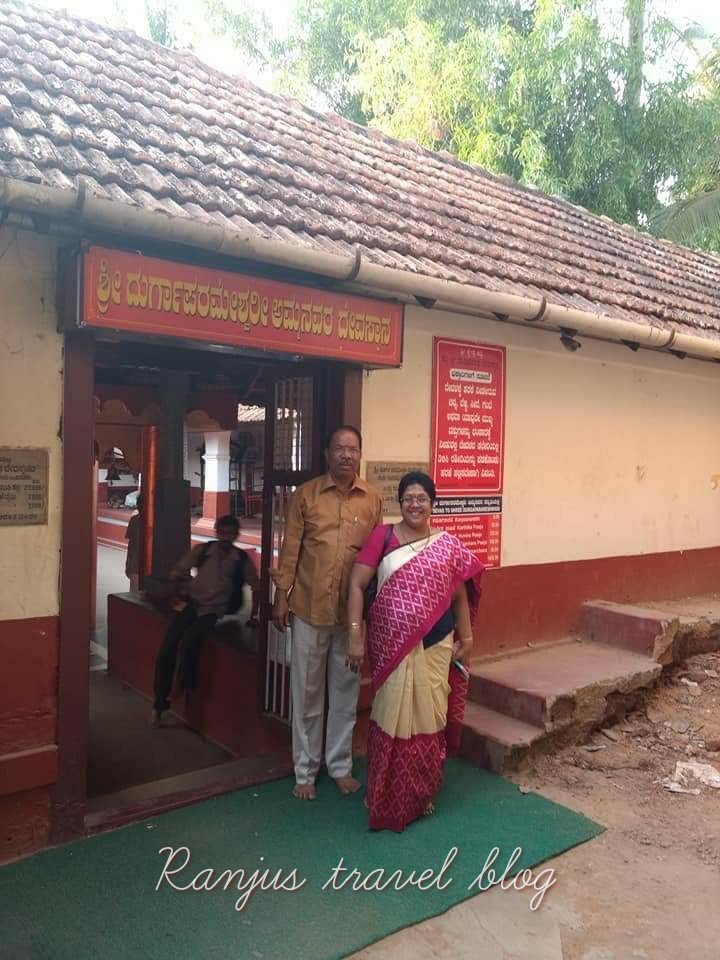
Udipi Sri Krishna temple is one of the must visit temples to Lord Krishnas devotees.
I had the divine dharshan of Lord Krishna during my Mangalore spiritual tour. Udipi is 60 kms from Mangalore.
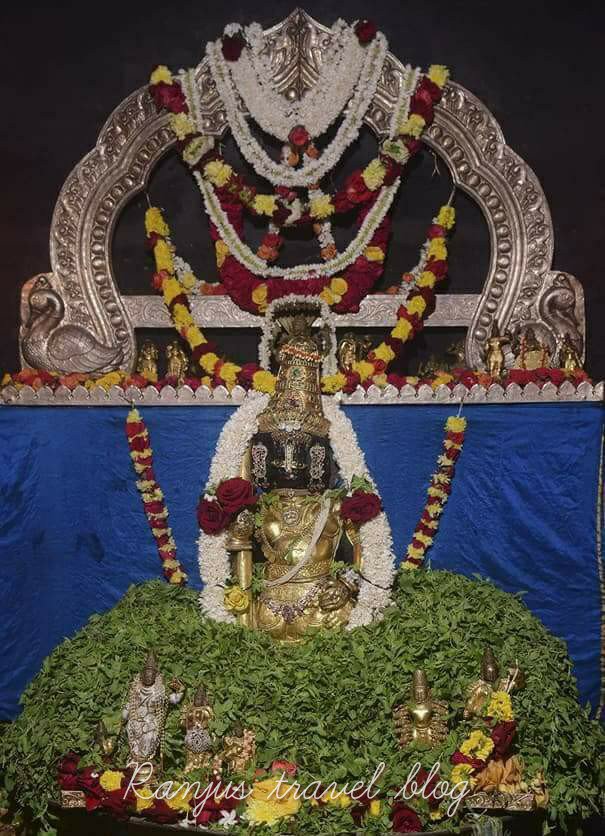
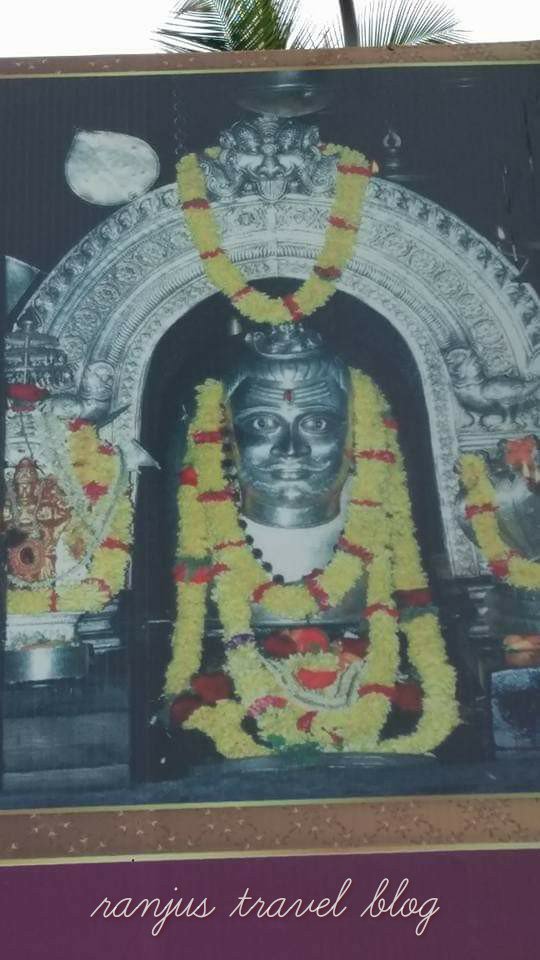
In this temple Lord Krishna is seen with a churner in one hand and rope on the other hand.
Udupi Sri Krishna appears to his devotees as Muddu Krishna in child form. The temple has a large collection of gold Jewelry including contributions from the emperors of Vijayanagara rulers, Mysore Maharajah .
The Lord idol is said to be installed by Madwacharya as he got it as a huge lump of clay ( Gopi chandan ) from a sailor from Dwaraka to Mangalore coast . It is said that Idol of Lord Krishna was worshipped by Rukmani in her garden earlier .It is believed the lamp lit by Madvacharya is maintained till now by the temple priests .
Unlike other temples in India, a fascinating aspect of this holy shrine is , devotees can have darshan of Sri Krishna only through a window with nine holes called the “Navagraha Kindi” (Nava means nine; Kindi means window) and the window is elegantly carved and is silver plated.
Kanakana Kindi or Kanaka’s Window is a small peephole in the Udipi Sri Krishna temple through which the great Indian saint Kanaka dasa was given darshan by lord Krishna. This is present in the outer wall of the temple and the gopuram is known as Kanagagopura.
There is a legend behind the presence of ” Kanakana kindi”. Shri Kanakadasa was a great devotee of Lord Shri Krishna. He lived at around the same time as Shri Vadiraja Swamiji at Udupi and was carrying out his Bhajans in front of the temple regularly . Kanakadasa, an ardent believer of God, came to Udupi to worship Lord Krishna. He was not allowed inside the temple as he was of lower caste .
Undeterred, Kanakadasa lived just behind the temple to serve Sri Krishna from outside the temple .One night the temple wall collapsed and this enabled Kanakadasa to get a darshan of his Lord.
Further, it is believed that Sri Krishna himself turned his face in such a way, that Kanakadasa could get his darshan. As for this ardent devotee, a long-cherished ambition had been fulfilled by the lord himself, a privilege that people of higher caste could not get. This incident implies that to the almighty, He treats all this devotees equally, regardless of caste, color and creed.
Adjacent to the temple is a pond named madvasarovar .
In front of the temple With our tour organizerUdipi Krishna Source Facebook temple connect pageMadwasarovar
Located in Karnataka, this magnificent shrine is dedicated to Lord Shiva.
The Murudeshwar temple is located in Kanduka hill which is surrounded by the Arabian Sea on 3 sides.
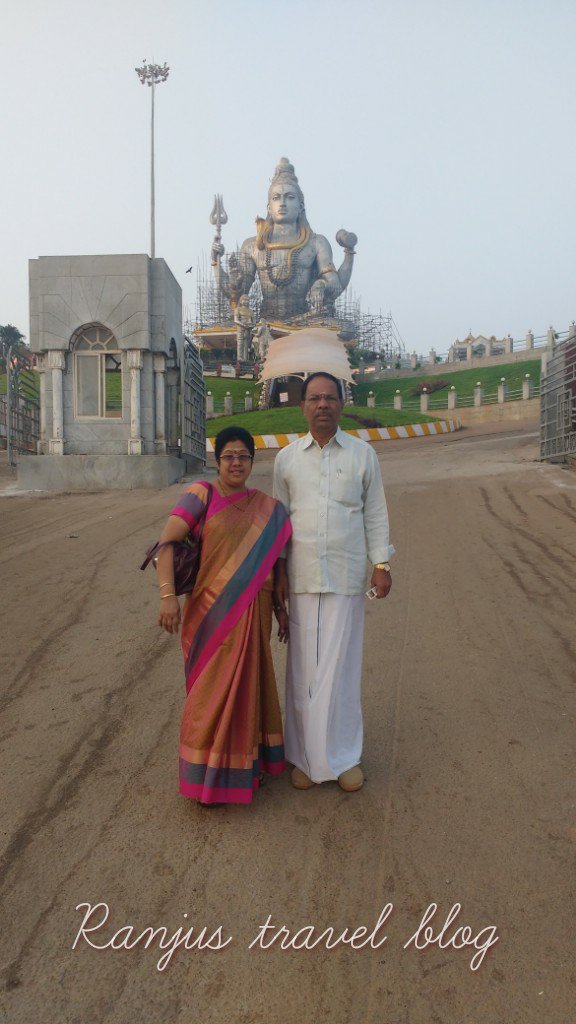
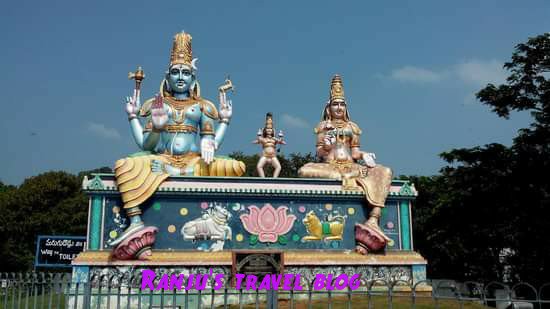
This temple boasts of the second highest statue of Lord Shiva in the world, and the sheer magnanimity of the statue will fill you with a sense of awe.
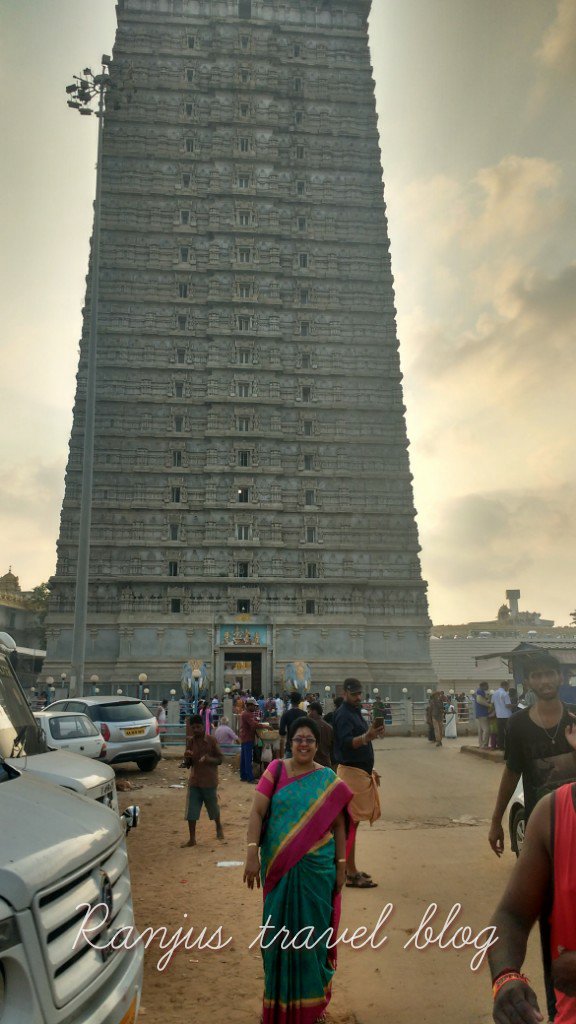
The main temple’s entrance, also called the ‘Gopura’ stands at 123 feet and you can witness the breathtaking view of the Shiva statue from the top of the Gopura.
It’s a 19 stories Gopura and lift facilities r there , they charge Rs. 20 per head . Lift facilities start from 9am till 6 pm only .
We reached this temple from Kollur Mookambiga temple by 5pm, first we opted for lift facility as it is said to be operated till only 6 pm, saw from the top view of the highest Lord Shiva statue sitting admist Arabian sea. Then had dharshan of the lord inside the temple .Spent some time in the beach and stayed in RNS residency very near by the temple . Morning once again we had the dharshan of the Lord Shiva .
The entire surface of this temple is covered in the most intricate and detailed carvings that you will ever see. The compound of the temple has been modernized except the sanctum sanctorum, which retains its original form. The main deity of the temple is the Sri Mridesa Linga, which is believed to be a part of the original Atma Linga.
The Shiva statue here is quite an impressive one and will surely leave you with a humble sense of tranquillity. This magnificent statue is a perfect tribute to a God who is held in high reverence in lands far and wide.
Inside the main shrine of the temple is a Deepam which is believed to be burning the way it burnt when the temple was built. In order to get blessing of the God for prosperity and good luck, people pour oil into the burning Deepam and see their image into the oil.
The gigantic Gopuram at the entrance is believed to be the second tallest of all the Gopurams in the world and has a height of 237.5 feet while the tallest Gopuram is located at Srirangam temple in Tamilnadu.
Next to the temple is a cave museum which has the idol of Lord Shiva Lanka king Ravana along with Sthalapuranam .Located in Karnataka, this magnificent shrine is dedicated to Lord Shiva.
The Murudeshwar temple is located in Kanduka hill which is surrounded by the Arabian Sea on 3 sides.
This was the last temple we visited on our second day of Mangalore spiritual tour .
The tall GopuramLord Shiva View of Lord Shiva from our Hotel entrance The main entrance Inside the temple Inside the temple The golden chariot of the temple View of the Gopuram from our Hotel balcony
This temple is located in the heart of Mangalore. This is one of the ancient temples . From Kukke Subramanya after having lunch we reached this temple by 5 pm .
It is that Parashurama who was living in Sahyadri, killed the kshathriyas who were cruel and donated the lands to Kashyapa. He prayed to Lord Shiva for a place to live. Lord Shiva assured Parashurama that if he performed a penance at Kadali kshethra, Lord Shiva would reincarnate as Manjunatha for the betterment of the world. As per Shiva’s orders Parashurama threw his axe into the sea and created a place for his penance. Yielding to Parashurama’s prayers Lord Shiva appeared to him as Manjunatha with Goddess Parvathi and stayed at Kadri for the betterment of the world. As per the orders of Manjunatha the sapthakoti manthras become the seven theerthas .
The chief deity of this temple is Manjunatha, which incorporates a Shiva linga. The statue of Lokeshwara in the seated position with three faces and six arms is tipped to be the best bronze statue in India. It is about 1.5 meter tall.
There’s a garden surrounding the ponds. When one walks down from there in front of the temple is a huge lightpole. During karthika maasa, deepothsava is held here.
There is a natural spring at an elevated location at the back of the temple. It is called Gomukha. It is believed that the water flows from Bhageerathi river, in Kashi and thereby it gets its name as Kashi Bhageerathi theertha. The water from this spring is let into seven ponds of different sizes adjacent to it. Visitors wash themselves in these ponds before entering the main temple.
There are statues of Machendranath, Gorakanath, Shringinath, Lokeshwara, Manjushri, and Buddha in the temple.
This temple is located in the heart of Mangalore. This is one of the ancient temples . From Kukke Subramanya, after lunch we reached this temple by 6 pm .
It is believed that Parashurama who was living in Sahyadri, killed the kshathriyas who were cruel and donated the lands to Kashyapa. He prayed to Lord Shiva for a place to live. Lord Shiva assured Parashurama that if he performed a penance at Kadali kshethra, Lord Shiva would reincarnate as Manjunatha for the betterment of the world. As per Shiva’s orders Parashurama threw his axe into the sea and created a place for his penance. Yielding to Parashurama’s prayers Lord Shiva appeared to him as Manjunatha with Goddess Parvathi and stayed at Kadri for the betterment of the world. As per the orders of Manjunatha the sapthakoti manthras become the seven theerthas .
The chief deity of this temple is Manjunatha, which incorporates a Shiva linga. The statue of Lokeshwara in the seated position with three faces and six arms is tipped to be the best bronze statue in India. It is about 1.5 meter tall.
There’s a garden surrounding the ponds. When one walks down from there in front of the temple is a huge lightpole. During karthika maasa, deepothsava is held here.
There is a natural spring at an elevated location at the back of the temple. It is called Gomukha. It is believed that the water flows from Bhageerathi river, in Kashi and thereby it gets its name as Kashi Bhageerathi theertha. The water from this spring is let into seven ponds of different sizes adjacent to it. Visitors wash themselves in these ponds before entering the main temple.
There are statues of Machendranath, Gorakanath, Shringinath, Lokeshwara, Manjushri, and Buddha in the temple.
One of the ancient temples In front of the temple Inside the temple The silver chariot of the temple Elevated Pond Gomukha
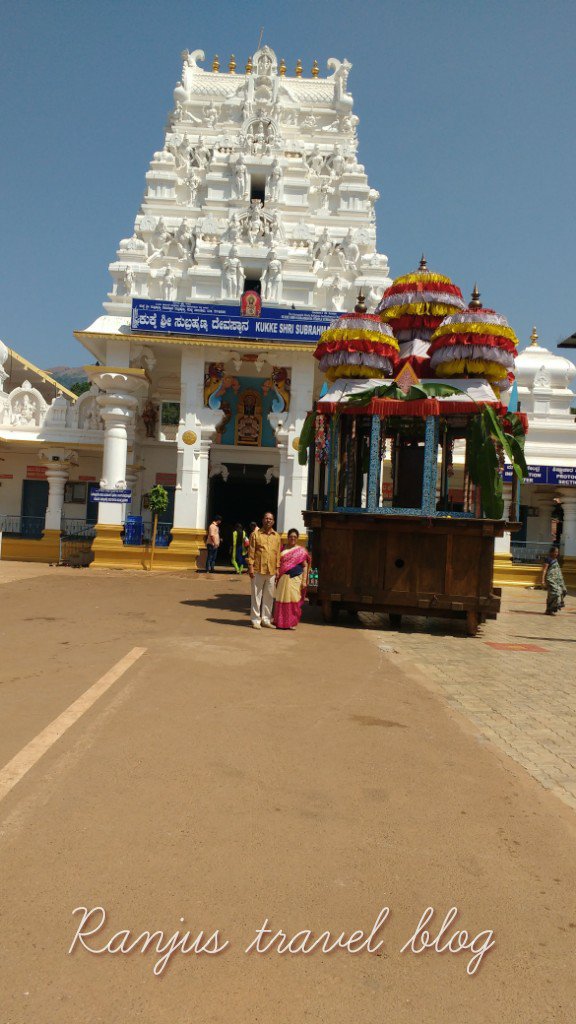
From Dharmasthala we went to Kukke Subramanya. The distance was about 45 km and it took 2 hours for us to reach .
In this temple Kartikeya is worshipped as Subramanya , lord of all serpents. The epics relate that the divine serpent Vasuki and other serpents found refuge under Subramanya when threatened by the Garuda.
Kukke Subrahmanya, one among the seven holy places created by Parashurama is mythologically and historically famous for “Nagaradhane”. Residing with Vasuki, God Subrahmanya showers his divine grace on devotees as the presiding deity of the Kshetra. It is also called “Guptha Kshetra”. “Mruthika Prasada” given here is regarded as sacrosanct. The devotees believe that the holy bath in the Kumaradhara Thirtha and Madesnana eradicate dreaded diseases like leprosy. Diseases related to skin, the devotees firmly believe, get cured here. God Subrahmanya has earned an honorific title “Annadana Subbappa”. Thousands of devotees receive Annadana everyday here . Special pooja are done for those having naga doshas and behind the temple is Adi Subramanya with a pond besides it . The temple is calm and serene .
Adi Kukke Subramanya Swamy Sri Kshetra is on the river bank of Kumaradhara. Born to annihilate the demonic forces. Kumaraswamy Killed Tarakasura and other Asuras in the battle to Kumaraparvatha with his from this sibling Ganapathi. Devendra had decided to give away his daughter Devasena to him on “Margashira Shudda Shasti”. Accordingly the marriage took place on the banks of Kumaradhara Thirtha. Bestowing his grace on “Sarpa Raja” Vasuki, who was doing Thapasya at that time. Kumaraswamy assured to dwell along with Devasena in him. Since then, it is behind that Lord Shanmukha (Skanda) in his spiritual presence is residing with Vasuki in the shrine.
Five Thousand year old Temple: In the past Subrahmanya Kshethra, the edicts and Grantha inform, was known as Kukke Pattana. Shankara Vijaya authored by Ananda speaks about Sri Adi Shankaracharya visiting Subrahmanya during his philosophical conquest and his sojourn here. Reference to his sketra could be inferred from “Bhaje Kukkelinga” which forms a part of “Subrahmanya Bhujanga Prayatha Sthotra” composed by Sri Adi Shankaracharya. According to Sthala Purana many Devarushis installed Shivalingas in this Kshetra. Reference to such Shivalingas should be understood as Kukkelinga.
Sanathkumara Samhite in Sri Skanda Purana (a portion of it is called Sahyadri Khanda which describes pilgrimage places) informs that Subrahmanya Kshetra is on bank of Dhara. Sri Shanmukha Swamy after vanquishing Tarakasura and other Asuras washed his weapons of destruction in this thirtha and hence the name Kumaradhara is derived from this episode.
People affected by / suffering from Sarpadosha, whose diseases were not cured by medication, undertake sevas and these they are able to fulfill their wishes. During Subrahmanya Shasti the devotees participate in Beedhi Madesthana, the remover of their physical and mental problems. Not only that, the performing of Madesthana on Uchista of mass feeding and Uruluseva in the quadrangle are well known vows undertaken in this temple.
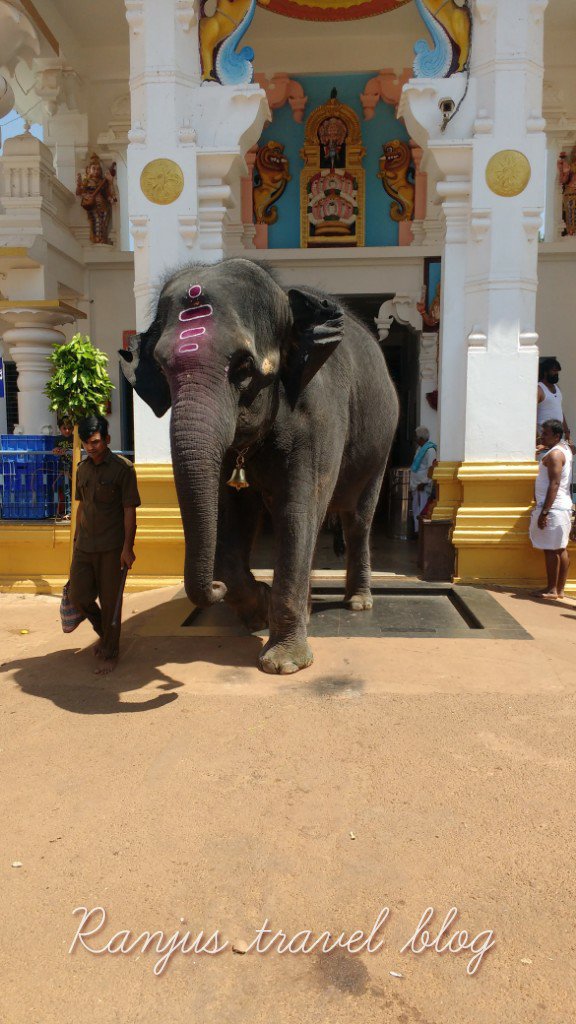
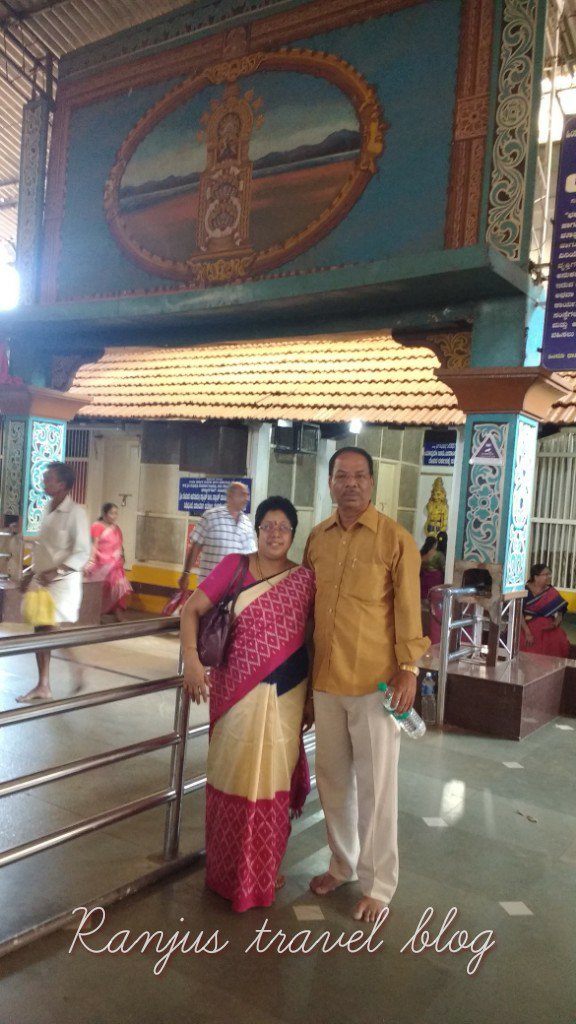
In front of the temple Temple elephant Inside the temple Way to Adi Subramanya A park near Adi Subramanya
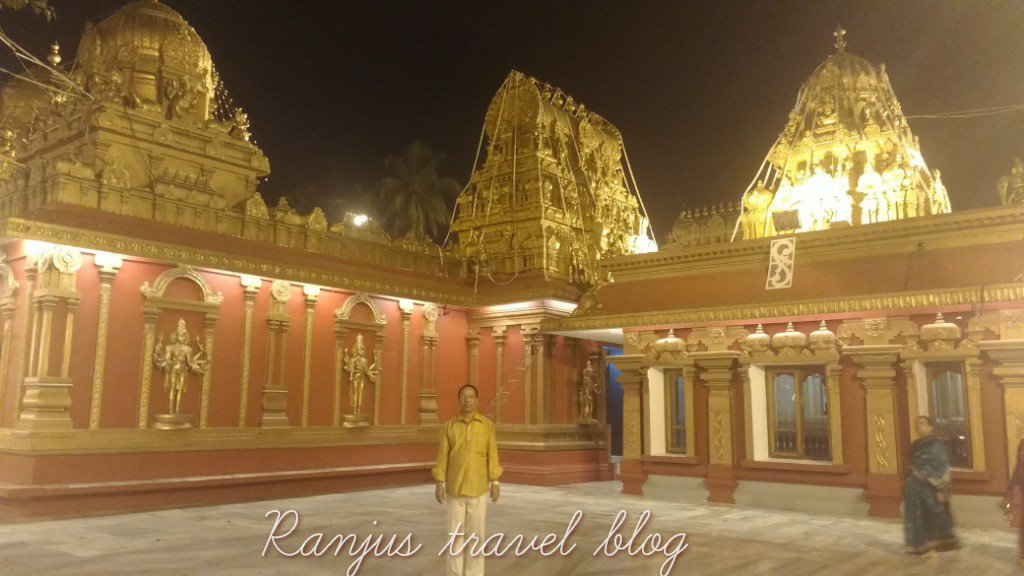
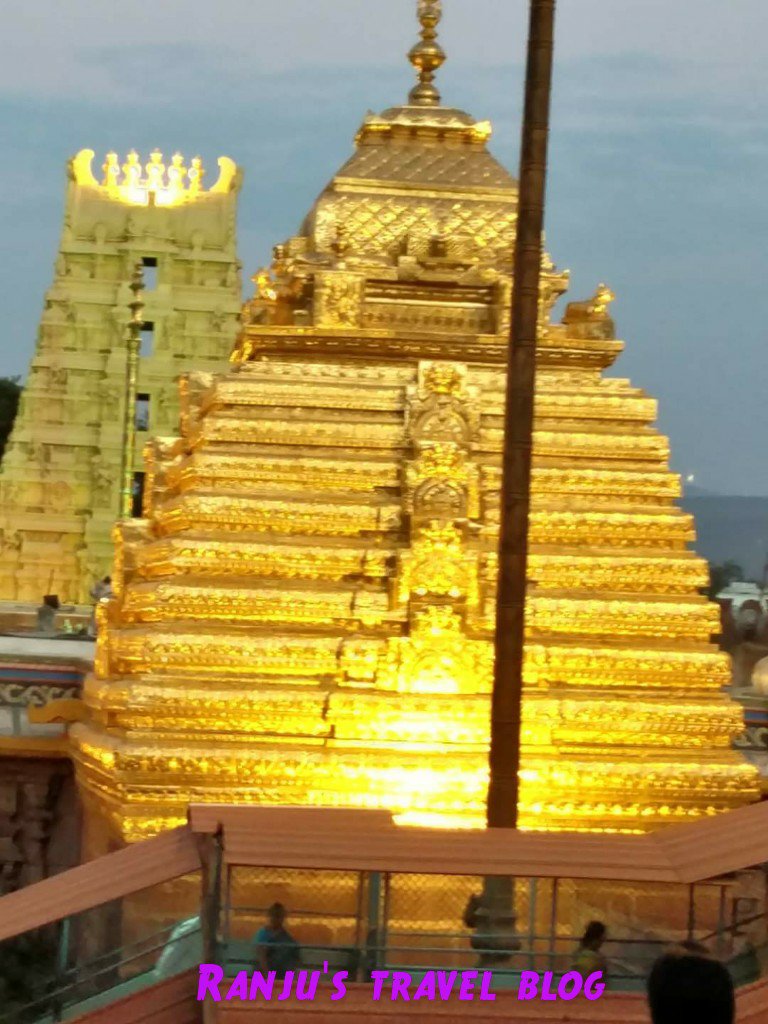
From Kadri Manjunath temple we went to this temple by evening 7.30 pm. Our tour organizer insisted that visiting this temple in illumination is a visual treat , really we were amazed seeing the temple glittering in the light effects .
This temple is situated in Kudroli area (about 5 km from the City Bus Stand) in the city of Mangalore. . It is dedicated to Gokarnanatha, a form of Lord Shiva.
Built in 1912, is one of the main attractions of Mangalore. Sri Gokarnanatheshwara Temple is a unique Temple built by Sri Narayana Guru, the saint and social reformer from Kerala, and is the only one in Karnataka by Guru. The reformist Narayana Guru installed this temple for the Billava community, who were prohibited the entry to other Temples.
Gokarnanatheshwara, Lord Shiva, is the main deity. The main Temple is surrounded by the smaller Temples for Mahaganapathi, Subramanya, Shaneeshwara, the Navagraha, Annapoorneshwari and Anandabhairava.
One should visit this temple during evenings in illumination the temple glows like gold .
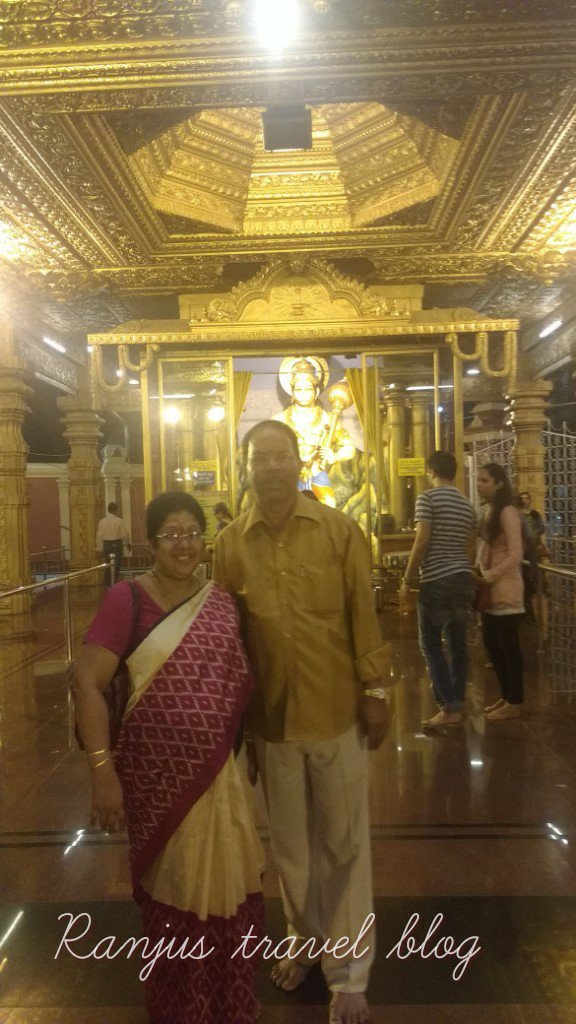
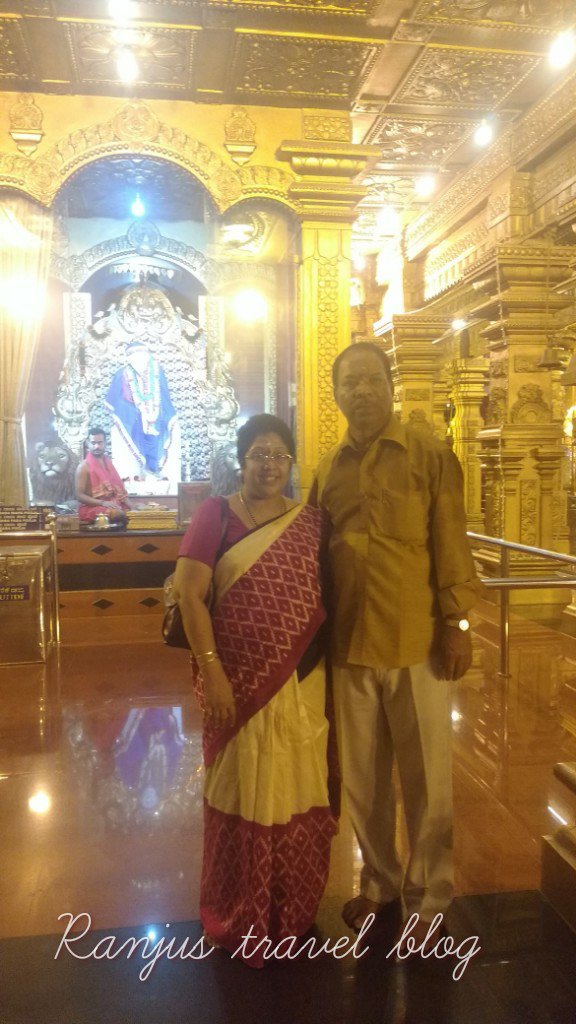
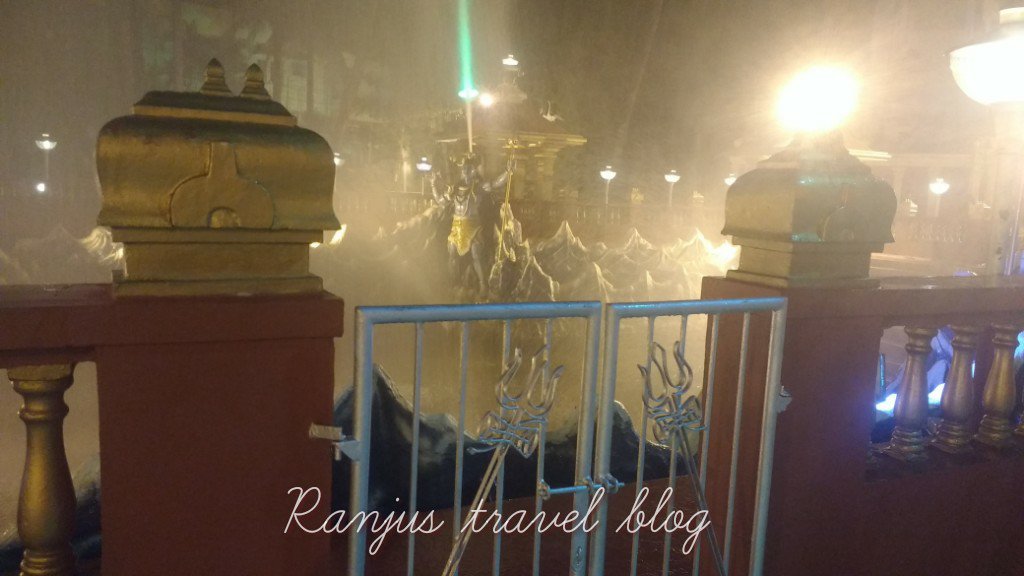
The whole temple seemed to be glittering in gold at the entrance a huge Lord Hanuman Saibaba and Lord Shiva pariwar were there and huge golden doors . Gitopadesham elephants and Poorna kumbham all were gold and was a visual treat at the backside of the temple was fountain show along with Lord Shiva in mountains.
This was the last temple for the first day of our Mangalore spiritual tour.
The view of the temple from insideLord Hanuman Huge Nandi SaibabaGitopadesham PoornakumbhamGolden GateFountain showIn front of fountain show
This temple is in Guwahati is one of the Shakthi Peedams. This temple is about 20 kms from Guwahati airport. Kamakya is also known as the bleeding Goddess of Assam .This temple is on a hillock named Nilachal of 562 feet high .
The temple of Kamakhya has a very interesting story of its origin. It is one among the Shakti peedams. The story of the Shakti peedam goes like this; once Sati fought with her husband Lord Shiva to attend her father’s great yagna. Despite her husband Lord Shiva’s disapproval, Sati had gone to attend the universal ‘yajna’ organised by her father Daksha. Shiva was not invited, and was also abused by Daksha. Unable to bear the insult, Sati committed suicide. When Shiva came to know that his beloved wife had committed suicide, he went insane with rage. He placed Sati’s dead body on his shoulders and did the tandav or dance of destruction.
To calm him down, Vishnu cut the dead body with his chakra. The 51 places where Sati’s body parts fell are called Shakti peedams. Kamakhya temple is special because Sati’s womb and vagina fell here.
One has to climb about 120 steps to reach the temple .
We reached by 10 am straight from Guwahati airport to this temple and our tour organizer had arranged a special dharshan . We were taken inside the main sanctum sanctorum .There was no idol of the Goddess only a Peedam along with 3 heads covered with silks and flowers tha main deity here is in the form of Yoni , which we had to get down a few steps and is damp with fluid they were collected and given us as prasad to us .We were garlanded with the flowers on the Sakthi peedam .
There were 4 tombs and the entire walls were of carvings of different deities.
There is a mantapa were we can lit diyas and agarpathis and pray to Maa Kamakya.
Kamakhya Devi Temple is a unique temple that celebrates the fertility and womanhood with a grand fervor -“Ambubachi Mela”.
The Ambubachi Mela is the most important festival of the Kamakhya Temple of Guwahati. It is believed that the presiding goddess of the temple, Devi Kamakhya, the Mother Shakti, goes through her annual cycle of menstruation during this time stretch.
During the Ambubachi Mela in Guwahati, the doors of the Kamakhya Temple remain closed for three days. It is believed that the Mother Earth becomes unclean for three days. During this time any kind of farming work is not taken on. Daily worships and other religious performances are also stopped during the Ambubachi Mela of Guwahati in Assam. After the completion of three days, the doors of the Kamakhya Temple are reopened. But the doors of the temple are reopened only after Devi Kamakhya is bathed and the other rituals are executed. It is then believed that the Mother Earth has retrieved her purity. This is purely a ritual of the Tantrik cult.
On the fourth day, the devotees of the Goddess are allowed to enter the temple for worshipping Devi Kamakhya. Thousands of pilgrims are found to visit the Ambubachi Mela in Guwahati, who comes all over India.
In addition to this temple there are Dasa Maha Vidya temples . They are 10 forms of Shakthi named as Kamala Matangi and Tripurasundari which are found within the temple complex and Tara Kali and Chinnamastha few steps down to Kamakya temple and Bhuvaneswari Bagalamukhi Bhairavi and Dumavathy within a km distance from Goddess Kamakya temple.
The tombs of Kamakya temple The entrance Lord Ganesha Carvings on the walls The main deity (Yoni)Kali temple In front of Goddess Tara temple Goddess Tara
After a day in Shillong we reached Guwahati saw Purva Thirupathi Balaji temple and Bhimashankar jyothirlingam and stayed at Hotel Prag Continental.
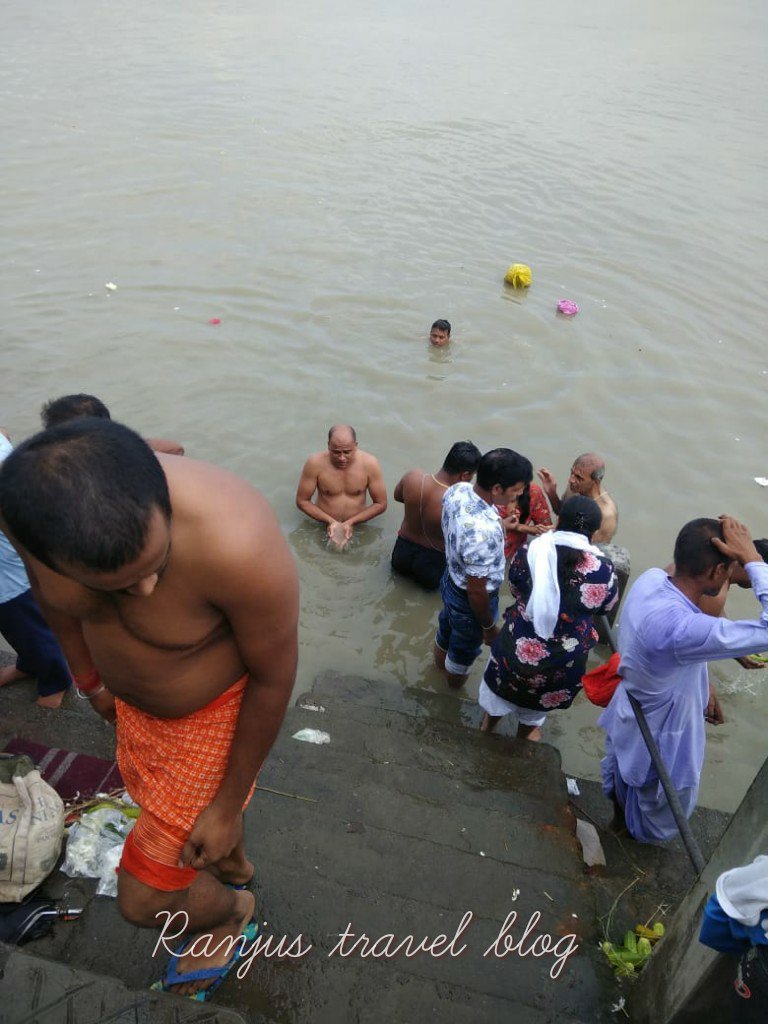
The next day early morning we took auto and went to near by Jaganath temple and took a holy dip in the Brahmaputra flowing at the backside of this temple there are steps to get down in to the river . Then we changed our dresses at adjacent cloak room and left back to the Hotel .
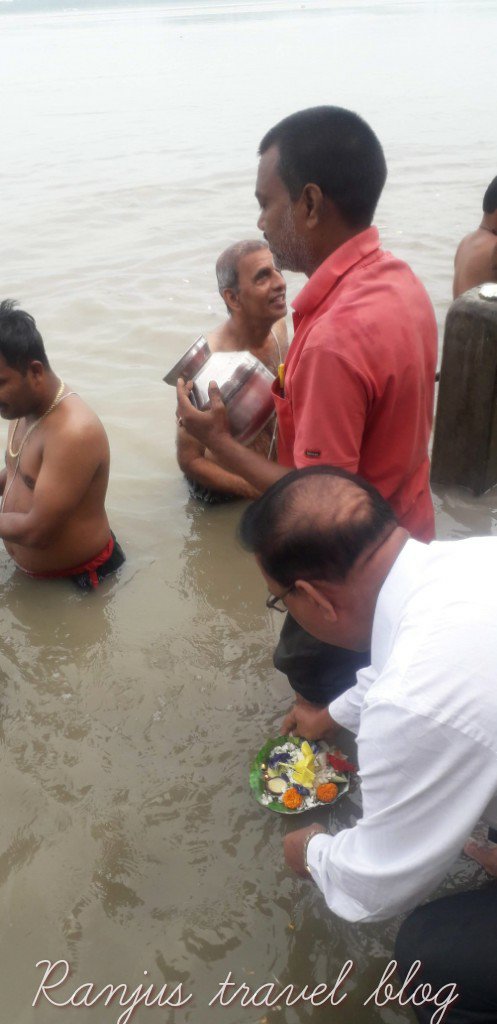
After having breakfast we again came as a group in the mini van bought flowers diyas and offered our tributes to river Brahmaputra and then went to Jagnath temple and opposite to it a few steps to climb is a Sukleshwar temple of Lord Shiva .
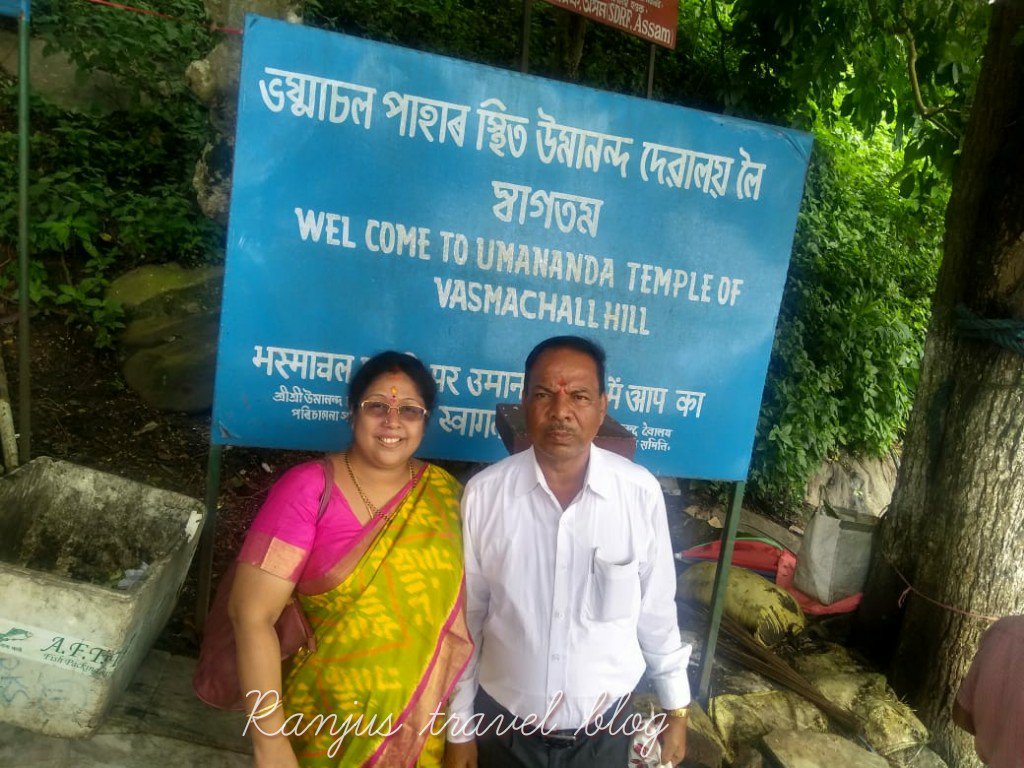
Having the divine dharshan of both Jaganath and Sukleshwar we went to Umananda temple .
As our tour group was of 32 members our organizer arranged a boat and we travelled to Umanand temple.
This temple is a must visit as it is located on an island called “Peacock Island” in the middle of the Brahmaputra river in the northern part of Guwahati. One has to go in a ferry or boat to reach this temple which is seen on a hillock called Bhasmachala or Bhasmakuta.
One has to climb more than 150 steps to reach the temple. One can book ferry ride from Uzan Ferry Ghat (Kachari Ghat) managed by Inland Water transport. The fee is 20/- per person. This official boat service is available from 7.00 a.m. to 4.00 p.m. One can go to Umananda from Shukleswar Ghat and Fancy Bazar Ghat also. The ferry ride gives you a beautiful view of the flowing Brahmaputra River with distant view of hills and greenery. The journey takes just 15 to 20 minutes to reach the foot of the Bhasmakuta hill.
While climbing steps one can see an abundant number of trees and different kinds of birds also. According to bird-watchers there are nearly twenty species of birds in this area. The golden langurs one of the rarest type of monkeys are seen on this island only.
As per legend this island was created by Lord Shiva to make His spouse, Uma happy. So this place is called Umananda. The British people named this island as peacock island as the shape of the island looks like splayed feathers of a peacock. This island is regarded as the smallest river island in the world. Lord Shiva while doing penance here was disturbed by Kama’s arrows. So Shiva became angry and burnt him to ashes with his blazing third eye. So this hill is named as Bhasmachal or Bhasmakut.
The temple of Umanada was built in Kamarupa style with a red colored dome. One has to descend a few steps to see the Lord as the sanctum is at a deeper level. Only diya were lit with that lamps the priest showed us the lingam form .The passage to the sanctum is very narrow and every time five to six devotees are allowed to climb down the steps. Inside the sanctum a tiny Shiva Ling is seen with a pedestal on the ground level. The priest there told us the Lingam is Swayambu and its Arthanari (both lord Shiva and Goddess Shakthi form) .The sculptures of Ganesha, Shiva and Devi (with a scorpion as an emblem) are carved on the rocky walls of the temple showing the architectural skills of the local sculptors . The temple is crowded during Mondays and Mahashiva ratri. During Shiva Chaturdasi a colorful festival is held here. People believe that pooja offered to Lord Shiva on Monday with Amavasya Thithi brings highest merit and bliss to the devotees. The temple timings are from 6.00 a.m. to 6.00 p.m.
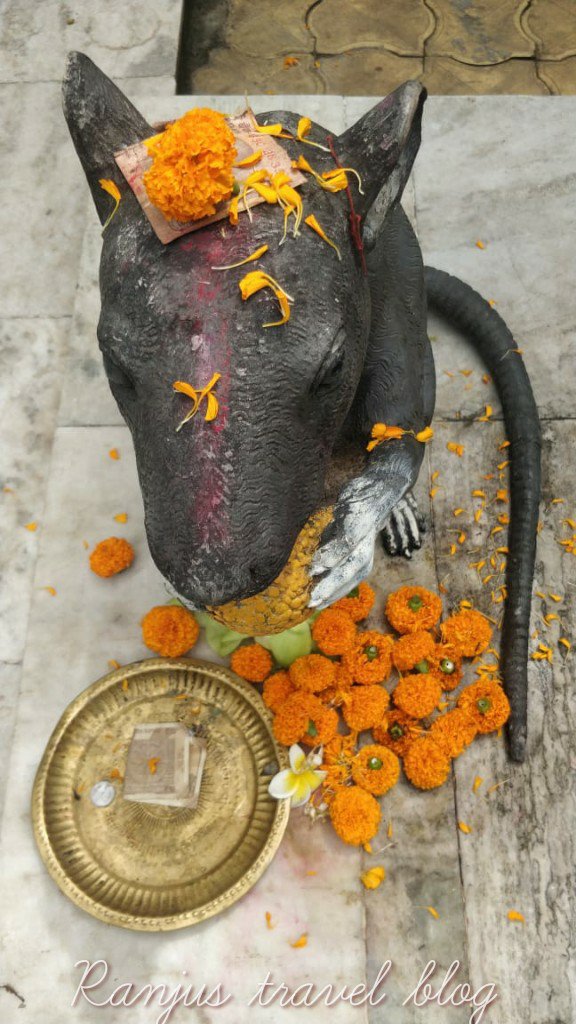
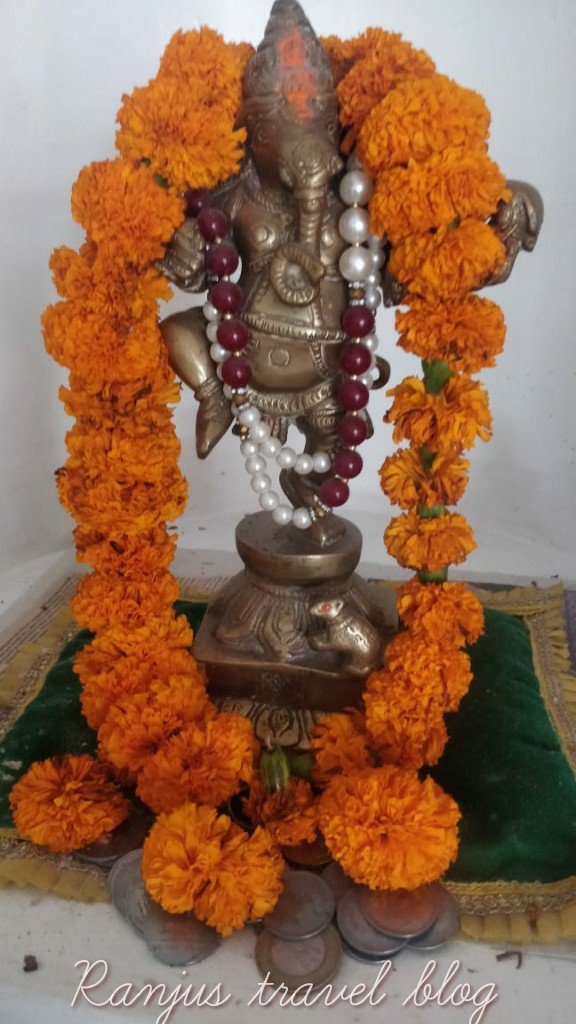
Near the entrance of the temple premises there is Ganesha’s shrine with a big sculpture of a rat in sitting position facing the idol of Ganesha in the shrine. There is a Hanuman temple beside the temple. Another Shiva shrine called Chandrasekhara shrine is seen beside the main shrine. The dasavataras of Vishnu are seen on the outer walls of newly constructed temple walls. The calm surroundings with beautiful scenes of trees and birds makes one feel very happy and relaxed.
After the dharshan we relaxed in the temple complex and again travelled back on the river Brahmaputra by boat .
After having lunch started to Guwahati airport to reach Chennai .
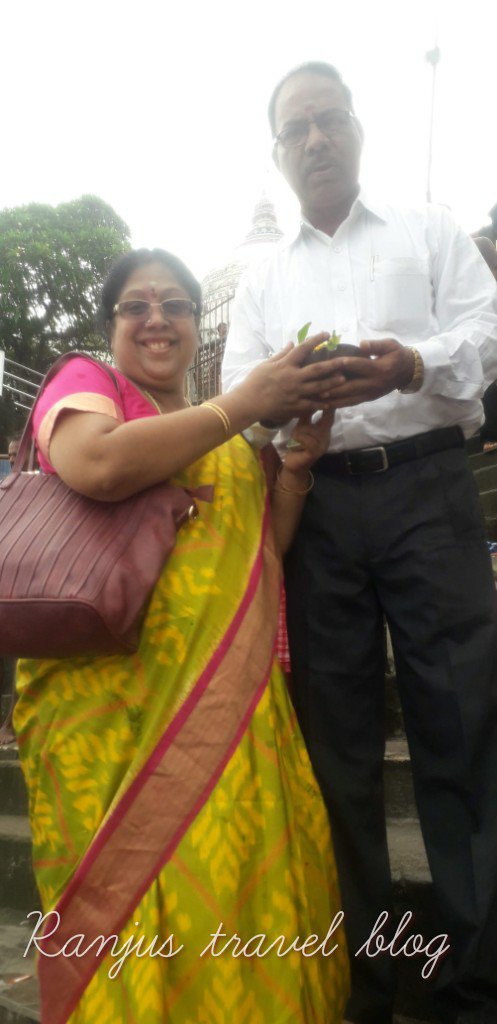
Taking Holy dipBrahmaputra Pushkar Offered our tributesEntrance of both Jaganath and Sukleshwar mandir Jaganath temple Steps to Sukleshwar mandir Sukleshwar mandir Boating in Brahmaputra to Umanand temple Climbing the steps Entrance of Umanand temple Mushigha vahanaLord Ganesha
During our Brahmaputra Pushkar trip to Guwahati after visiting Maa Kamakya Shakthi Peedam and Dasa Maha Vidya temples we travelled to Shillong .
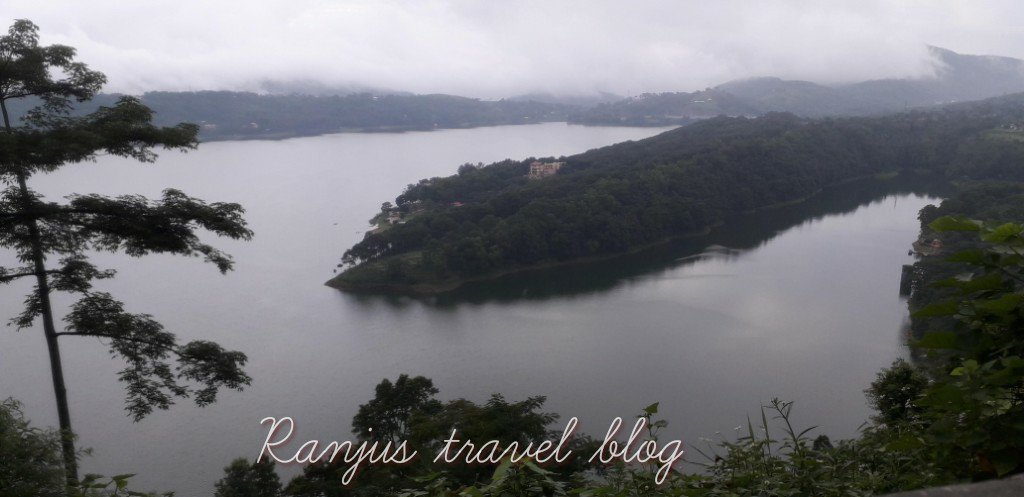
By 4 pm we reached Umiam lake . It is a lake surrounded with small mountains, calm and serene place , there is a boat ride facilities as it was drizzling we dint go for boating . Had hot masala tea and did window shopping on the roadside shops mostly was art work hand made of bamboos were sold here . This lake serves as a major tourist attraction for the state of Meghalaya.
Umiam lake
By the time we reached it was 8.30 pm we had night dinner at Madras cafe in the near by hotel before reaching Polo Towers as most of us were senior citizens and diabetic . Our tour organizers arranged idly dosai payasam chutney sambar in Shillong .
Hotel Polo Towers welcomed us with a complimentary buttermilk and along with it a muffin as that was 20th year anniversary of their Hotel .
Morning got freshen up and had complimentary breakfast and started our travel .
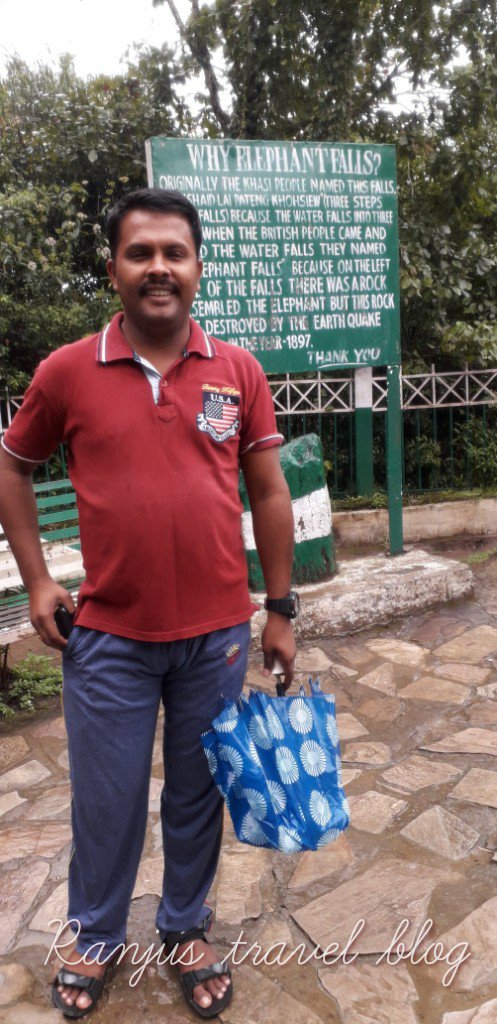
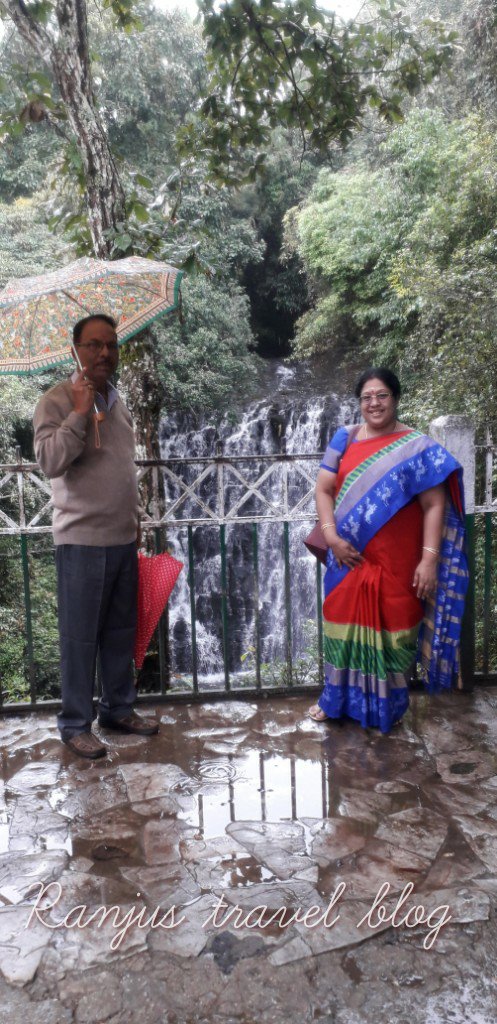
Meghalaya is a place of falls and lakes . Our first visit was to Elephant falls Located 12 km away from the capital city of Shillong, Britishers named it so as the stone looked like a elephant it’s a 3 layered waterfalls admist the dense forest there are steps to get down and see all the 3 layers , must be carefull if it’s raining . We almost spent an hour admiring the beauty of the falls .
Our tour organizer Elephant falls Elephant falls
Our next destination was Wakaba falls , the falls was invisible fully covered with mist and climate was too chill , we waited half an hour for the mist to clear could only hear the sound of the falls as it started raining we got into the mini van we were travelling .
Fully covered by mist Wakaba falls
Next falls we saw was Daienthlan falls as the rain stopped we enjoyed walking in the water flowing and took as much ever videos and photos we wanted .Then we went to Noklihai falls . Though we could see the falls couldn’t get down from mini van as it was raining heavily .
Dainthlen falls Gods gift
We reached Cheerapunzee, which is said to be the highest rainfall receiving region of India . The climate was awesome no rain . We had afternoon lunch in a hotel there and bought cinnamon sticks sold there .
Had lunch at Cheerapunzee Holiday resortCheerapunzee
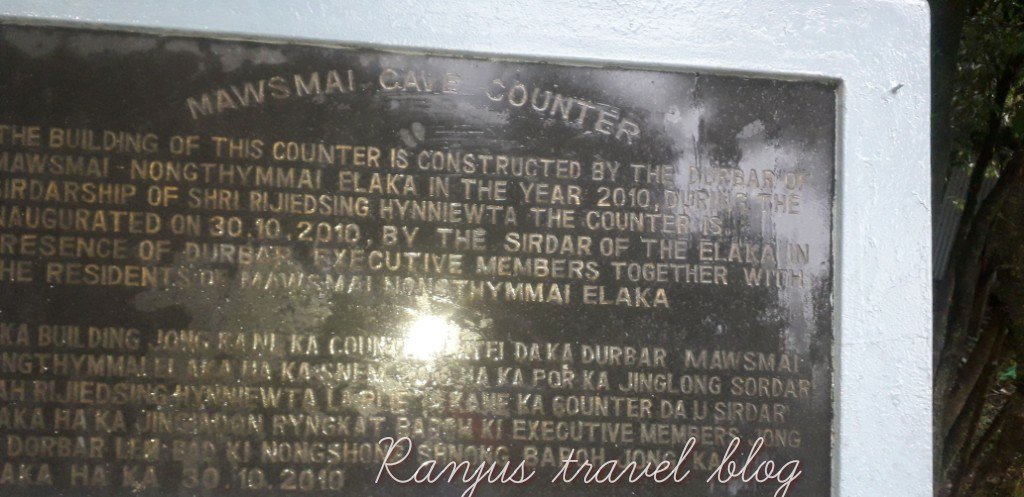
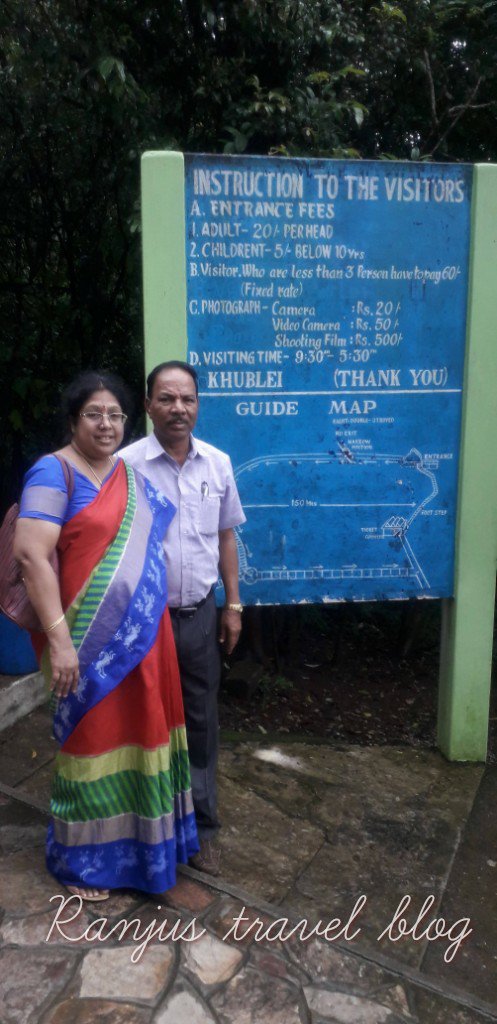
After lunch we went to Mawsmai cave they charge Rs.20 as entrance ticket we could succeed only to a certain distance as due to rains there was a feet of water and we returned back . We got exhausted and that days final destination was to Seven sisters water falls was a visual treat opposite to it another falls we took as many videos and photos and returned back having night dinner in the same Madras cafe and returned to room .
Entrance of Mawsmai caveDescription of the Mawsmai cave Entrance ticket Rs.20
Next day morning we packed up our luggage and after the breakfast the first place we saw was a Cathedral Church in Shillong . It was big with colourfull stain glass paintings and then to Shillong view point .
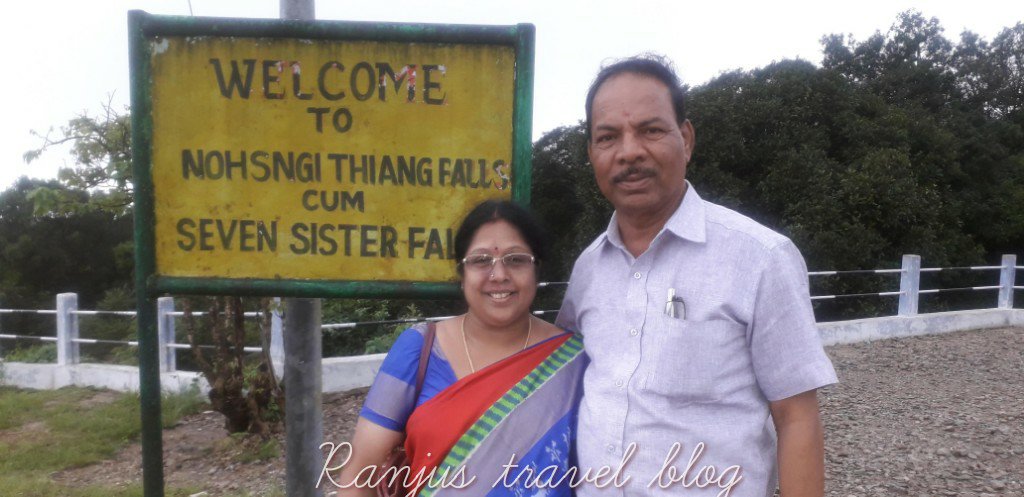
In front of the Hotel we stayedNohsngi Thiang falls and Seven Sisters fallsNohsngi falls
Next day morning we packed up our luggage and after the breakfast the first place we saw was a Cathedral Church in Shillong . It was big Church with colourfull stain glass paintings and then to Shillong view point .
Cathedral Church Shillong view point
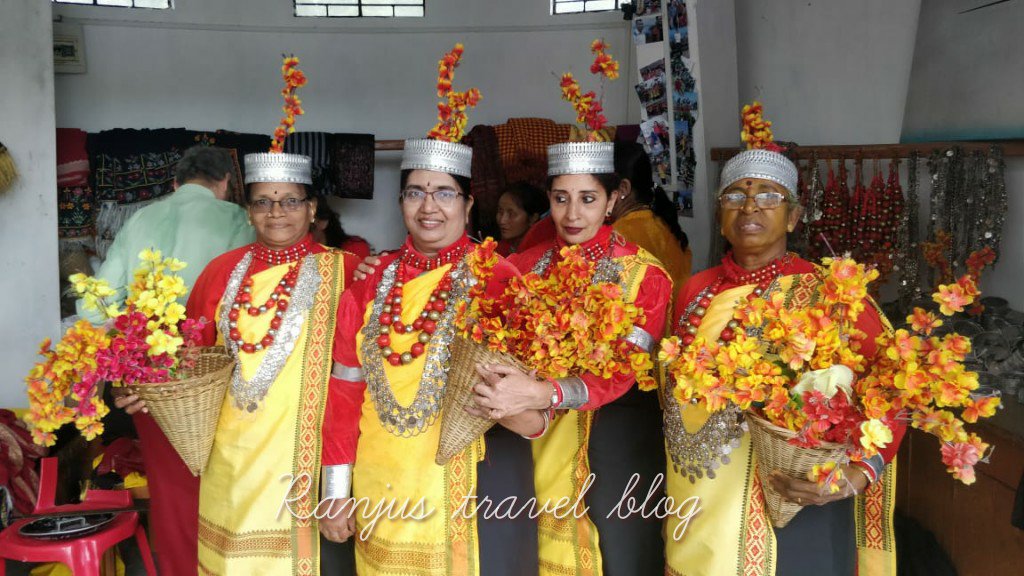
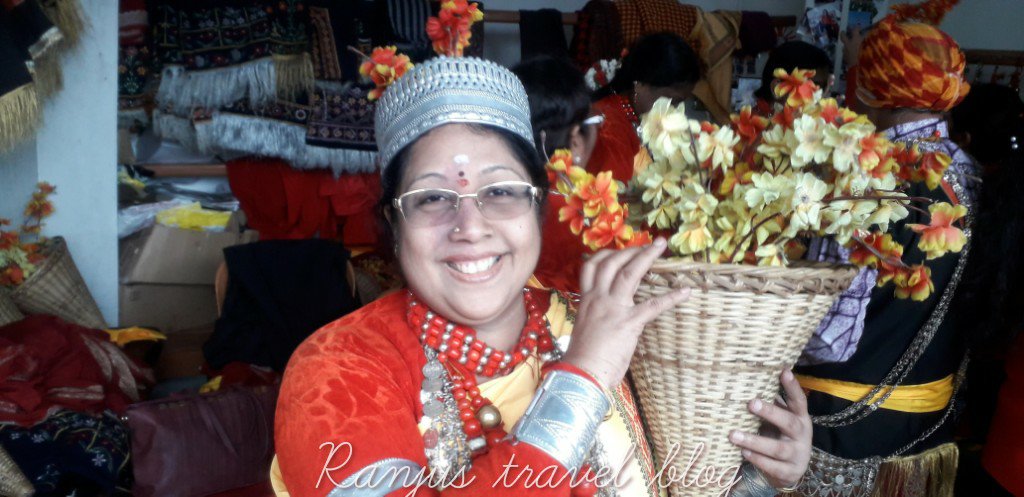
We had to climb a winding steps to see the entire view from top . The best part of the trip was wearing their tribal dress and a photo shoot of it . We all dressed up they hire it for Rs.100 per head and for photos they charge Rs.50 per photo.
Shillong tribal dress Myself
Then we travelled to Guwahati on the way had afternoon lunch by 4 pm we went Purva Thirupathi Balaji temple in Guwahati.
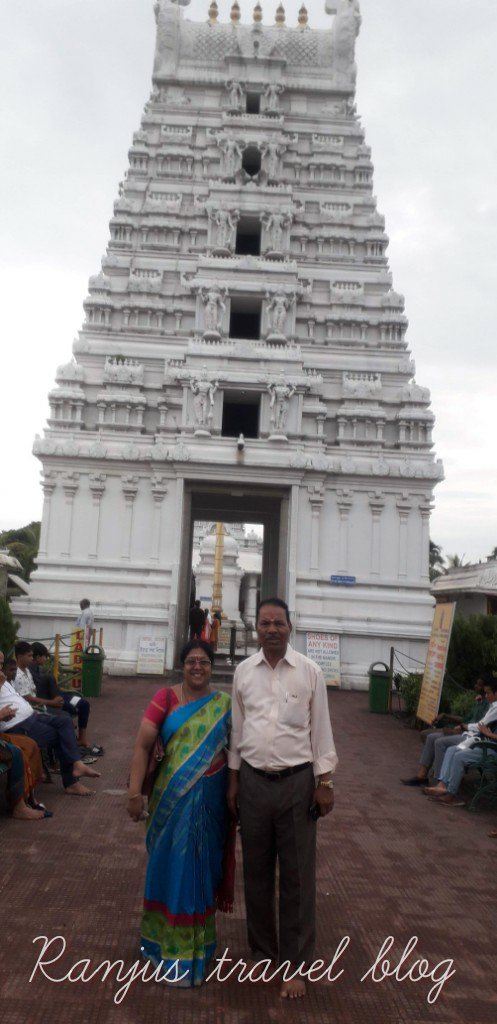
Purva Tirupati Sri Balaji Mandir is a beautiful Hindu Temple situated at Ahom Gaon area of Guwahati in Assam. It is one of the popular temples in Guwahati.
Dedicated Lord Venkateswara, Purva Tirupati Sri Balaji Mandir was built in the year 1998. Sprawling over 2 acres, the temple is considered as the replica of the original Tirupati Balaji Temple. This white colored temple is built in the similar architectural style of the South Indian temples. The temple has a Rajagopuram (70 feet in height), a Maha Mandapam, an Ardha Mandapam, and the Sanctorum.
There is a Ganesha Temple at the entrance of the complex. The main temple is the home of Lord Balaji. The deity inside the sanctum sanctorum is carved out of a single stone that weighs more than 4 tonnes. Besides, there are also the temples of Goddess Padmavati and Garuda- the vahana of Lord Balaji inside the premises. A recent addition to the temple complex is the Yagasala that has been built in traditional style to enable devotees to perform Yagnas.
Purva Thirupathi Balaji mandir
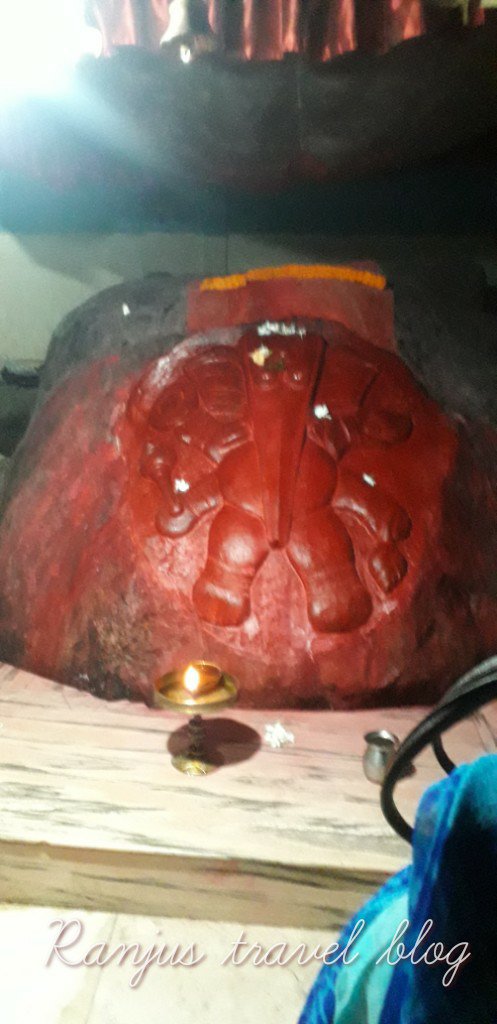
Then we went to Bhimashankar jyothirlingam at Pamoghi . It was a pradhosam day .We were happy of getting the dharshan and blessings of Lord Shiva . Though there us a Bhimashankar jyothirlingam in Maharashtra here they consider this as a jyothirlingam. From the main entrance we had to walk about a half km to reach Lord Ganesha temple .The Ganesha idol is rock cut on a huge stone we did pooja to Lord Ganesha and walked the slope a small bridge about a km admist the dense forest with streaming water we saw and did pooja to the Jyothirlingam by the time we were back to our van it has become dark . The priest told us dont waste time here as these are elephants pathway they requested us to move away soon . With the divine blessings of the Lord Shiva we reached our room in Hotel Prag Continental Guwahati .
Lord Ganesha Bhimashankar Jyothirlingam Bhimashankar Jyothirlingam Daienthlan falls Seven Sisters falls Mawsmai cave Daienthlan falls Shillong view point
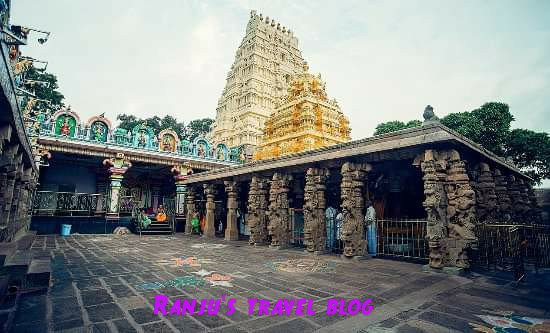
Srisailam Mallikarjuna Temple. This temple is in Andrapradesh, after visiting Ahobilam we reached by night at Srisailam and stayed at Haritham resorts .
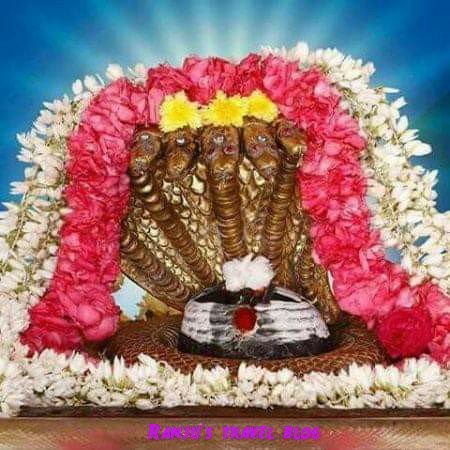
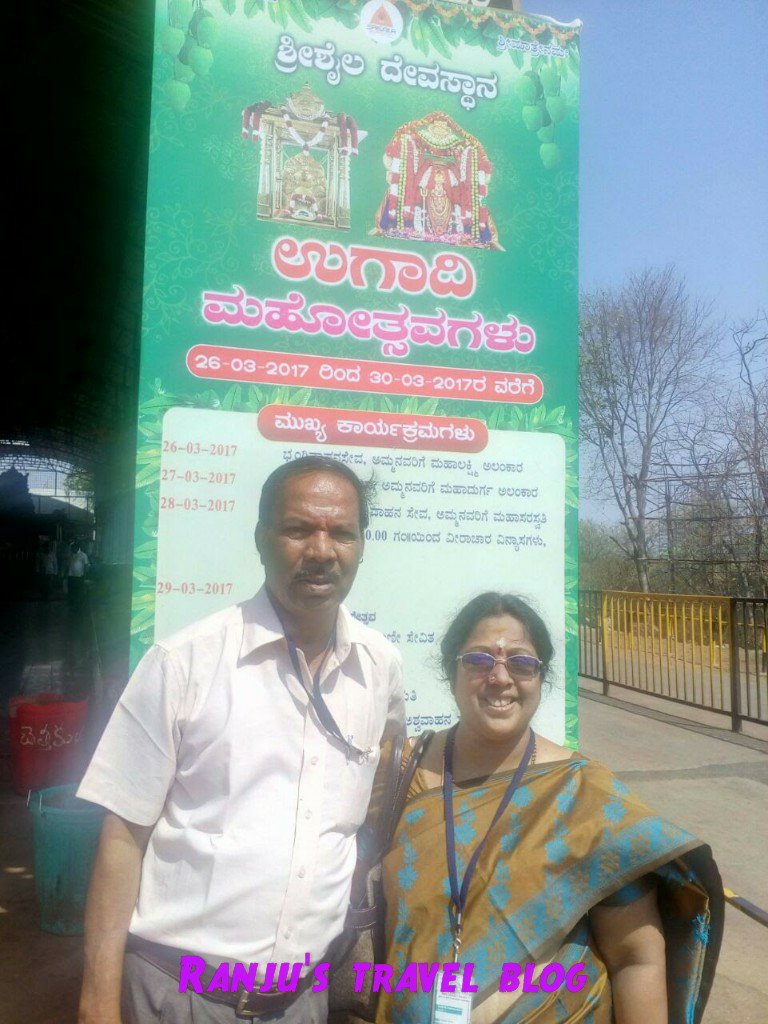
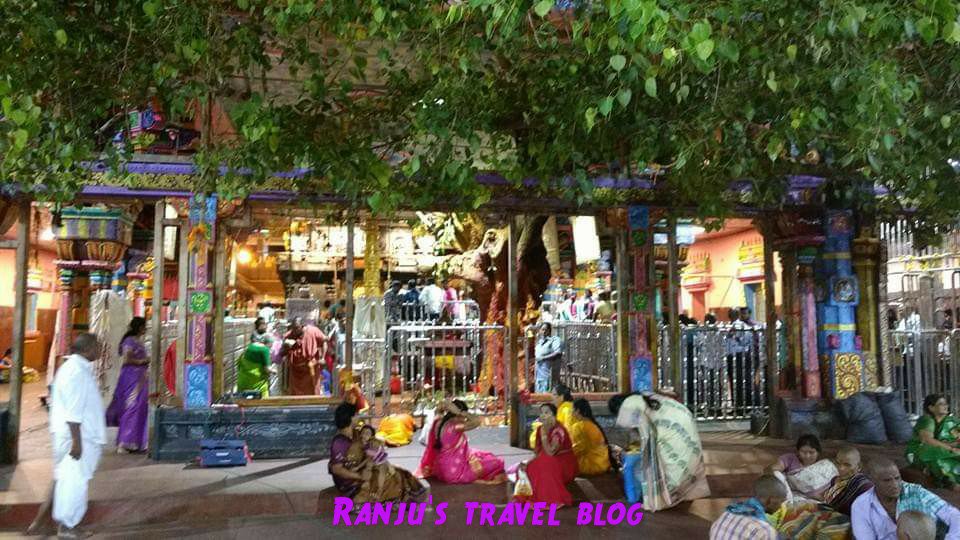
As it was on a Ugadhi day it was over crowded and we opted for special dharshan along with abhishegam. For a couple they charged Rs.1500 and we were made seated in a mantapa near the entrance . All couples were given a kalasam (a small brass pot filled with water) plate flowers coconut and we were guided by a priest from a podium .First pooja was for Lord Vinayagar then to Goddess Lakshmi then they chanted Rudram and finally Lord karthikeya and we were asked to tell each of us name kothra nakshatra and then allowed to the main sanctum sanctorum . The main diety is Sri Mallikarjuna Swamy in Lingam form . The Lingam was small hooded with serpent . We were allowed to pour the kalasam water which we carried after the pooja on the Lingam , handed over the kalasam there and by showing the receipt they gave us the prasadham such as a coconut kangan vibuthi laddu in a bag . Then to Goddess Bhramaramba shrine .
Sri Bhramaramba Mallikarjuna Temple or Srisailam Temple is a Hindu temple dedicated to the deities Shiva and Parvati, located at Srisailam in Indian state of Andhra Pradesh.
It is significant to the Hindu sects of both Shaivam and Shaktam as this temple is referred to as one of the twelve Jyothirlingas of Lord Shiva and as one of the eighteen Shakti Peethas of goddess Parvati. Shiva is worshiped as Mallikarjuna, and is represented by the lingam. His consort Parvati is depicted as Brahmaramba. It is the one of the only three temples in India in which both Jyotirlinga and Shaktipeeth is revered.
The temple, which shines like a jewel on the Nallamalai range of the Eastern Ghats, is known by different names like Srigiri, Srimala, Srinagara and Rishabagiri. Rishaba or Nandi Deva did penance on this hill and obtained the darshan of Lord Shiva and Devi Parvati. Hence the name Rishabagiri.
Long ago, Princess Chandravathi of the Chandra Gupta dynasty faced a domestic calamity and decided to forsake royal comforts. She went to the Srisailam forests and was living on fruits and cow’s milk. One day, she noticed that one of the cows around was not yielding milk. Later she learned through her herdsman that the cow was going to a secluded spot and showering milk on a Linga amid mallige (jasmine) creepers. The next day she herself went to that spot and witnessed the miracle. The same night Lord Shiva appeared in her dream and asked her to build a temple at this spot. Since the Linga was entangled in mallige creepers, the deity was named Mallikarjuna.
According to anther legend, Lord Shiva once came to the Srisailam forest for hunting. There He met a beautiful girl of the Chenchu tribe, fell in love with her and decided to stay with her in the forest. The girl was none other than Parvati Herself. In the temple, there is a bass relief depicting this story. It is significant to note that even today, people of the local Chenchu tribe are allowed into the sanctum. On the night of Maha Shivaratri, they are permitted to perform abhisheka and puja to the deity. Another interesting feature is that devotees irrespective of caste, creed or sex can go into the sanctum and perform
Brahmarambika Sakthi peedam
Alampure Jogulamba, Sri Shaile Bhramarambika Kolhapure Maha Lakshmi, Mahurye Ekaveerika Adisankaracharyas slogan on Shakthi Peedams
The idol of the Goddess has eight arms and is wearing a silk sari. Inside the garbha griha of the temple, there is an idol of Lopamudra, wife of saint Agastya. There is a sri yantra in front of garbha griha.
There is one more legend associated with Bhramaramba devi temple as it is one of the shakti peethas. According to the story of Shakti peeth, King Daksha, father of Goddess Sati, organized a yagna but did not invite Lord Shiva and Goddess Sati. In spite of this, Goddess Sati decided to attend her father’s yagna. However, grieved by the insults she and her husband Lord shiva had to face at the yagna, she jumped in the holy pyre. Angered by this, Lord Shiva killed King Daksha and destroyed the entire yagna. Later he carried the corpse of the devi and started his dance of destruction- Tandava. In order to stop tandava, Lord Vishnu intervened. He cut the corpse of devi through his divine Sudarshana Chakra; because of this different parts of the body fell on various locations. Each of the place where a part of the devi fell is considered as Shakti peetha. It is said that neck of devi fell here in Srisailam.
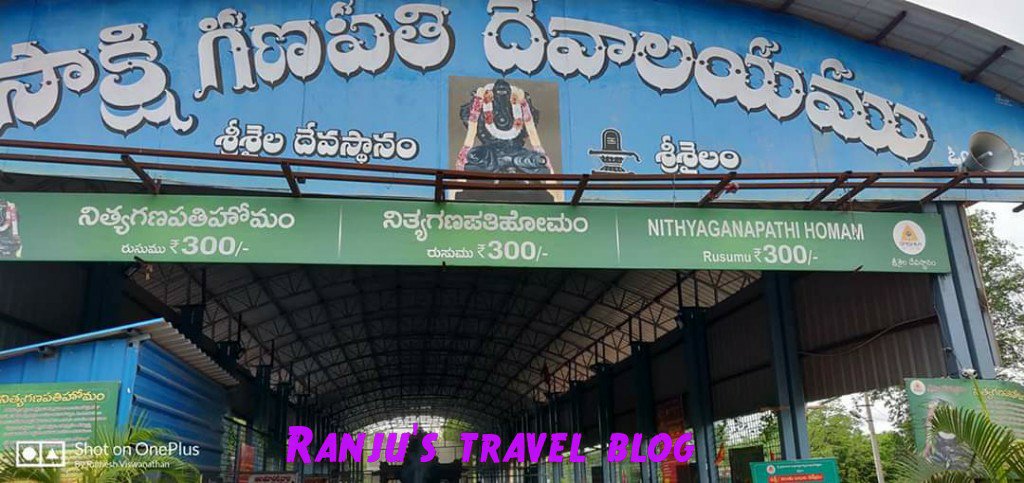
Sakshi Ganpati Temple, Srisailam Andhra Pradesh
Sakshi Ganapati Temple is located on the way to Srisailam. An important part of any Srisailam tour, this temple is visited by every devotee who comes to seek blessings of Sri Mallikarjuna Swamy. Amidst the panoramic background of nature, this temple is located just a few km away from the Shikaram.
It is believed that a visit to Srisailam goes unrecorded if a devotee doesn’t visit Sakshi Ganapati Temple. The main deity of this temple is Lord Ganesha. The word Shakshi means the one who witnesses, which is representative of the belief that Lord Ganesha keeps a record of everyone who visits Mallikarjuna Jyotirlinga, which is then shown to Lord Shiva .
Sri Mallikarjuna Swamy At the entrance The temple gopuram Inside the temple On the way to the temple Sakshi Ganapathy temple Entrance of Sakshi Ganapathy temple
Bhadrachalam or Bhadradri, the temple is considered one of the Divya Kshetrams of Godavari and is also revered as Dakshina Ayodhya. According to the legend , Lord Vishnu appeared (Mount) Meru’s son Bhadra as Rama to answer the latter’s prayers.
We travelled from Vedadri to Bhadrachalam and reached by night .We stayed in Bharathi theertha Nivas . It was near the temple by early morning we took an auto to the temple and we paid Rs.10 per person .
We went in the early morning and did Thirumanjanam for this they charge Rs.150 per couple . We were allowed inside the main sanctum sat in front of the main deity .The main deity is Lord Ramar with his consort Goddess Seetha on His thigh and besides Him is Lakshmana . The main diety here is Swayambu (self manifested).
Legends speak of a severe penance Bhadra, the son of Meru, did in this sacred place to have darshan of Lord Vishnu. The Lord appeared before him and promised to stay at this place during Rama Avataar. Hence the place is known as Bhadragiri or Bhadrachalam.
When Sri Rama left Ayodhya on a 14-year vanvaas (exile), he along with Sita and Lakshmana crossed the Ganges and reached this area, then known as Dhandakaaranya. They preferred to stay in a place called Parnashala (32 km away) for its serene atmosphere. References are found to these events in the epic Ramayana.
The Lord is believed to have informed a woman by name Dhammakka in her dream that certain idols are lying at a particular spot on the hill. The devotee promptly picked up the idols (of Sri Rama, Sita and Lakshmana) and installed them in a place which is the site of the present shrine.
In later years, Ramadas, an ardent Rama devotee who was Gopanna by birth, renovated the temple. There is an interesting incident associated with this development. Gopanna was serving the then Sultan Tanashah as his Tahasildar. Being a Rama bhakta, he utilised revenue collections, to the tune of Rs 6 lakh, to renovate the temple. The Sultan came to know of this and got Gopanna arrested. He was languishing in jail for many years, spending his time singing the glory of Sri Rama. The Lord decided to show mercy on His staunch devotee. Rama and Lakshmana one day appeared in the guise of merchants in the Sultans court and returned to the treasury all the money in gold coins. The Sultan, realising the greatness of Gopanna, released him from jail. He also offered him and the temple valuable gifts.
Even today, tourists and pilgrims visiting the famous Golconda Fort can see the cell where Gopanna was kept under arrest.
The temple is also associated with Saint Kabirdas. Kabir was the foster son of a Muslim family and a staunch devotee of Sri Rama. Once he came to the shrine to worship the Lord. But the priest prevented him from entering the shrine. To the shock of the priest, the images in the sanctum disappeared. Ramadas happened to be in the temple at that time. He intervened and convinced the priest to let Kabir into the shrine. As Kabir came into the temple, the images miraculously reappeared in the sanctum and Kabir had darshan of Lord Rama. This devotee later came to be known as Kabirdas.
Adi Shankaracharya had visited Bhadrachalam and named the mula-vigraha as Sri Vaikuntha Rama.
Sri Vaikuntha Rama is in padmasana and is having four hands. The shankha and chakra in the upper two hands are interchanged. Shankha in the right hand signifies the importance of blessing the devotees more.
In mula-vigraha, Srimati Sitadevi is sitting on the left side of the Lord and Lakshmana is also standing on the same side. However in the utsava-vigrahas, Sitadevi and Lakshmana are on the either side.
Dhammakka to whom Lord Rama appeared in the dream to reveal the location of the Deities, was the descendent of Sabari.
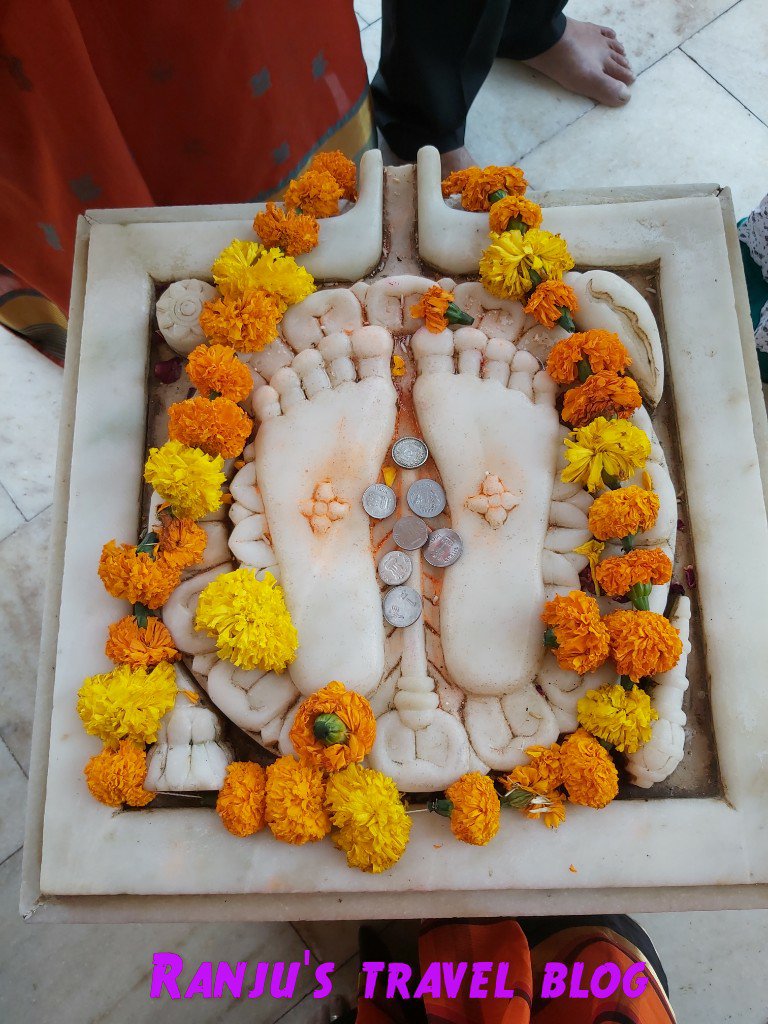
Panchamrita abhisheka is performed every Sunday in the morning. It is only during the abhisheka that one can have darshana of Lord’s lotus feet.
The total cost of the temple and the jewelry of the Deities was 6,00,000 INR which was paid by Lord Rama Himself in the form of gold coins. Those coins belonged to Treta-yuga, the era of Lord Rama. Till date two coins are preserved in the temple museum.
The pancha-patra which is used in the worship of Deities is made of 1.5 kg of gold.
The shikhara crowing the temple is carved from a single block of granite weighing 36 tonnes.
Mobiles are not allowed inside the temple. There are photographers to take instant photos.
This temple is admist of the busy Vijaywada town on the banks of river Krishna .
The temple of Kanaka Durga the Goddess of power, riches and benevolence and the presiding deity of Vijayawada, is swarmed by lakhs of pilgrims for worship during the “Navarathri” festival which is celebrated with Religious fervour, pomp and festivity. The small but ancient temple of Kanaka Durga , a top the Indrakeeladri hill on the banks of the Sacred river Krishna in Vijayawada abounds with legends of historical interest.
Indrakeeladri is unique in that it has been the chosen abode of Kanaka Durga and Her consort Malleswara as Swayambhu (the self-existent one). Here Durga is one the right side of Malleswara as against the tradition of Goddesses taking their position on the left of their consorts. This shows that Shakthi is predominant on the Indrakeeladri.
Legend has it that the demons acquired great powers by appeasing the Gods and began harassing the sages on the earth. Goddess Parvathi assumed various forms to kill these demons. It was kausiki to kill Sumbhu and Nisambhu, Mahisasura Mardini to kill Mahishasura and Durga to kill Durgamasura. “Kanaka Durga because she was a glow with golden hues, and prayed Her to stay on earth and bless them.
Kanaka Durga asked Keeludu an ardent devotee to take the form of hill to enable Her stay on him. Thus Keeladri became the abode of Durga. She took the form of Mahisasura Mardini with eight arms holding different weapons, riding on a lion and trampling Mahishasura on the hill of Indrakeeladri. Her consort Shiva took his place on an adjacent hillrock as Jyothirlinga. He was worshipped by Lord Brahma with jasmines (Mallelu) whereby he got the name of Malleswara Swamy. As celestial beings like Indra visited the place, the hill came to be called Indrakeeladri.
Here it was according to another legend, that Arjuna performed penance and fought with Lord Shiva, who had appeared in the guise of Kiratha to win pasupathastra, the most powerful weapon. So this place is also called phalguna theertha.
When Indrakeeladri came in the way of the River Krishna the Gods requested the hill to allow the river to pass through it to join the sea. Keeludu obliged and gave a small passage for the river. But the ferocious Krishna made the passage larger than permitted and carried a part of the hill four miles downstream to Yanamalakuduru, where there is now a hillrock called “Thelukonda” or floating hillrock.
According to another legend, Kanaka Durga borrowed the nose-stud of the Krishna and to avoid returning it jumped up the hill. Krishna vowed to take back her ornament by raising her level to the hill top by the end of kaliyuga
Adi-Sankaracharya visited the temple and installed the Srichakra and initiated workship of Kanaka Durga in vedic ways.
Lift facilities are available and they charge Rs 25 for it . As it was crowded we went in special dharshan Rs. 100 person . Rope car work too was undergoing when we went . Mobiles are not allowed inside the temple. There are cloak room at the foothills mobile lockers and chappel stands .
The temple gopuram The main deity Outside the temple Urstavam
This is a Hill temple and a cluster of 3 temples . Sri Vyagara Narasimha Swamy temple at the foot of the hill .
Sri Shobanachala Lakshmi Narasimha Swamy temple at the Hill and Sri Achanteswara Swamy (Lord Shiva) temple at even more top of it .
Sri Vyagara Lakshmi Narasimhar Swamy is in Agripalli. It is 25kms from Vijayawada. This temple is dedicated to Lakshmi Narasimha Swamy. Here Lakshmi Narasimha Swamy is also known Sri Vyagra Narasimha Swamy. Vyagra means tiger in telugu here instead of lion the Lord Narasimhar has a tiger’s face . This is the foot hill temple with 25 steps .
Sri Shobanachala Narasimha Swamy This temple is on a hillock one has to climb about 750 steps to have the dharshan of the Lord .The main deity is Sri Shobanachala Lakshmi Narasimhar with his consort Goddess Rajalakshmi is an swayambu . Here the Lord is with a smiling face . Opposite to the main sanctum is Dwajasthambam in front of it Lord Hanuman temple and a mantap adjacent to the main sanctum. Only 10 people can enter inside the temple at a time .
As per legend Sri Mahavishnu and Sri Mahadeva were visiting the earth. It was evening time, when they were near this place. They were looking for a place to stay over for the night. They saw this place among the mountains and thick green forest. They were impressed with the scenic beauty and the tranquility of the place. They decided to spend the night in the scenic and peaceful environment. Sri Mahavishnu wanted to perform evening sandhya vandanam and requested Sri Mahadeva to find a suitable place for their stay. Sri Mahadeva, after searching for a while, found a nice place on the top of the mountain and settled down there, forgetting to inform Sri Maha Vishnu. Sri Maha Vishnu waited for some time for Sri Maha Deva to return, but finding that Sri Maha Deva did not come back, he went in search of him. When he found that Sri Maha Deva settled down comfortably on the top of the mountain, Sri Maha Vishnu felt some what angry and thumped the head of Sri Maha Deva with his fist and cursed that no body will visit him without having the Darshan of self (Sri Maha Visnu). Saying this, Sri Maha Vishnu came down in two steps and settled down at the foot of the Mountain. Even now, one can notice the impression of the fingers on the top of the sacred Siva Lingam and the two large stone slabs (representing the imprint of the foot steps of the Lord). Lord Sri Maha Vishnu is known in this place as Sri Shobhanachala Swamy (Sri Lakshmi Narasimha Swamy) with Mother Sri Rajya Lakshmi. Lord Sri Maha Vishnu is considered here as Shobana or happy or shanta Murty (after pacification by Bhakta Prahlada).
One has to climb 100 more steps to have the dharshan of Lord Shiva named Achanteswara Swamy .
Sri Rameswaraswamy temple is positioned in Achanta, West Godavari district of Andhra Pradesh. Achanta also referred to as as Marthandapuram inside the past. The Shivalinga present in this temple is said to be Swayambhu (self-fashioned). Here Lord Shiva is referred to as as Achanteswara Swamy. This temple is having beautiful structure. There are sub-temples of Lord Vighneswara Goddess Saraswathi and Saptamatrukalu inside the predominant temple . From the inscriptions on the wall’s of this temple, it’s far recognised that this temple changed into built at some point of the duration of Eastern Chalukyas . The Raja Gopura of this temple is maximum one in this area, which ripples the construction fashion of Chalukyas . There is 6 Shiva linga’s in the temple, which are Lakshmaneswara lingam, Someswara lingam, Markandeya lingam, Bhimalingam, Skandalingam, and Indralingam.
The Pancha Narasimhar sthethram are Mangalagiri Vedadri Matapalli Vadapalli and Kethavaram in Vijaywada. Since the roads were blocked due to some reasons our tour organizer took us to this temple .
Hope will get a chance to have the dharshan of Lord Narasimhar in Kethavaram.
Entrance of Vyagara Narasimha Swamy temple Entrance of Sri Shobanachala Lakshmi Narasimha Swamy temple Before the main sanctum and that grilled gate is the mantapSteps of the hill temple took this pic just before climbing On the way to Hill temple one could see Sri Vyagara Lakshmi Narasimha Swamy temple beneath
This is one of the Pancha Narasimhar kshetram in Andrapradesh. (Vedadri, Vadapalli, Mattapalli, Mangalagiri, Ketavaram)
The Vadapally Lakshmi Narasimhar temple is situated in Nalgonda district near the town of Miryalaguda, at the confluence of the River Krishna and Musi River. These two rivers very unusually come together in the shape of an “L”.
There are Puranic references to the history of Lord Narasimha’s appearance at Vadapalli. According to the Puranas, Vyasa Bhagavan, knowing the piousness of the place, meditated for a long time on the manifestation of Sri Narasimha Swamy. The Lord benedicted him by manifesting in His ferocious Ugra form.
Vyasa Bhagavan experienced Lord Narasimha at the moment when His breath was filled with tremendous anger, so he concluded that the Lord had come to him just after killing Hiranyakasipu. Therefore, he prayed to Sri Narasimha Swamy to manifest at Vadapalli in that Form only. Accordingly, Lord Narasimha swamy manifested there to bless the devotees and to alleviate their suffering.
Even now, it is said that the Deity breathes in out. The temple priests have arranged two lamps here. One lights near the face of the Lord and the other near the navel of the Lord the lamp near the face quiver frequently , as evidence of the fact that the Lord is continually breathing in and out. The second lamp, kept below, burns resolutely.
Sri Narasimha Swamy is believed to bless the devotees with health and prosperity who pray to him soulfully. The sacred river Krishna has a very prominent place in the history of our country.
At the entrance and opposite to main sanctum is a seperate shrine for Lord Anjineyar and one at side when we come pradakshanam on the right side of the temple.
From outside the temple Near the main entrance Lord Anjineyar opposite to the main entrance Lord Anjineyar right side of the temple The main diety (source Facebook page)
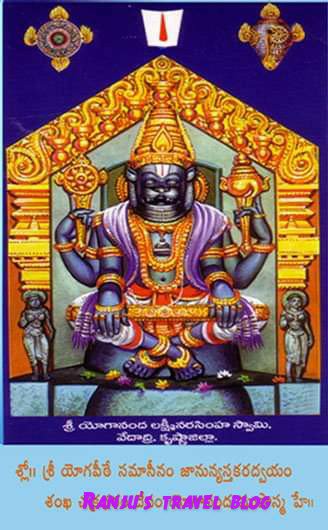
It is located in Mattapalli or Mattapalli village in the Nalgonda district and is 25 km from the Huzurnagar Taluk on the banks of River Krishna . It is regarded as one of the Pancha Narasimha Kshetras. The temple houses the triple deities of Sri Yogananda Lakshmi Narasimha Swami, Sri Rajyalakshmi Thaayar and Sri Chenchu Lakshmi Thaayar.
Several Telangana temples dedicated to Lord Narasimha Swamy are housed within caves. Similarly the Yoga Narasimha Swamy Temple is also located within a cave. The west facing Sanctum Sanctorum is accessed by a narrow passageway.
We stayed in mukoor Lakshmi Narasimhacharyas ashram as well as koshala it was a circular halled temple with the main deity as Lakshmi Narasimhar and Chakrathalwar and beautiful carvings on either side of the pragharam . Surrounded by rooms all 4 sides .
There is a rock above the door to the sanctum sanctorum. On it is the sculptured motif of Gaja Lakshmi with two elephants raising their trunks upwards on either side. The sanctum is a cave. The roof of the Garbhagriha is a big rock.
Inside the Garbagriha there are brass idols of Sankh Chakra and many Alwars . We went early by 6am as we did thirumanjanam , Rs 250 per couple .
The main hall housing the deity known as the mukha mantapam is huge measuring 24 feet x 45 feet. The hall comprises 21 pillars holding up a cement roof. A similar hall, though smaller is also present above the north door comprising 5 pillars.
The temple houses some of the finest specimens of rock sculpture. One such beautiful piece of art is found crowning the main door of the sanctum sanctorum displaying the motif of Gaja Lakshmi. It shows two elephants with their trunks raised up facing each other. Another one is found above the Garba Griha shows Lord Narasimha seated in the yogic posture of Padmasana. He is shown holding the Chakra in his upper right hand and Sankha in his upper left hand. His lower left hand is shown resting on his left knee. His lower right hand however is not visible. Yet another rock structure resembles the Divine serpent of Sesha. It appears as if the Serpent is spreading its hood over the Lord’s rock sculpture. This sculpture is about 1 foot in height.
Lord Sri Lakshmi Narasimha Swamy The stone image of Lakshmi, the consort of Vishnu, is placed to the left of the rock sculpture. The Goddess is shown in a sitting posture on a lotus with Makuta the crown on her head and her upper hands holding lotus. Her lower hands are shown in the Abhaya and the Suchi posture. Beneath this is another image of Rajya Lakshmi that is installed in order to enable devotees offer their prayers to the goddess as the original idol of Goddess Lakhshmi is not made available to them.
A peculiarity of the Yoga Narsimha Swamy temple which distinguishes it from the other Telangana temples is the absence of a pradakshina path around the Sanctum sanctorum. Therefore in order to complete this ritual devotees circle the sacred pillars or the Dhwajasthambha. Alternatively, they can also circle around the stone image of Hanuman which faces the main deity.
It is believed those who do 36 pradhakshanam of this Dwajasthambam along with Lord Hanuman shrine in this temple the Lord fulfills their desires .
The Yoga Narasimha Swamy is located on the banks of the River Krishna. The temple premises provide steps which lead devotees to the River Krishna. The temple also houses the Ramanuja Kutam or the kitchen where the Naivedya is prepared.
The Narasaimha Swamy Temple is another beautiful structure of the Telangana temple architecture. It bears rock sculptures of gods and goddesses which are revered and worshipped by many ardent devotees. The temple premises receive huge crowds in the months of January and May during the time of Vykunta Ekadasi and Kalyana Mahotsva. Both these festivals are celebrated in a grandeur manner .
On the banks of river Krishna View from topWe reached by evening and did 36 pradakshanam circumbulating lord Hanuman along with the dwajasthambam The main entrance of Matapalli temple early morning dharshan (thirumanjanam)Side entrance of Matapalli temple Mukoor Lakshmi Narasimhacharyas ashram Beautiful carvings inside mukoor Lakshmi Narasimhacharyas ashram Beautiful carvings inside the temple of mukoor Lakshmi Narasimhacharyas ashram
This Temple is located on the banks of River Krishna at VEDADRI village in Krishna district of AP and at a distance of 80 km from Vijayawada and 10 Kms from Chillakallu on Vijayawada-Hyderabad National Highway. The nearest town is Jaggaiahpet at 12km.
This is one among the Pancha Narasimhar sthethram near Vijaywada.
The Lord Narasimhar exists here in five forms as Jwala , Yoganandha, Veera , Saligrama and Lakshmi Narasimhar.
Lord Vishnu in His ‘Masthyavatar’ (fish) rescued Vedas from the demon Somakasura. The Vedapurush requested Him to reside on their heads. River Krishnaveni also wished to perform daily abhishekam to Him. Lord told them that their wishes will be fulfilled during ‘Narasimha avatar’ and asked Veda Purushas to remain in Krishna waters as Saligram till then and further assured them that He will stay with them as Panchamurthy.
On Killing Hiranyakasipu , Lord Vishnu self-manifested on Vedadri hill as JWALA NARASIMHA.
Later Lord Brahma installed SALIGRAMA NARASIMHA MURTHY on the SALIGRAMA mountain.
Later Sage Rishyasringa and others, in search of a suitable place for performing penance, heard Veda recitals in perfect swarms from the hill here, named it as ‘Vedadri’ and performed their penance here and having found in a cave a swayambhu YOGANANDA NARASIMHA , installed it here.
Again at Garuda’s request Lord self-manifested as VEERA NARASIMHA on the top of Garudadri hills, 5km east of Vedadri .
As per the prayers of Vanadevatha, the Lord is pervading the mountains as LAKSHMI NARASIMHA MURTHY.
Must be carefull as there are lot of monkeys if u are taking eatables fruits and flowers.
Near the car parking area is the access to Krishna river , we spent almost an hour as we went by evening . Mountains on one side and foot hill Vedadri temple and Krishna river at the back of the temple lovely ambience.
In front of vedadri temple Outside side view of the temple Yoga Narasimhar Lakshmi Narasimhar
Mangalagiri is a town in Guntur district situated between the twin cities of Vijayawada and Guntur of the Indian state of Andhra Pradesh.
Mangalagiri is a temple of Lord Vishnu in Narasimhar form. Mangalagiri (mangala means auspicious , giri means hill ) , as Lord Narasimha near Vijayawada .
As legend says after killing Demon King Hiranya Kasipu , Lord Narasimha killed Demon Namuchi ( he was blessed by Lord Brahma with boon that he should not be killed by either humans or animals or any other forms ) and settled on this hill . Lord here declared that he would be satisfied with ghee in Trete yuga , with milk in Dwapara yuga , with jaggery water (panakam in telugu) in Kali yuga . Hence Lord is Called Panakala Lakshmi Narasimha Swamy .
The speciality of the temple is , only mouth is visible as no idol existed (God is self existent here). God is offered jaggery water (prasadam ) only and when this is poured into mouth the gargling sound is audible and half the vessel (small or big ) is finished , sound is stopped , remaining water is thrown out . Being the less or large amount of jaggery water the phenomena is the same . This peculiar phenomina occurs recurringly during the course of the day .This is the amazing significance of this temple .
Behind the temple there is the temple of Goddess Rajalakshmi, to the west of which there is a natural cave. It is believed that it will lead to Undavalli caves on the banks of the Krishna river and the sages used to go to take bath in Krishna River.
There is a seperate shrine for Lord Anjineyar and Lord Ragnathar in this temple which we have to climb a few steps .
A small (kalasam) pot full of panagam is sold inside the temple complex itself for Rs.70 after offering to the Lord the rest is given as prasadham to us we can carry it in a bottle and use within a day . Near the split panagam near the Lord’s idol not a single ant or flies could be seen where as the remaining we fetched in the bottle were full of red ants , so we used it and threw the bottle .
At the foot hill there is a Lakshmi Narasimhar temple with a magnificent tomb . It is one of the highest gopurams in South India and only one of its type in this part of India. It is 153ft. in height and 49 feet wide with 11 storeys, and gates facing east and west . This temple is said to be built by Yudhistra the eldest among the Pandavas .
The Image of the Lord in the form of Narasimha (man-lion) and that of Lakshmi Devi to his left are of stone. The garland of the Lord with 108 saligramams is of special significance here.
At the entrance Inside the temple Lord Hanuman Lord Ranganathar In front of Goddess Rajalakshmi shrineOn top exit In front of Lakshmi Narasimhar temple The chariot behind Side view of tomb Magnificent gopuram of Lakshmi Narasimhar temple The full image of the magnificent gopuram
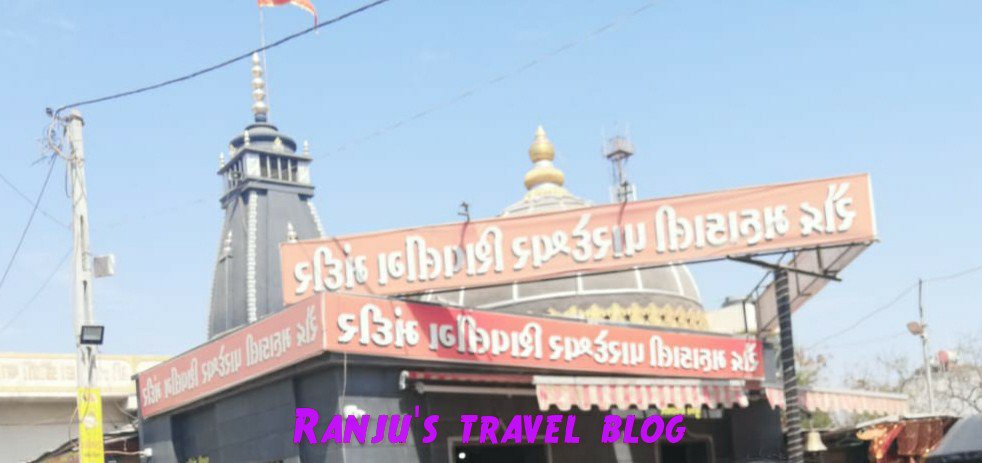
On the final day of our nava Dwaraka trip being a Friday we had an opportunity to visit chamunda devi temple and kali temple in Chotila in Surendranagar district in Gujarat .
We were on the way to Ahmedabad airport . The time was about 10.00 am . All were happy being a Friday visiting one more temple in addition.
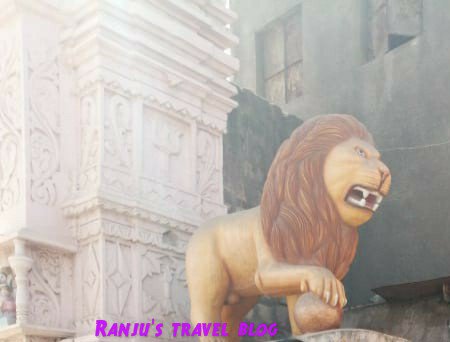
The temples of Goddess are mostly located at the top of the hills and Chamunda Devi temple is not different. Chamunda Devi is the Kuldevi of many Hindu families in Gujarat. The temple is situated at the top of the Chotila hill in Surendranagar district of Gujarat. The reason is that if the devotees want to visit the temple of Goddess, they will have to undergo some physical strain. It is the worship place for Mata Chamunda, which is one of the 64 Avatars of Shakti. Initially, there were around 366 footsteps. After renovation, the temple can be reached by climbing around 700 footsteps. A huge statue of a Lion is seen in the temple premises as it is Devi’s mount.
Though we dint climb there is a temple of Goddess Chamunda devi and Kali on the foot hill .
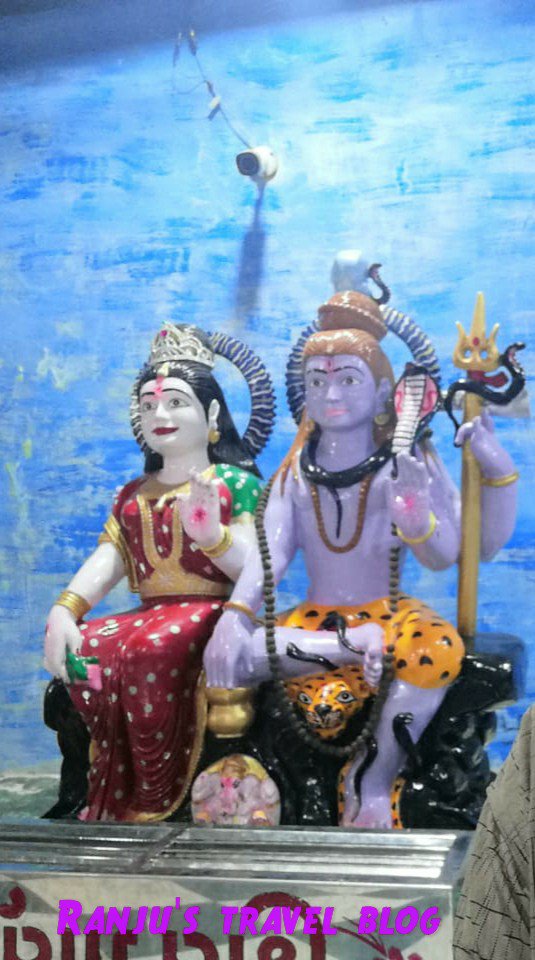
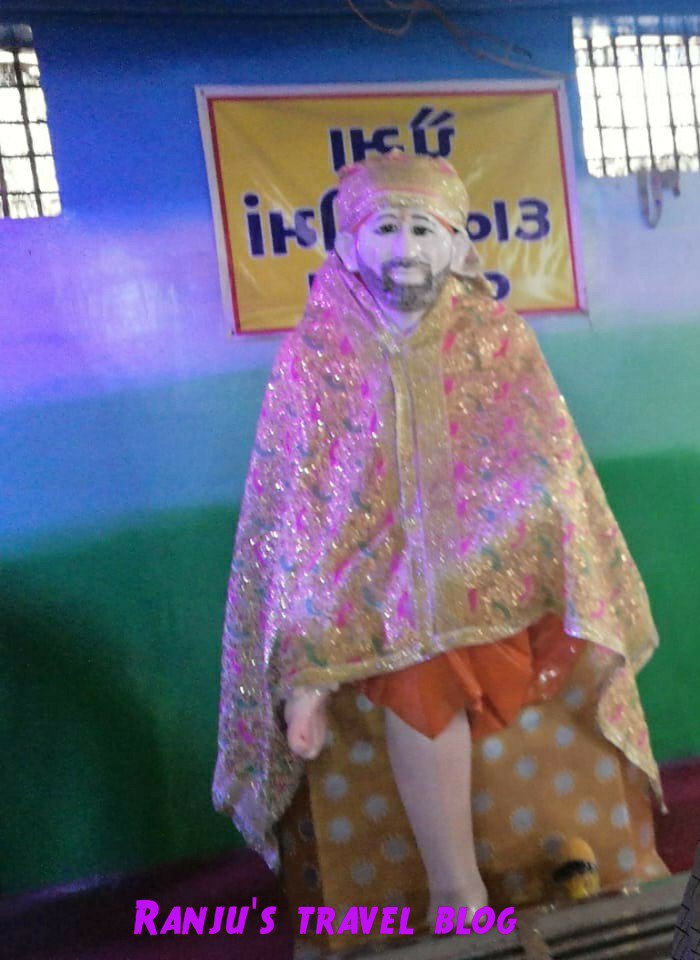
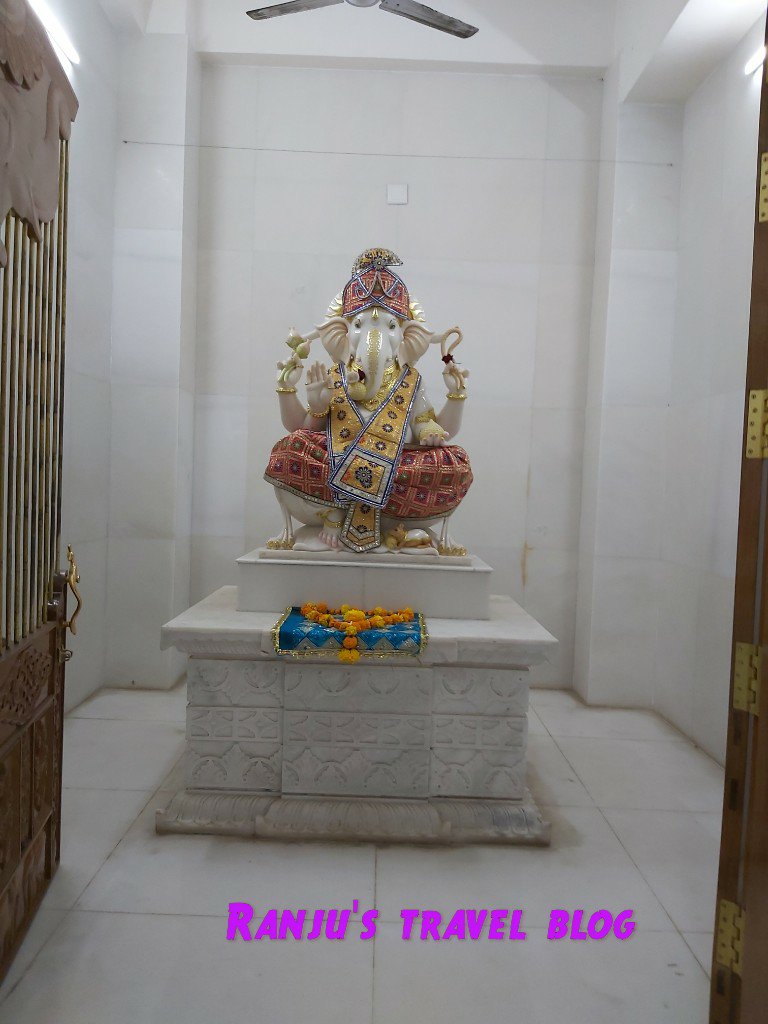
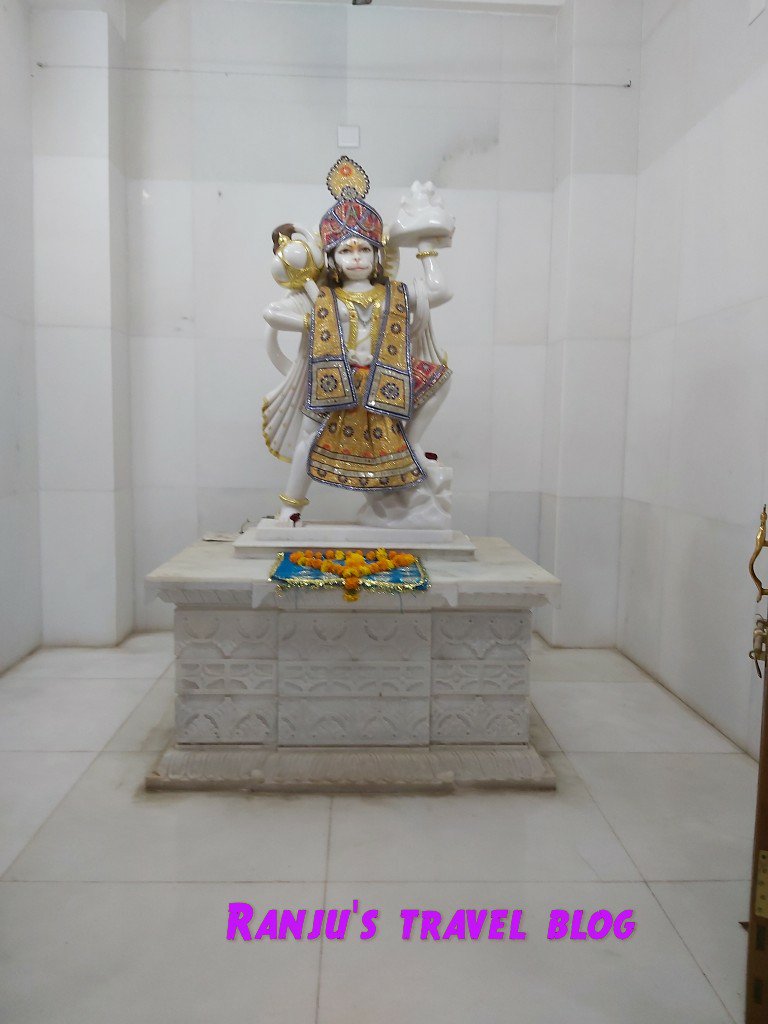
Inside the temple there was idols of many Gods, Lord Ganesha, Hanuman , Lakshmi Saraswathy Sani mahadev and many more even Saibaba.
The idol of Goddess Chamunda at this temple is self-manifested. There is an interesting story behind the existence of this temple. As per the folklore, a man had a dream in which he was told by Goddess that she was buried under the earth on Chotila hill. He was instructed to dig in a certain place and Goddess would appear there. He followed the instructions and found a beautiful idol of Goddess Chamunda. Later, a temple was consecrated at that spot.
Temple Legend
It is said that when the demons Chand and Mund came to attack Goddess Mahakali, she chopped their heads and presented it to Goddess Ambika, who in turn told Mahakali that she will be worshiped as Goddess Chamunda. There is a big market for tourists on the downside around the mountain where tourists can buy offerings and Prasad for Goddess. Chamunda Mataji Temple has a dinning hall, guest room, and beautiful garden. Free parking facility is being provided by temple trust.
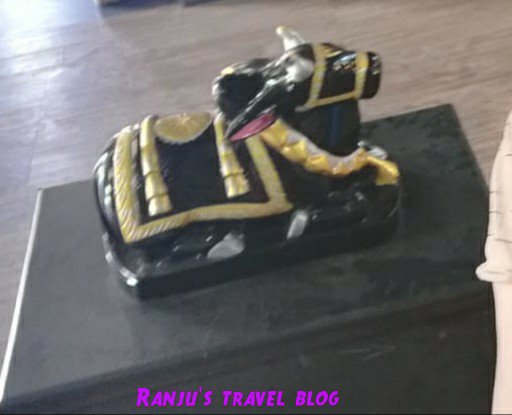
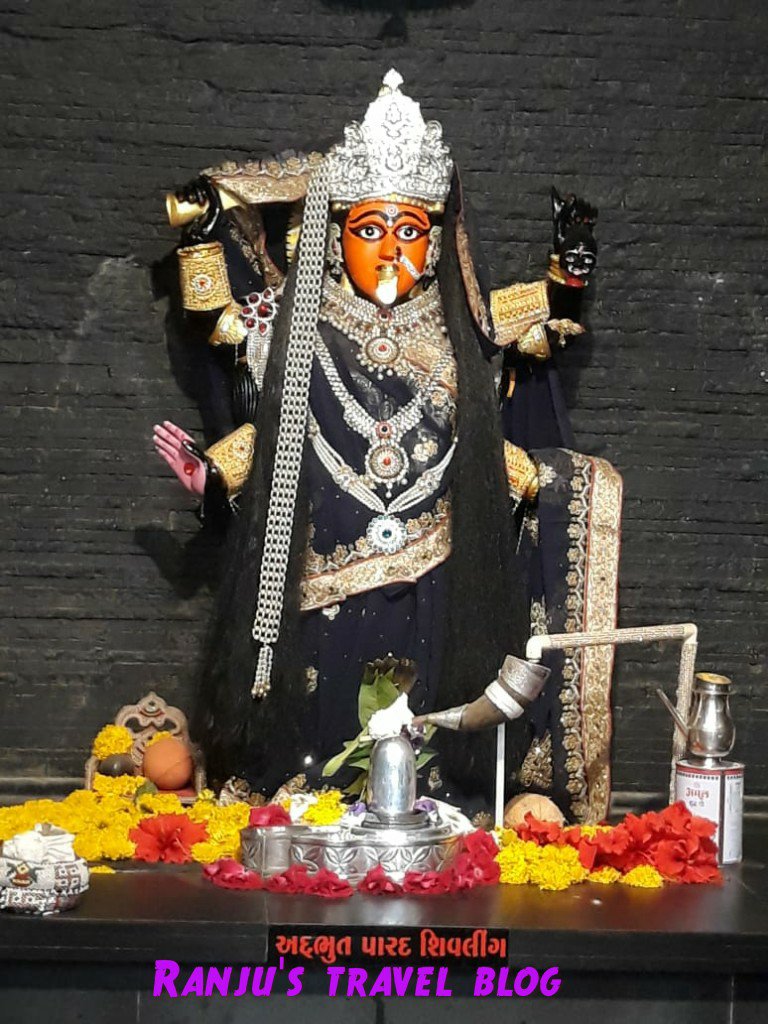
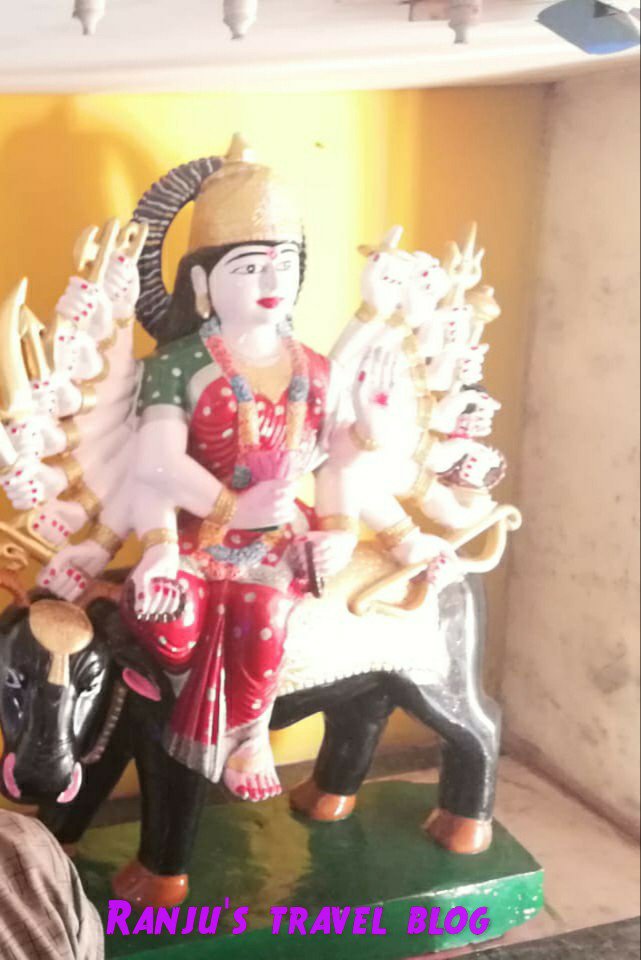
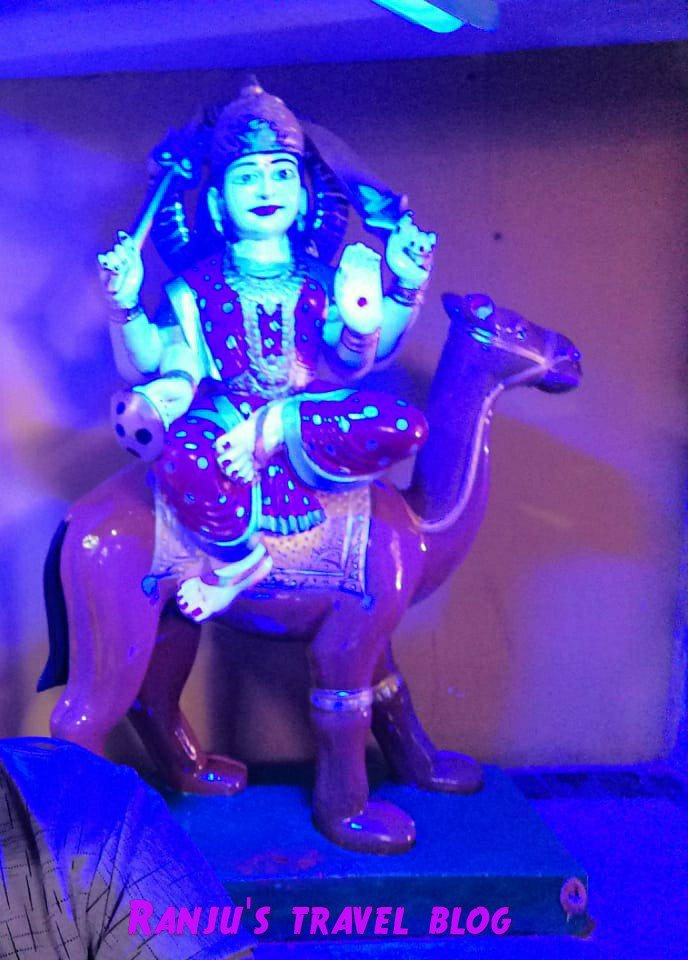
Lord Ganesha in Kali mandir Nandi in kali mandir Kali and in front is a small shivalingLord Hanuman Chotila mandirChamunda devi Gayathri Chamunda deviLord Shiva and Goddess Parvathi SaibabaThe main entrance Lion on the entrance
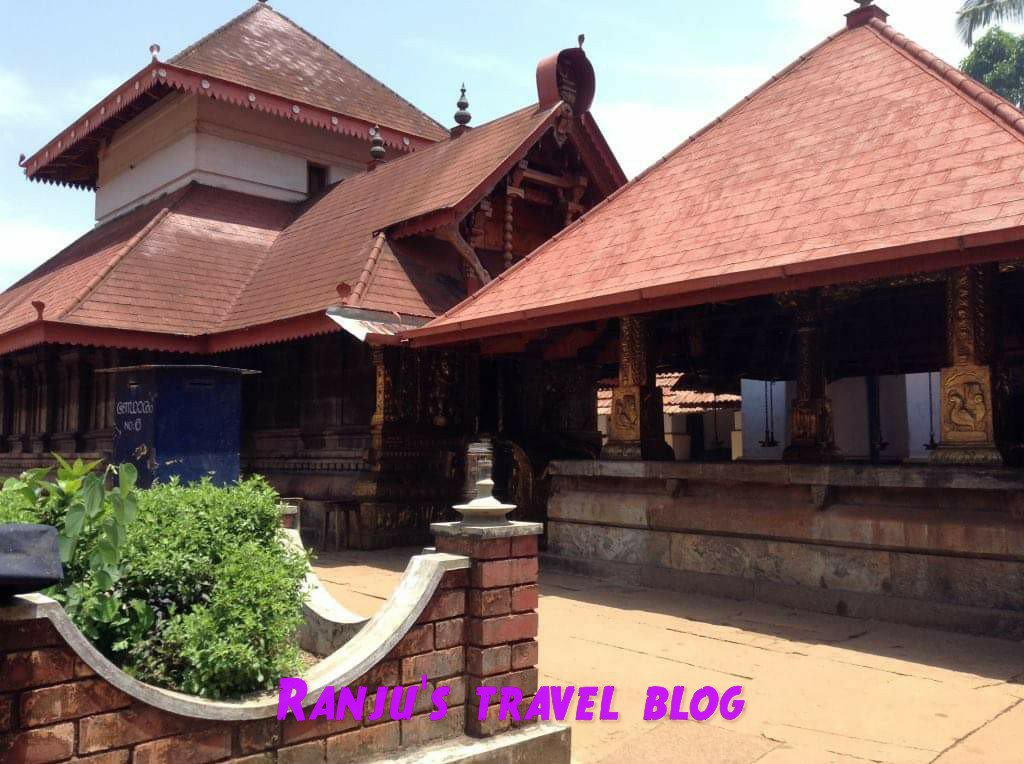
This temple in Wayanad with Lord Vishnu as the main deity is said to be Lord Rama gave 4th year pithru tharpanam to His father Dasaratha during their exile .
The temple has a step of 100 so one has to climb those steps for the dharshan of the Lord.
This is a famous temple in Kerala where the worship of Pithrus (a ritual done for our dead ancestors) is done. It is 32 Km from the Manandavadi town of Wayanad district, which is a dense tribal area of Kerala. The nearest Railway station is Kozhikode in Kerala, which is 72 Km from this place.
It is in a valley called “Brahma Giri” (Mountain of Brahma) It is believed that Lord Brahma did a great fire sacrifice here and because of that, this place is divine.
According to legends, once upon a time, some Brahmins happened to travel through these dense forests. When they were very hungry and had nothing to eat, they called Lord Vishnu for their help. Then they saw a goose berry tree. (Called Nelli in Malayalam), which was laden with fruits. All of them satiated their hunger by eating fruits of this tree. Suddenly their hunger and thirst was satiated and they felt the divine presence. Then they decided to call the place as “Thiru Nelli (sacred Gooseberry). “ Records exist to prove that this temple of Lord Vishnu is at least 1000 years old. It is also referred in Unni neeli Charitham which is the first book written in Malayalam. The temple is a very simple structure made of granite stone. The idol consecrated in this temple is that of Lord Vishnu with four arms. The walls of this temple are also made of granite. On these walls, very beautiful etchings are there. It seems one king of Coorg, tried to renovate this temple. When he was half through, the Vellattiri king who owned the temple objected. The renovation was discontinued. Even today we can see proof of the half finished renovation work. There are no wells in this temple. Water is being brought by a stone aqueduct from a stream in the Brahma Giri valley.
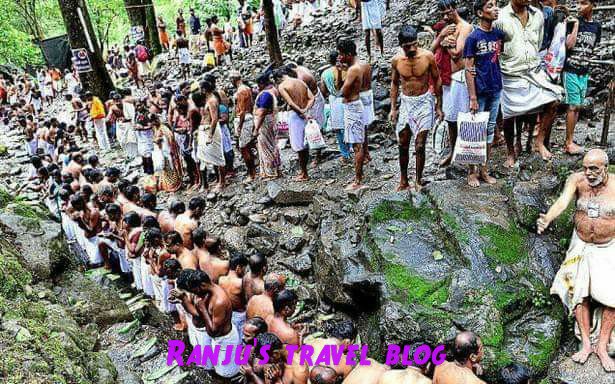
Very near the temple , there is a river called Papa Nasini (killer of sins) . It is believed that if we do rituals to the pithrus ( rituals done to our dead ancestors), they would get salvation. It is believed that the good effect is equivalent to doing Karmas (Rituals) in Gaya. The Pindas (rice balls ) are placed in the stream after the worship. People believe that both Lord Rama and Lord Parasurama did the Pithru Karmas here also in the vicinity is a sacred rock where ritual offerings (known as bali) are made for the ancestors on the New Moon days of the Malayalam months Karkkidakom, Thulam and Kumbham. Besides the rituals during the two-day festival, art forms like Kathakali and Ottanthullal are performed. Very near the Papa Nasini is the Padma Theertha pond. . In the middle of it on a raised stone, you find the marks of Lord Vishnu’s feet. People believe that Lord Vishnu stood on this rock and gave divine advice to Lord Brahma. Nearby in a cave there is a Shiva temple also. All the people who do Pithru Karma visit this temple on their way back.
During our visit we stayed in the devasom lodge opposite to the temple small mess are near the temple . The temple itself offers morning breakfast afternoon lunch and night dinner too . The plates are kept we had to take after having food should wash and place it the same place. They are maintaining it very neatly . The washing place is a square opened tank where water is stored .
There are other places of interest such as pookot lake athirapally falls edakkal caves .
View from our room one could see the steps of the temple Front view of the temple Back view of the temple Papanasini On the way to Papanasini Vishnu feet Papanasini Lord Vishnu
Next to Balka theerth in Dwaraka was a temple maintained by Brahmakumaris . The temple itself was in the shape of a huge linga and we were waiting for others to come , our bus driver asked us to have a visit of that temple . So we entered the temple. In the entrance a small garden was maintained with a fountain in the center and the in main entrance was Lord krishna in Venu madhav posture with a flute in hand and leg crossed with a cow at the back . The temple itself was like a circular hall . Inside there were statues of many more God n Goddesses idols .
Gomati Ghat is located at the mouth of River Gomati and falls within the city of Dwarka and within the district of Dwarka in the western Indian state of Gujarat.
One has go down a flight of 56 steps from Dwarkadheesh temple’s Swarga Dwar in order to reach the Gomati Ghat which is located 20mins away from Dwarka city centre.
Gomti River flows past the Gomati Ghat Dwarka and that makes the Ghat a real holy place and River Gomati is the tributary of Holy Ganges, the most sacred river for all Hindus.
The river originates in the Himalayan ranges of Nepal and flows down across many Indian states with Gujarat being one of those.
In lord Krishna’s legendary city Dwarka, Gomati Ghat is an important haunt for all devout pilgrims. It is also referred to as Gomati Sangam Ghat as the river flows past the Gomati Ghat and soon afterwards meets the Arabian Sea at the Chakratirtha Ghat.
Significance Gomti Ghat comes with great religious and mythological significance. According to myths River Gomati is the daughter of Sage Vashishtha and her waters are powerful enough to purge one’s mortal sins. Thus pilgrims make it a point to bathe in River Gomti and they usually take their holy dip into the Gomati Kund, the point of confluence of River Gomti and the sea. Gomti Kund is located very close to the Gomati Sangam Ghat of Dwarka. Also, River Gomti is believed to be the ‘descending Ganges’, a river that descends straight down from heaven which is why it is a river that can wash away every sin as per Hindu mythology.
It has become one of the tourist attractions now they collect rs.10 per person at the entrance and a bridge is built and camel rides are also there to take near the Gomathi river . As we went by evening sunset view was awesome .
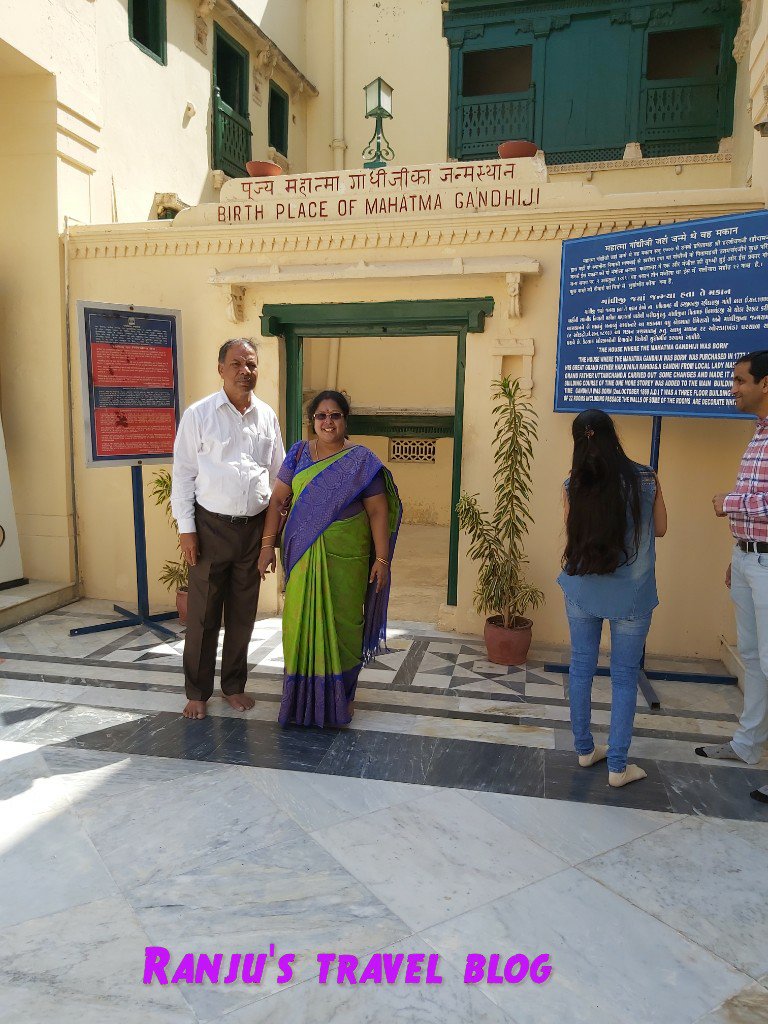
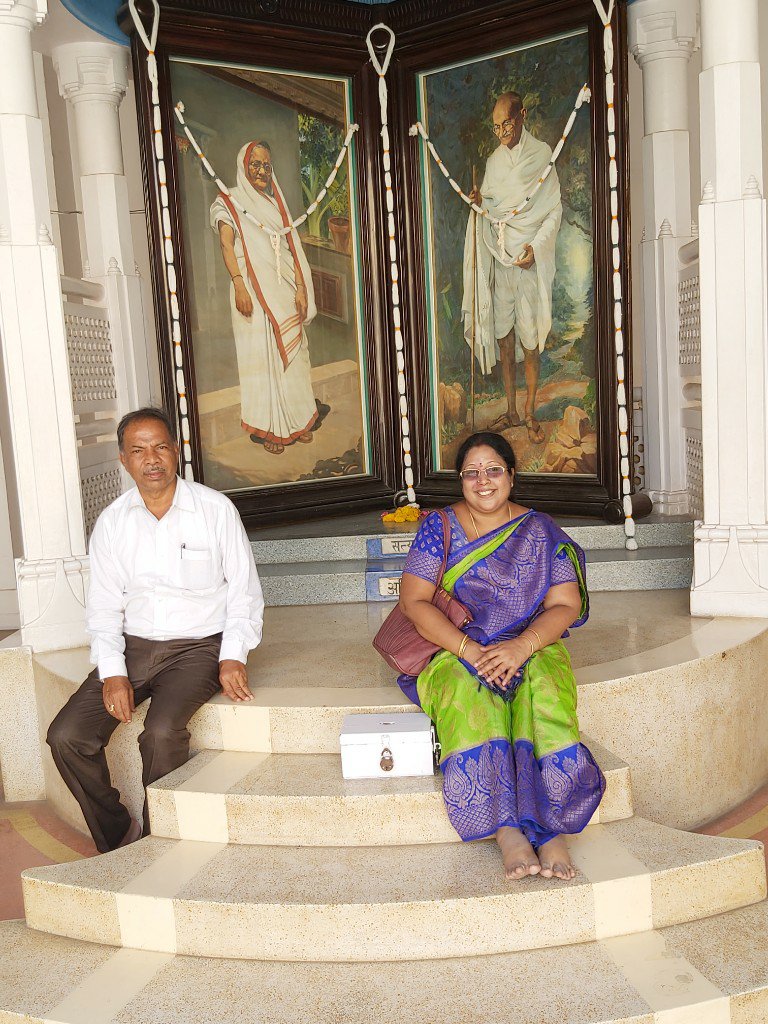
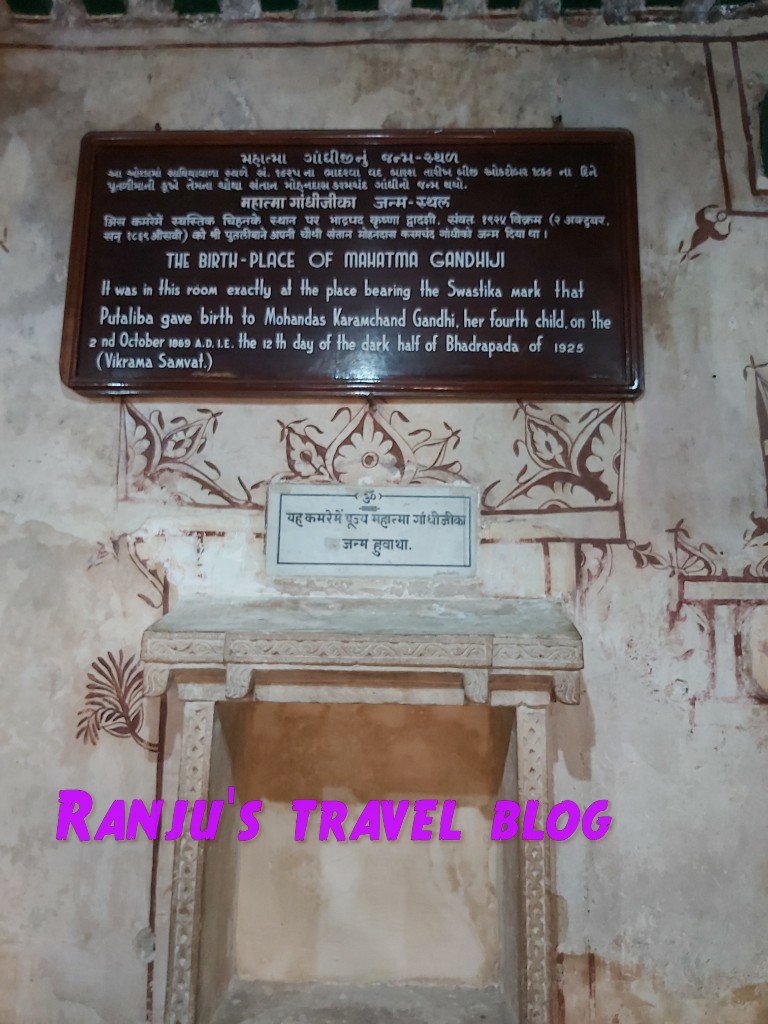
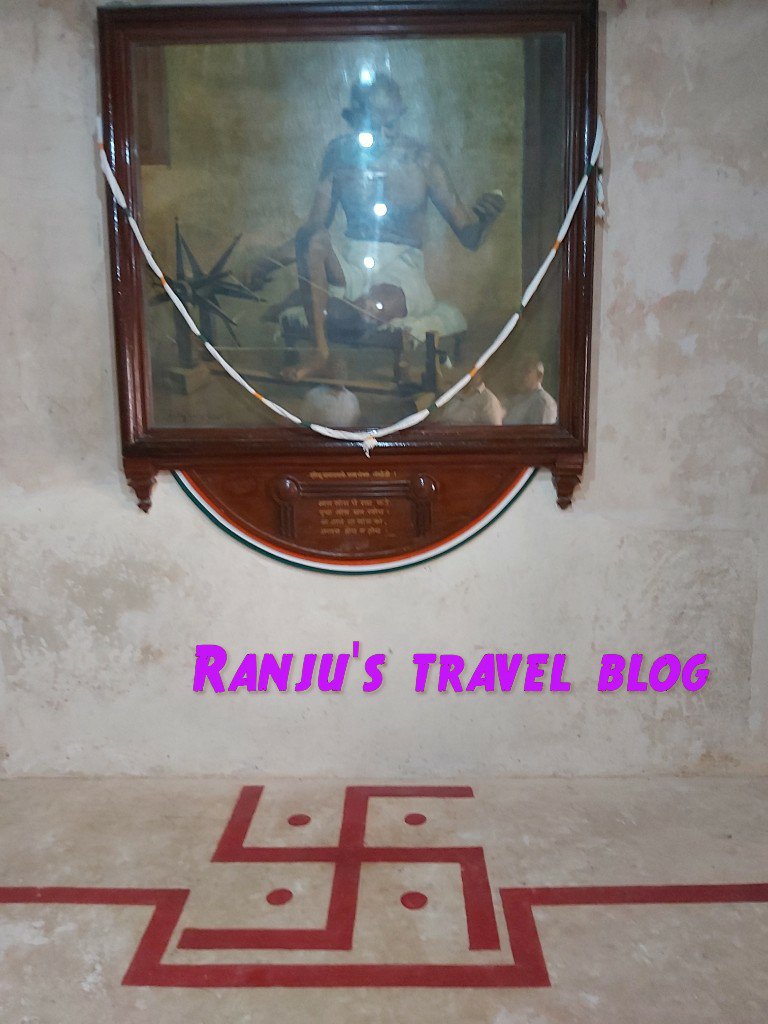
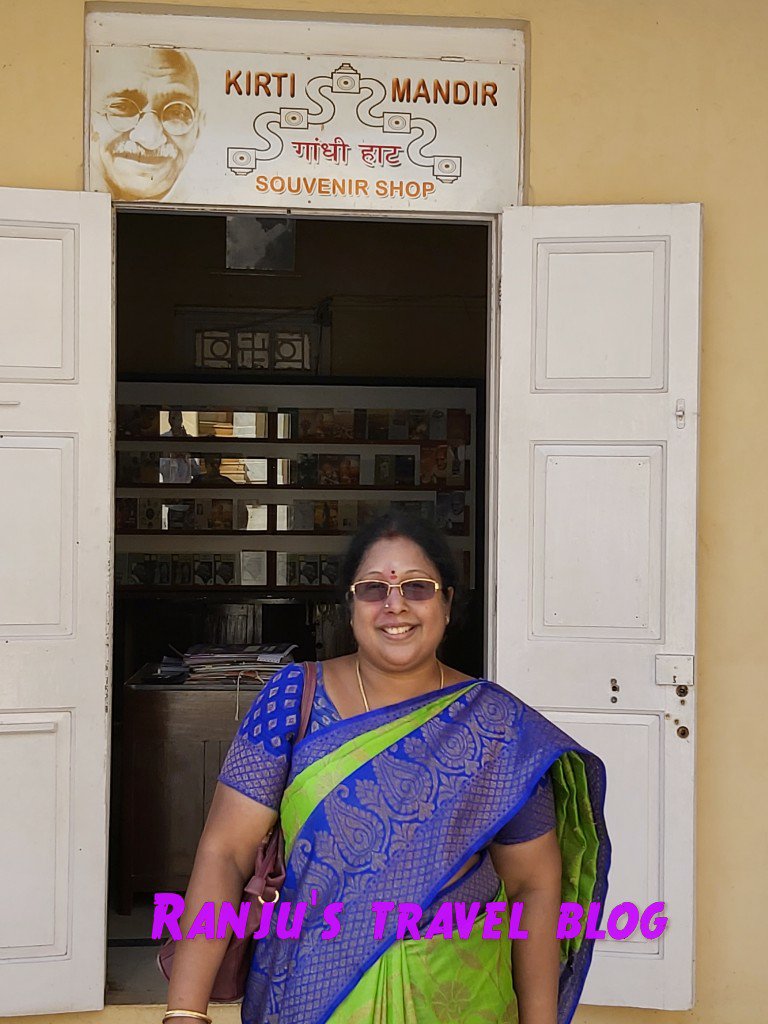
Kirti Mandir is the memorial house kept in memory of Mohandas Karamchand Gandhi and Kasturba Gandhi located in city of Porbandar, Gujarat, India. He is known as the father of our nation . His fight through non violence fetched freedom for our country .
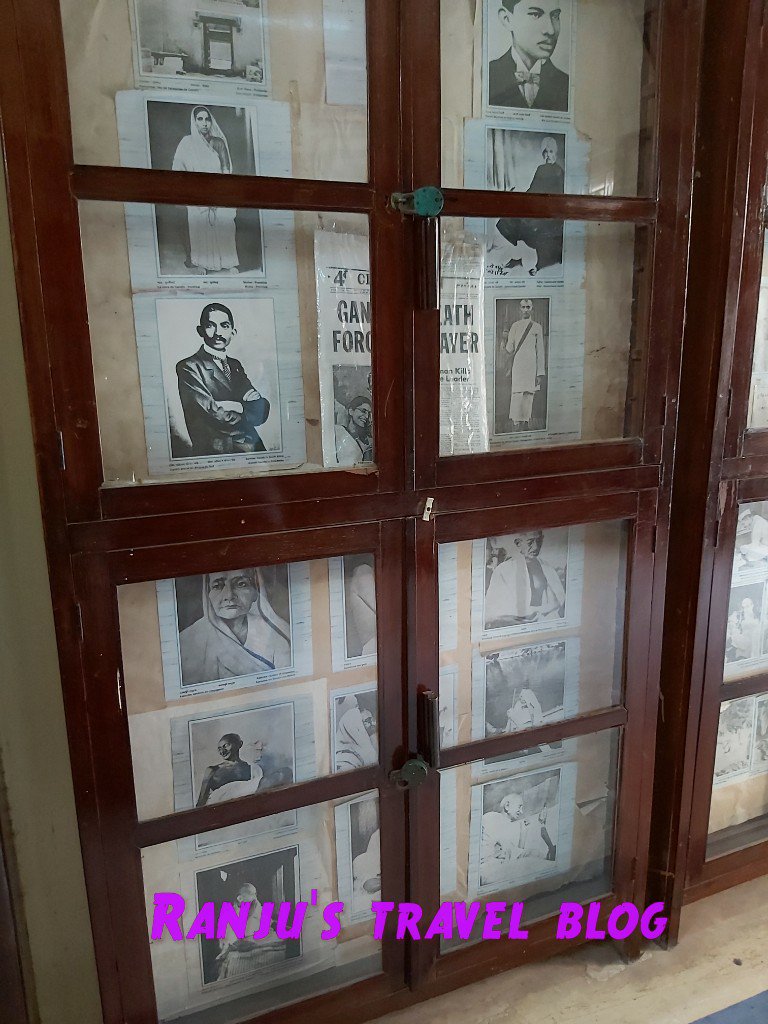
Photograph of Gandhiji and books the things used by him were kept in this place. A library and a office room selling books was also present.
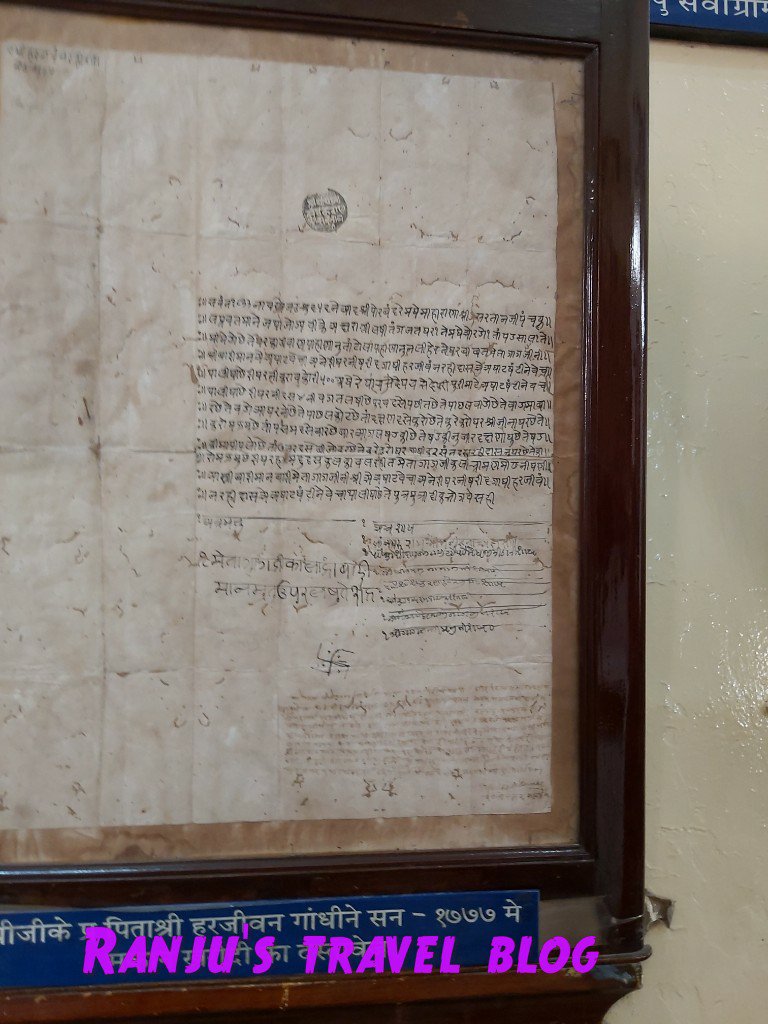
House of GandhijiHis parents photos on top Gandhiji with his wife kasthuribaiHis birth placeHis house documents His family tree
A small narrow road leads to the temple . The auto man left us in main road .
We had to walk to the temple the temple has a few steps . Instead of temple . It was more or like a village house .
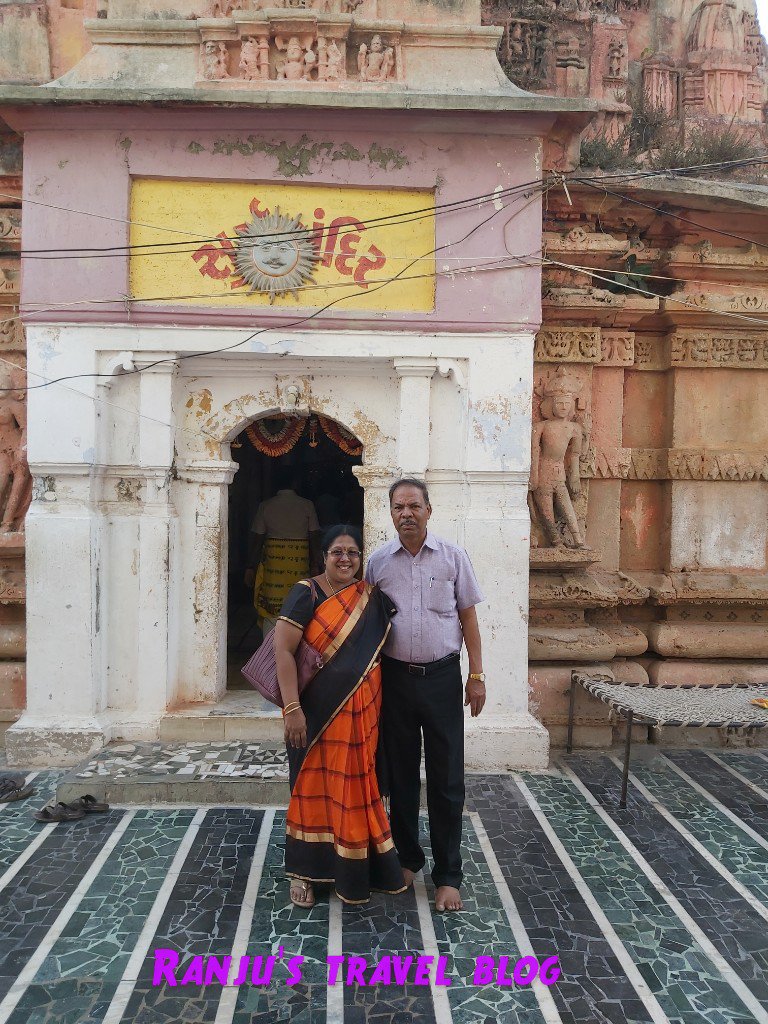
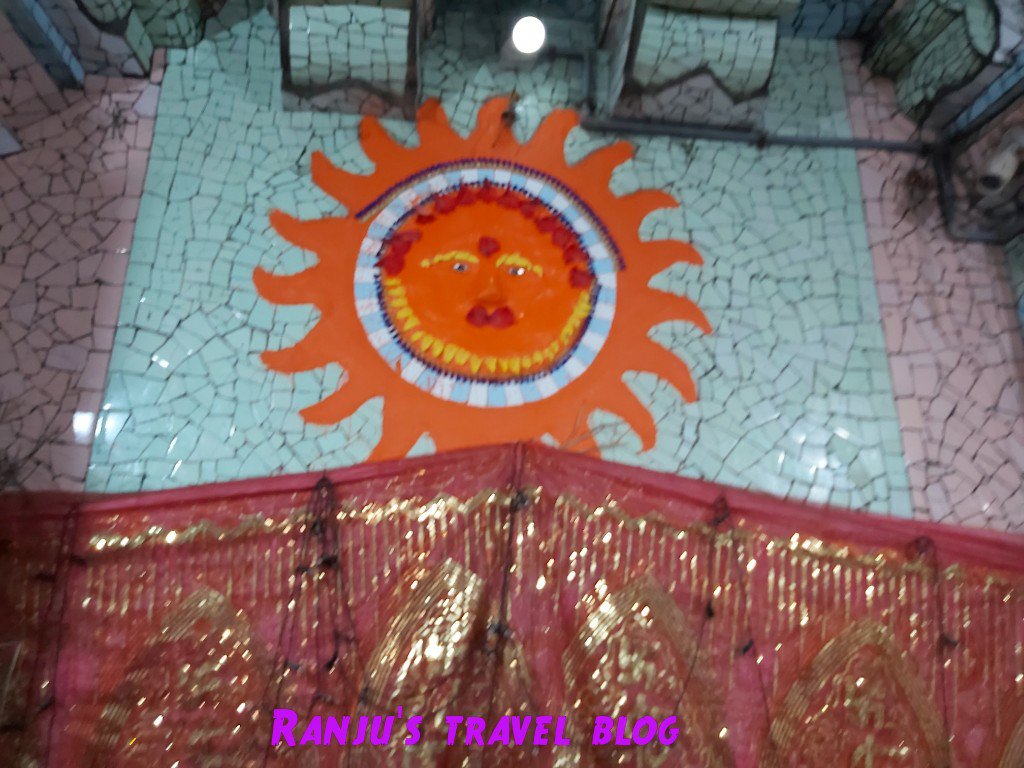
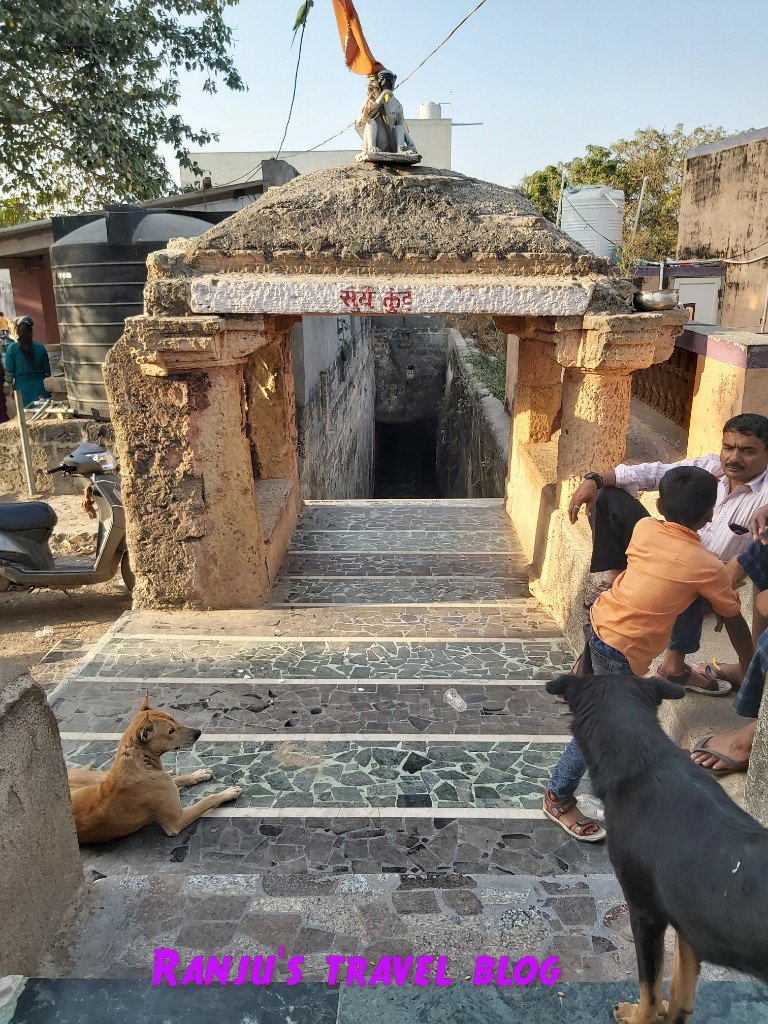
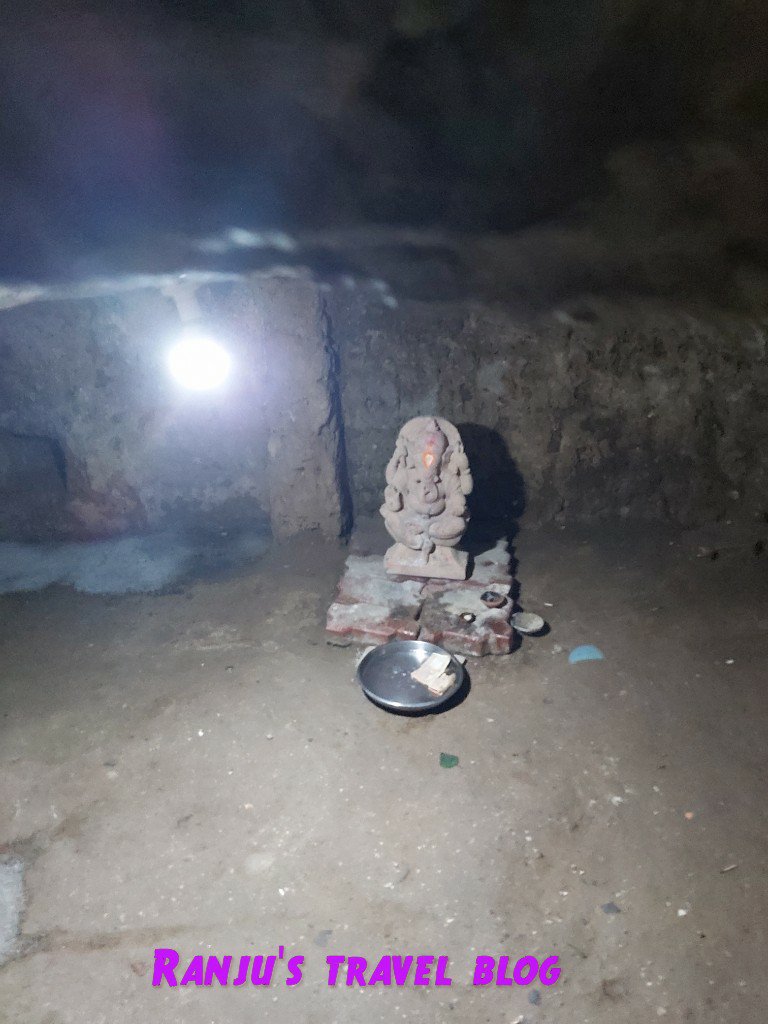
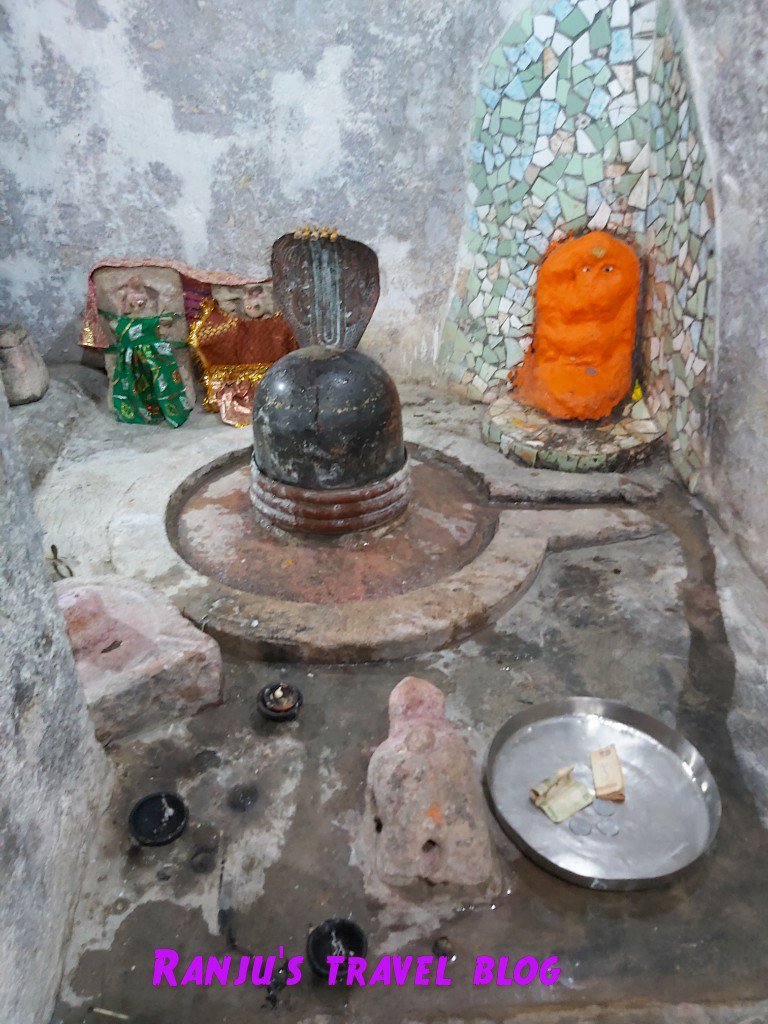
First we visited Surya mandir a small temple with the main deity as Surya Bhagwaan beneath is kept a idol of Sani mahadev son of Surya Bhagwaan , adjacent to it is a gufa with Lord Ganesha and Lord Shiva shrine with his consort Parvathi . Opposite to it is Surya kund . A pond to which we should go a few steps down. There were shops selling Surya idol in brass as well as copper , valampuri conch and many more .
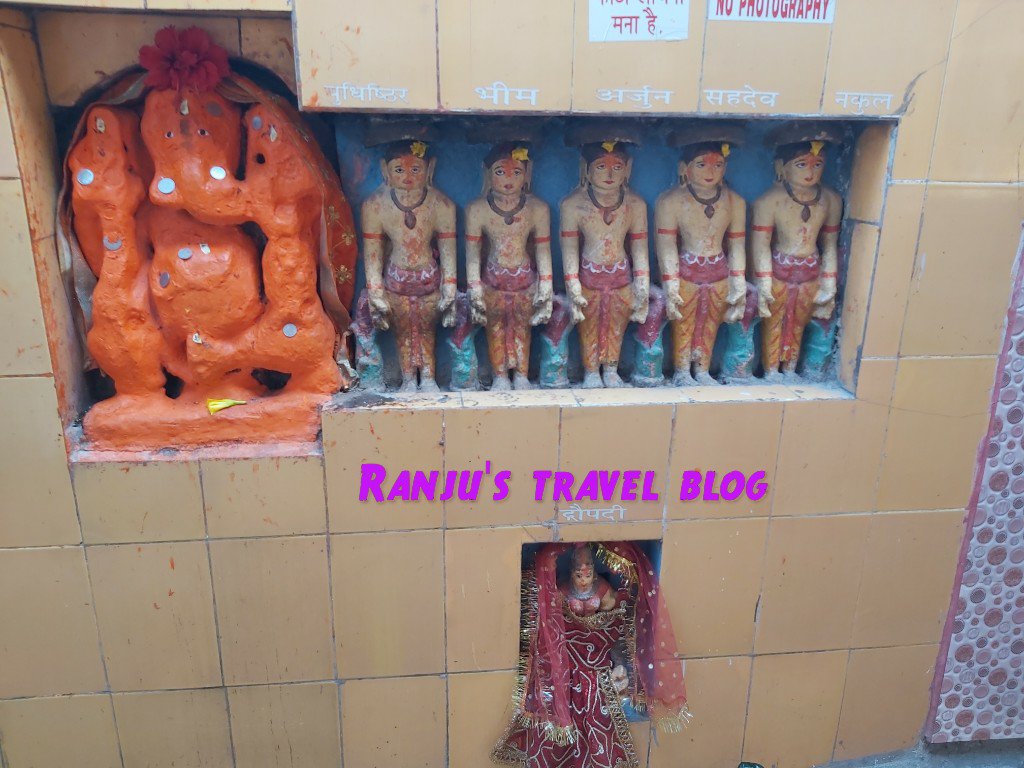
Next is Pancha Pandava mandir which consists of Lord Ganesha along with Pancha Pandavas Yudhistra Bhima Arjun Nakul Sahadev along with Draupadi beneath these idols .There were shops selling pooja articles.
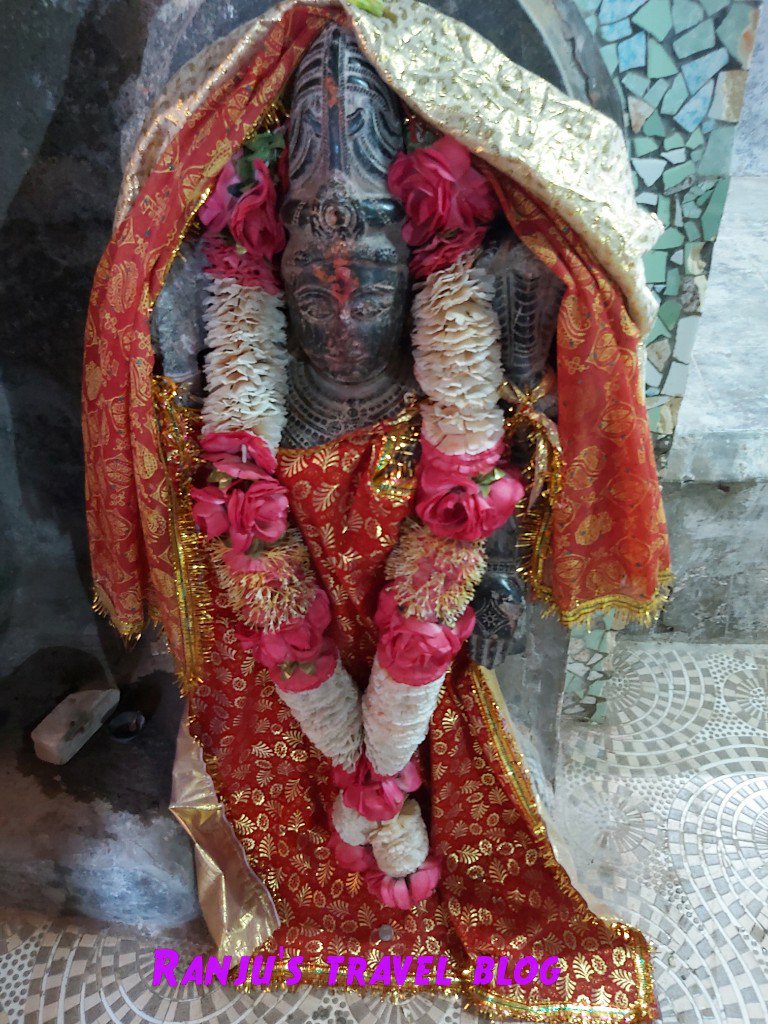
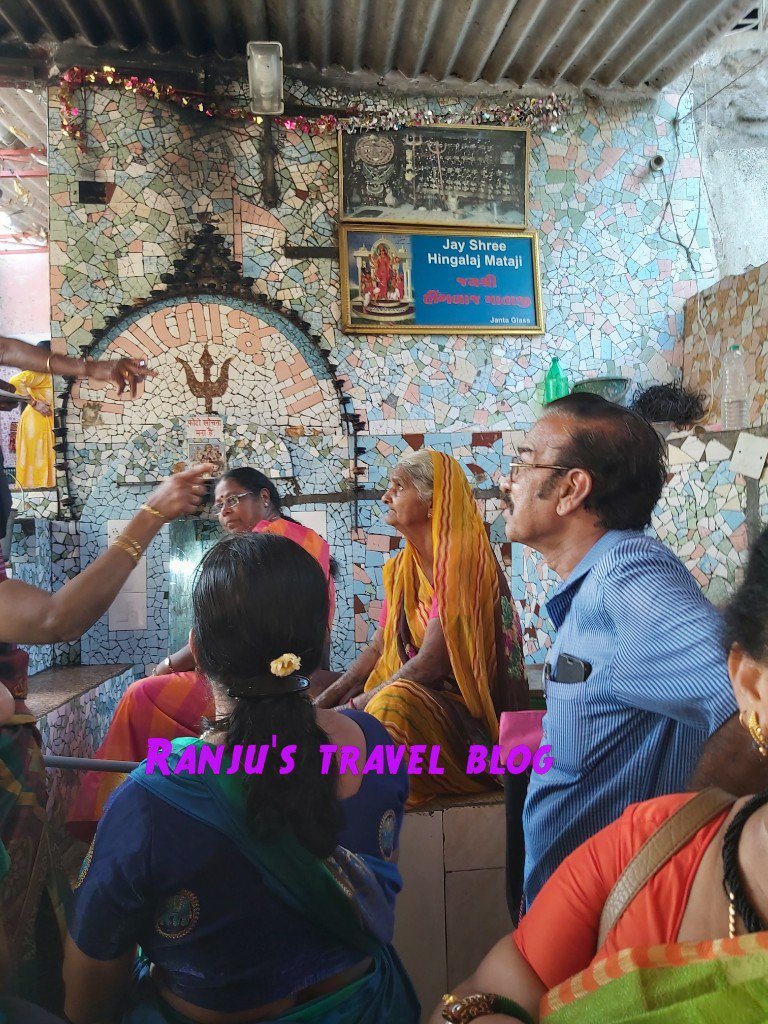
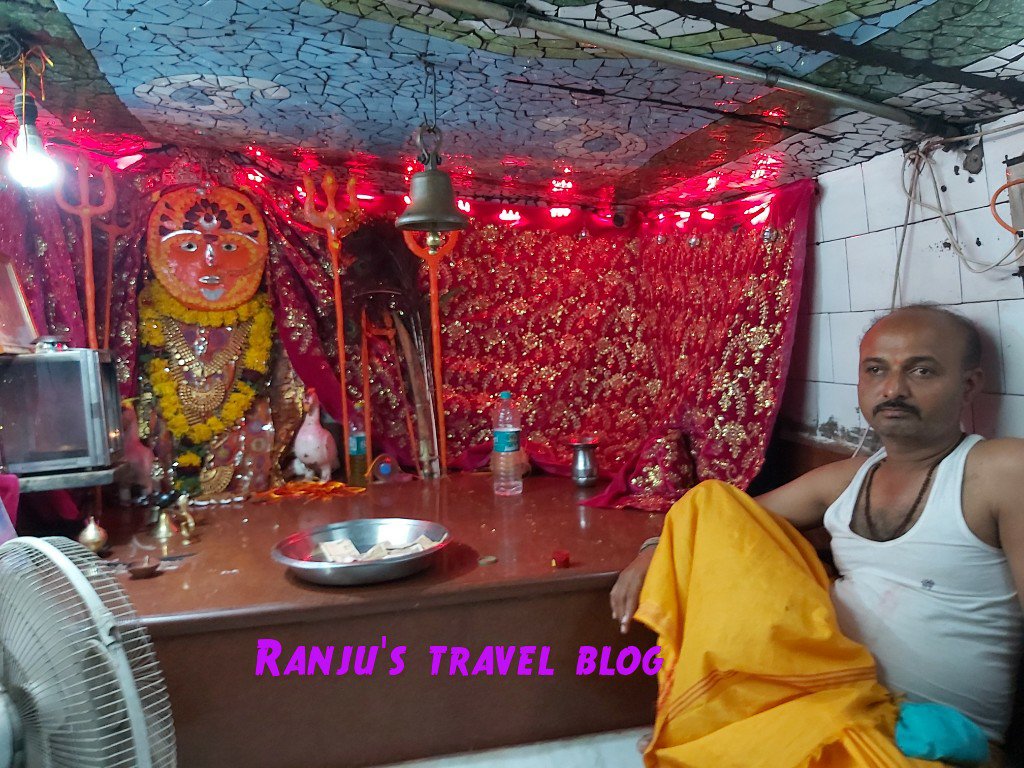
Hingalaj matha gufa in the same complex which is said to be the kuladevi of Pancha Pandavas . Gufa means caves . This is a narrow Gufa consisting of a few steps then a flat surface of 4 feet again we should crawl and go to see the main diety .There is a priest inside the gufa . Near the flat surface is kept a air cooler those who feels exhausted can sit near it for a few seconds before they crawl to the main deity. Near the priest is a fan . Those who have breathing problem and little obese people are not advised to go . I went inside the gufa and had the divine dharshan of the Hingalaj matha and while coming back literally crawled and came out of the Gufa .
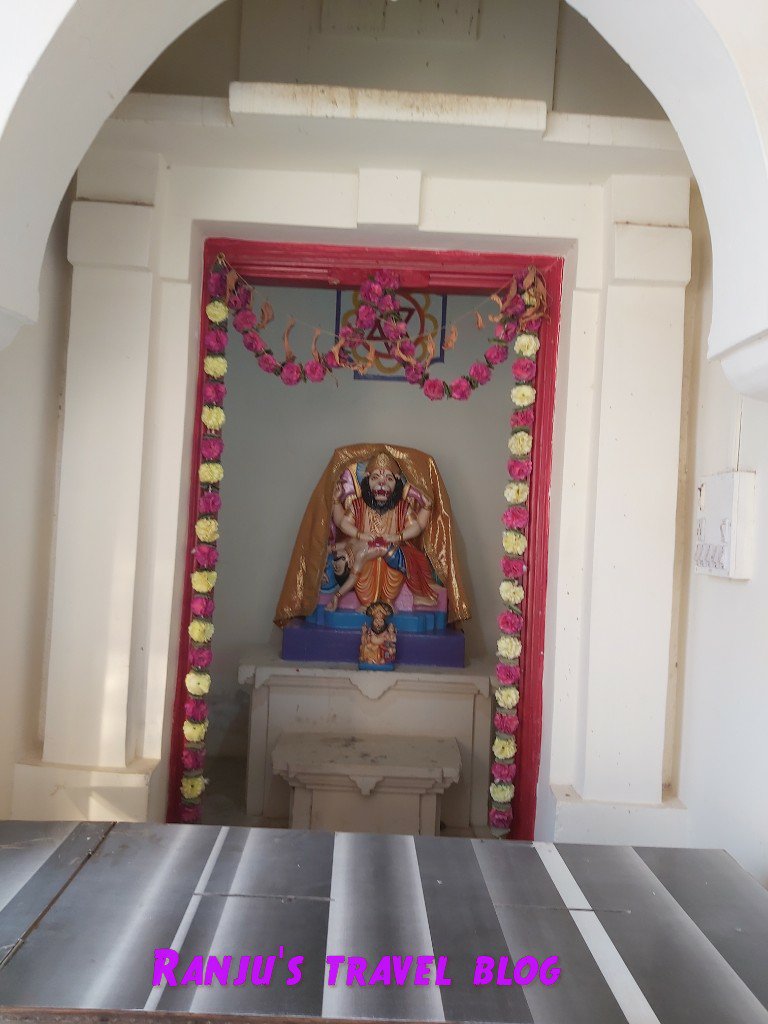
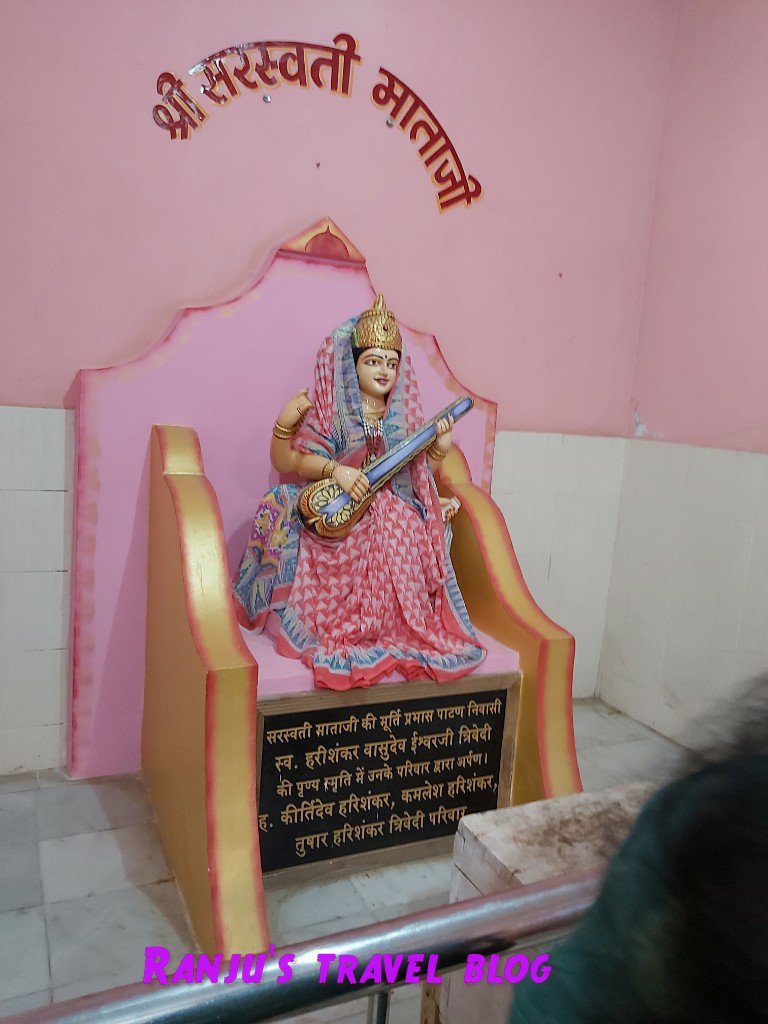
In the main road is Sharadamath. In this temple is Lord Narasimhar along with lord Shiva shrine with Lord Ganesha and Lord Hanuman idol on the both sides . Goddess lakshmi and Goddess Sarawathy idols are kept for worship.
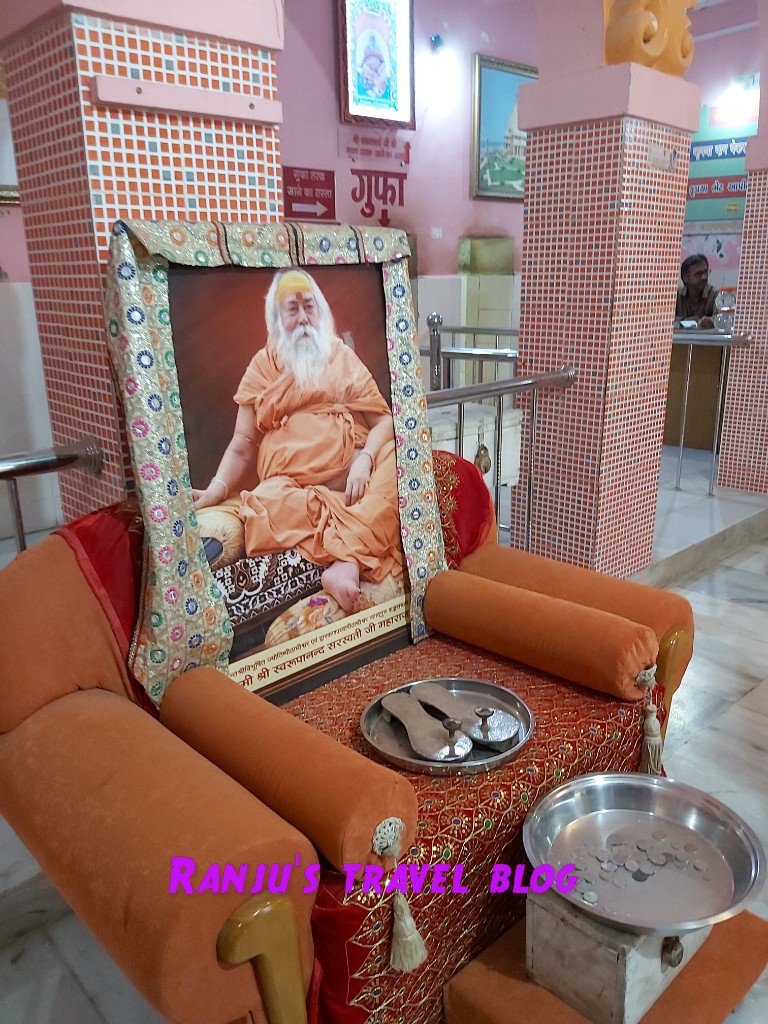
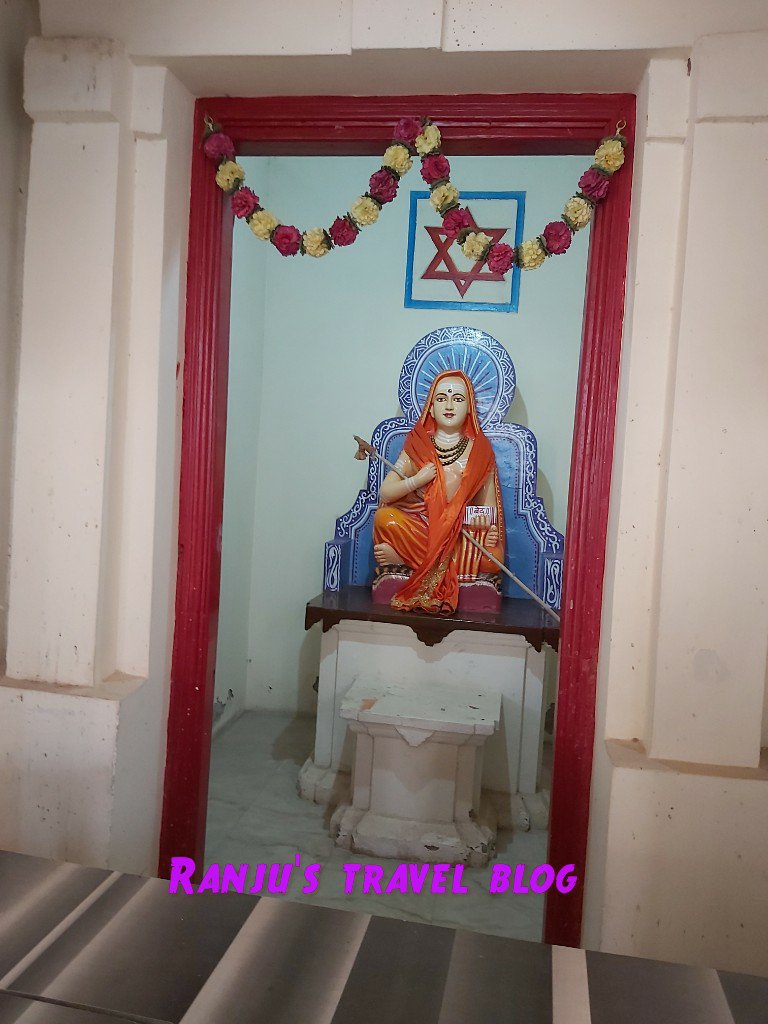
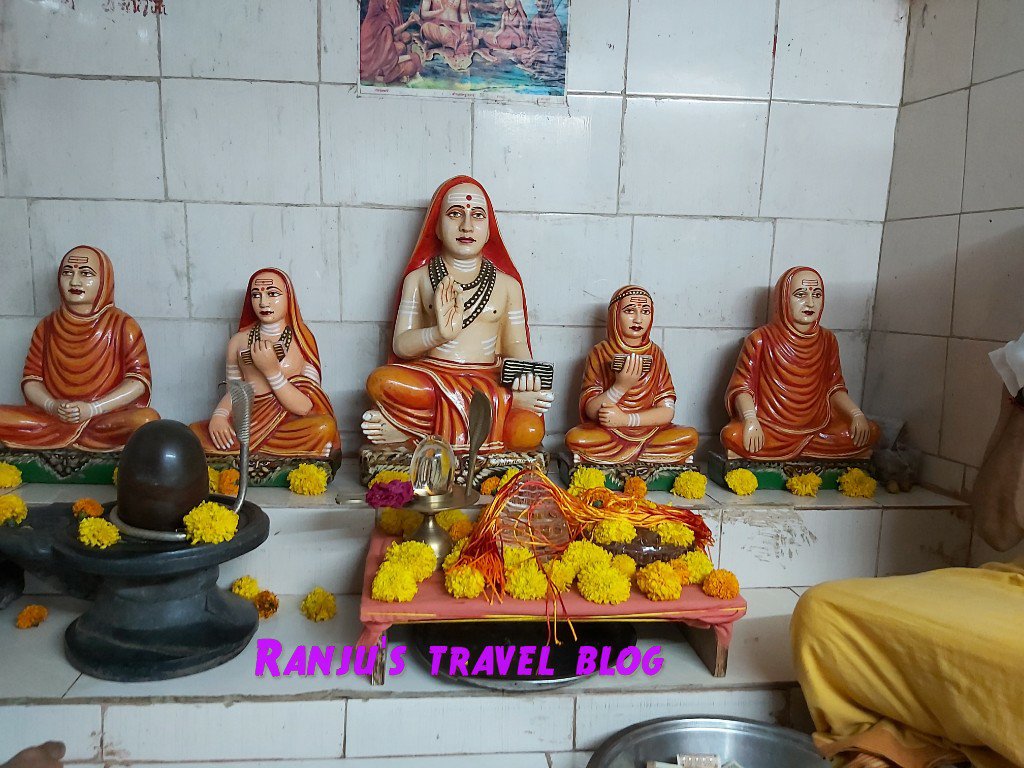
Here too there is a gufa in which Adisankaracharyas along with his ancestral leaders idols are kept . Next to it is a spadika lingam mount Meru made of spadika, lingam and kurmam ( tortoise) are kept and worshipped . This gufa is not that narrow as in Hingalaj matha gufa.
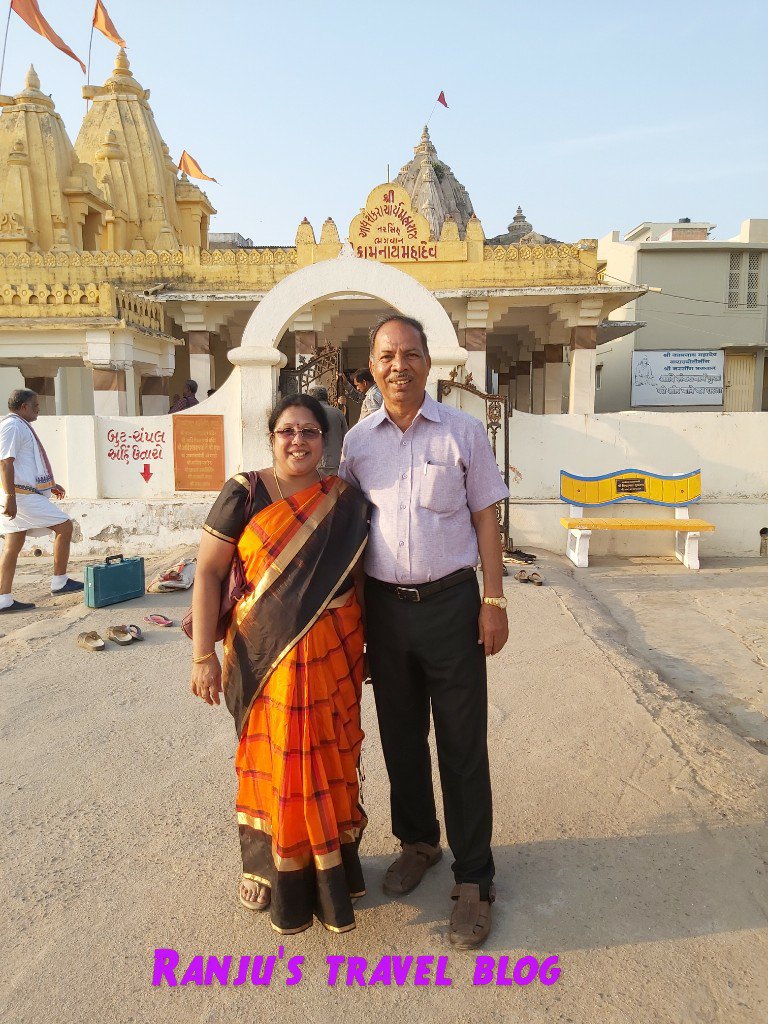
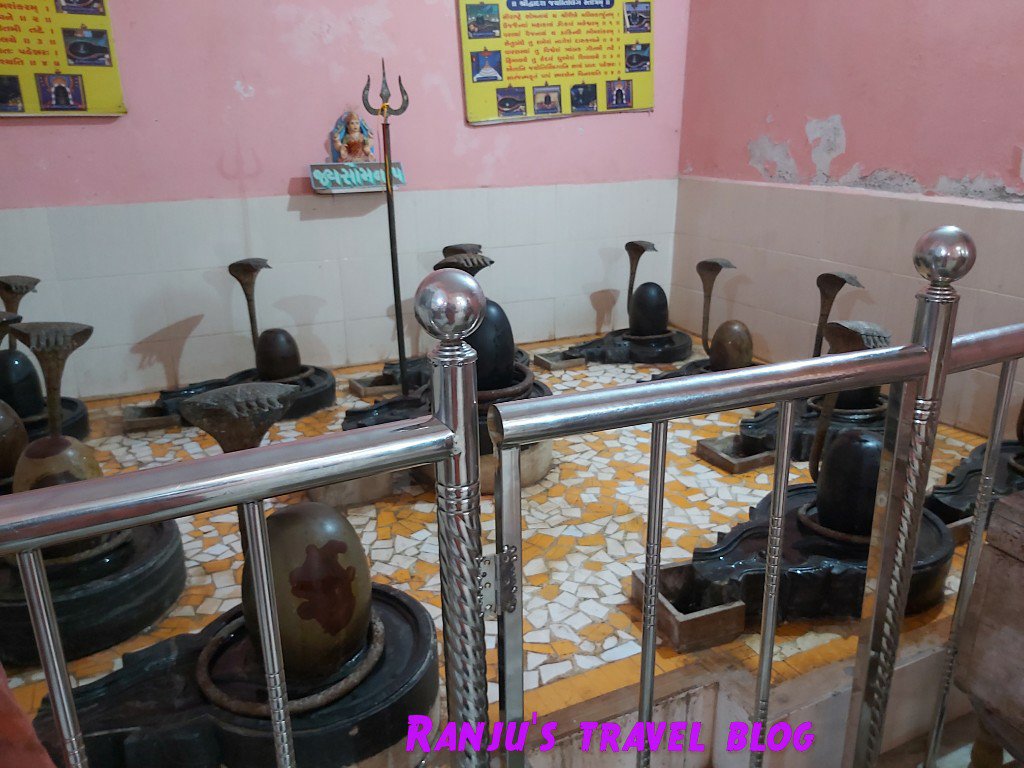
In front of Sharadamath The founder of Shardamath u can see the entrance of the gufa in this pic Adi Shankaracharya Lord Narasimhar Lord Shiva Lord Ganesha Lord Hanuman Goddess Lakshmi Goddess Saraswathy Inside the gufa in Shardamath Near the exit were these lingas Surya mandir The main deity Surya kundSani mahadev beneath the SuryaLord Ganesha Lord Shiva Goddess Parvathi Pancha Pandavas mandir with Draupadhi Entrance of Hingalaj matha gufa Hingalaj matha kuladevi of the Pandavas
Nageshwar was believed to be known as ‘Darukavana’, which is an ancient epic name of a forest in India. Below is a well-known legends attached to this mystical temple .
Located on the route between Dwarka city and Beyt Dwarka Island on the coast of Saurashtra in Gujarat is this important Lord Shiva Temple. It is enshrined by one of the 12 swayambhu (self-existent) jyothirlingas in the world, in an underground sanctum. A 25 m tall statue of a sitting Lord Shiva and a large garden with a pond are major attractions of this rather serene place. Opposite to the main sanctum is a Trishul and a Nandhi.
Peoples are allowed inside the main sanctum if they pay Rs. 200 and have to buy pooja articles sold inside the temples and change to traditional dress inside the cloak room . Peoples having nagha doshas in their horoscope do pooja rituals with the help of the priests and offer silver nagas small idol (serpent) to get rid of their doshas .
The linga is surrounded by a serpent hood and is covered by a dome like structure made of glass .
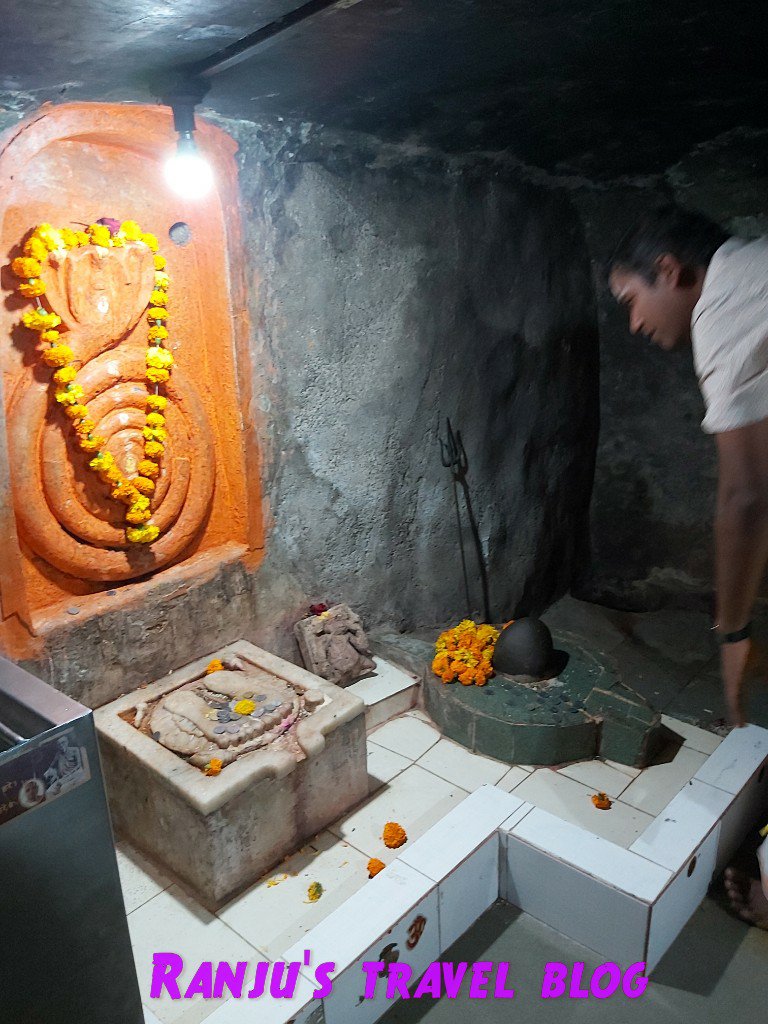
There is a shrine for Sani Mahadev under the peepal tree outside the temple.
A mantap were yagna were done was outside the temple adjacent to the main sanctum.
As per legend is that according to the Shiv Purana, hundreds of years ago two demons Daruka and Daruki lived in Darukavan. Daruka was blessed by Goddess Parvati. However, he misused the blessings and terrorized the local folks. One such time, he imprisoned a local woman, Supriya. Supriya told her fellow inmates to take the name of the Lord Shiva (Om Namashivaya) and no harm would come to them. When Daruka heard this, he was enraged. He rushed to kill her but Lord Shiva appeared to protect her. As Daruka was blessed by his own wife, Goddess Parvathi, the Lord could not kill him so instead he took the form of a lingam and promised to protect Supriya and the local folks forever in Dwarka.
Outside the temple In front of the temple In front of the main sanctum Opposite to the main sanctum Shiva pariwarYagna held in the temple
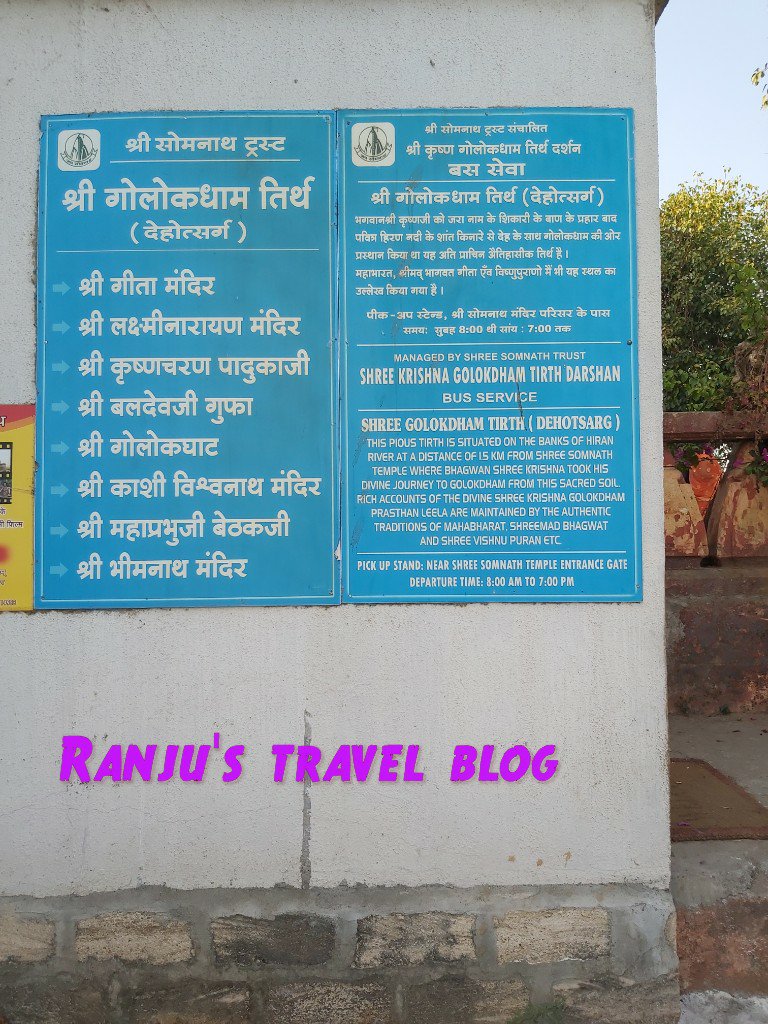
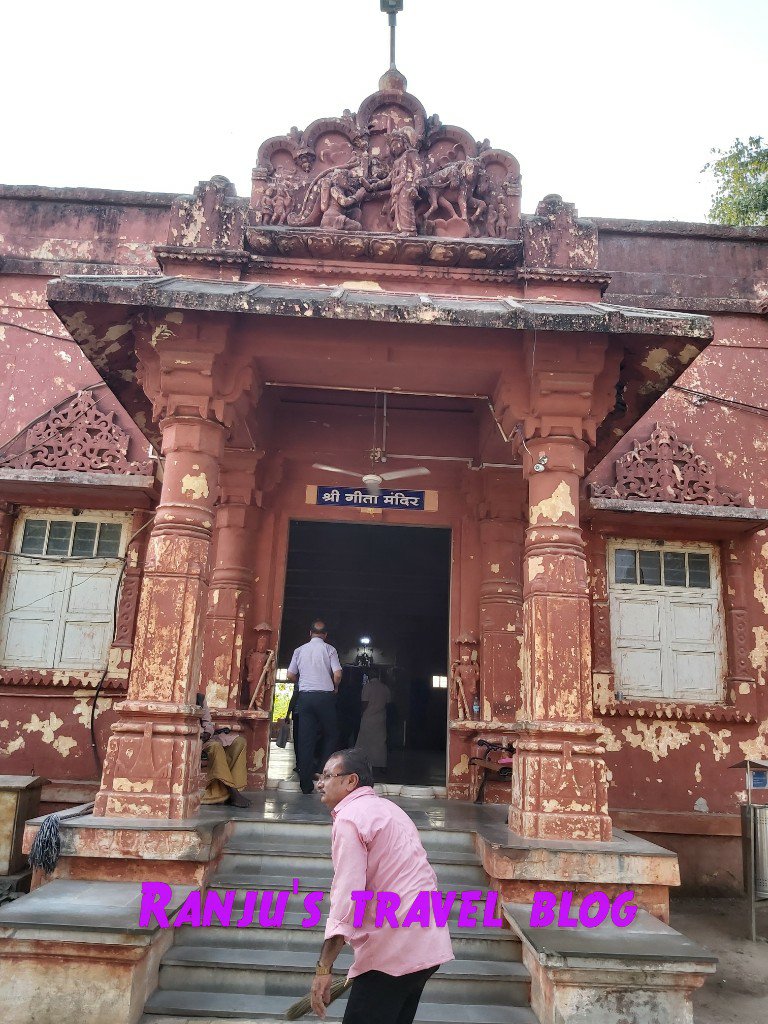
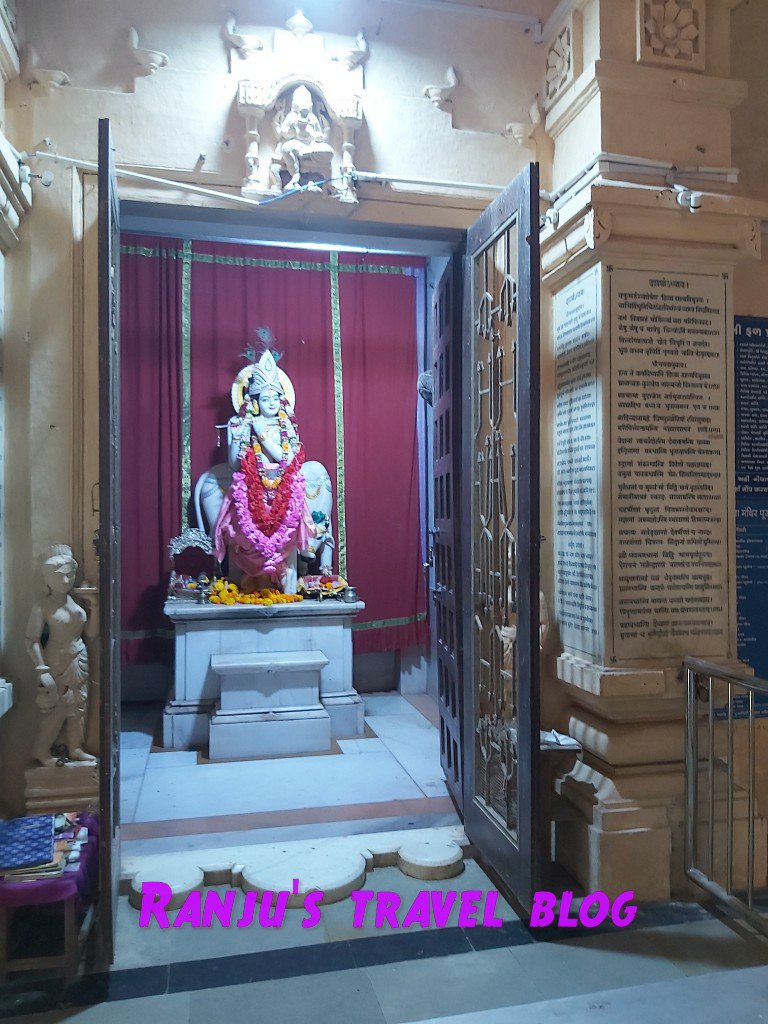
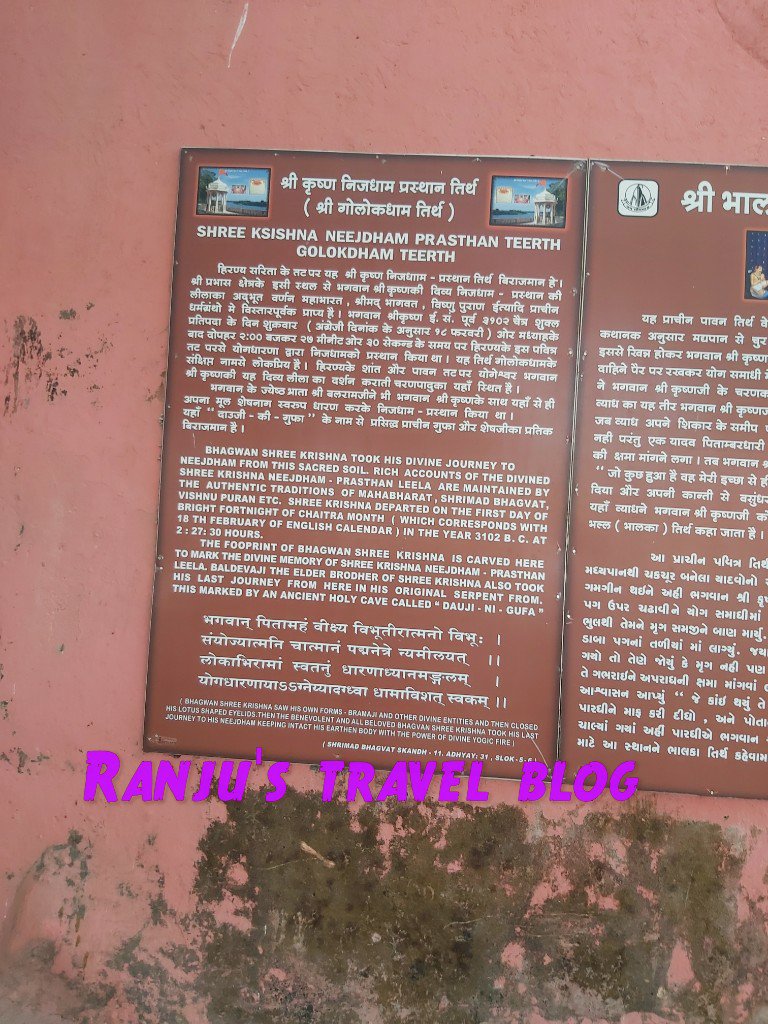
Gita Mandir is one of the sacred temples nearby the Somnath Jyotirlinga temple and dedicated to Lord Shri Krishna and current structure of temple built in the year of 1970 by Birla Group. The Gita Mandir is famous for its depiction of Holy book Bhagavad Gita and wall paintings of Lord Krishna. There are eighteen pillars in the temple and on each pillar is inscribed one chapter of Bhagavad Gita .
As per mythology, Gita mandir is situated at the spot where Lord Krishna took rest after his walk from Bhalka Theerth to Triveni Theerth, before his journey to Neej Dham. This incident happened after he was hit by an arrow, towards the end of Dwapara Yuga and Lord Krishna proceeded to heaven from this place.
This temple is part of a small complex comprising of 3-4 temples, which is very near the Triveni sangam. Actually, this complex is at the end of the road leading from the main Somnath temple to all the smaller but very sacred Hindu temples mentioned of Somnath.
The temple is well maintained, very peaceful and holy place. Must visit temple, when you visiting the Somnath, since many people dont know about this and is not as famous as Somnath temple.
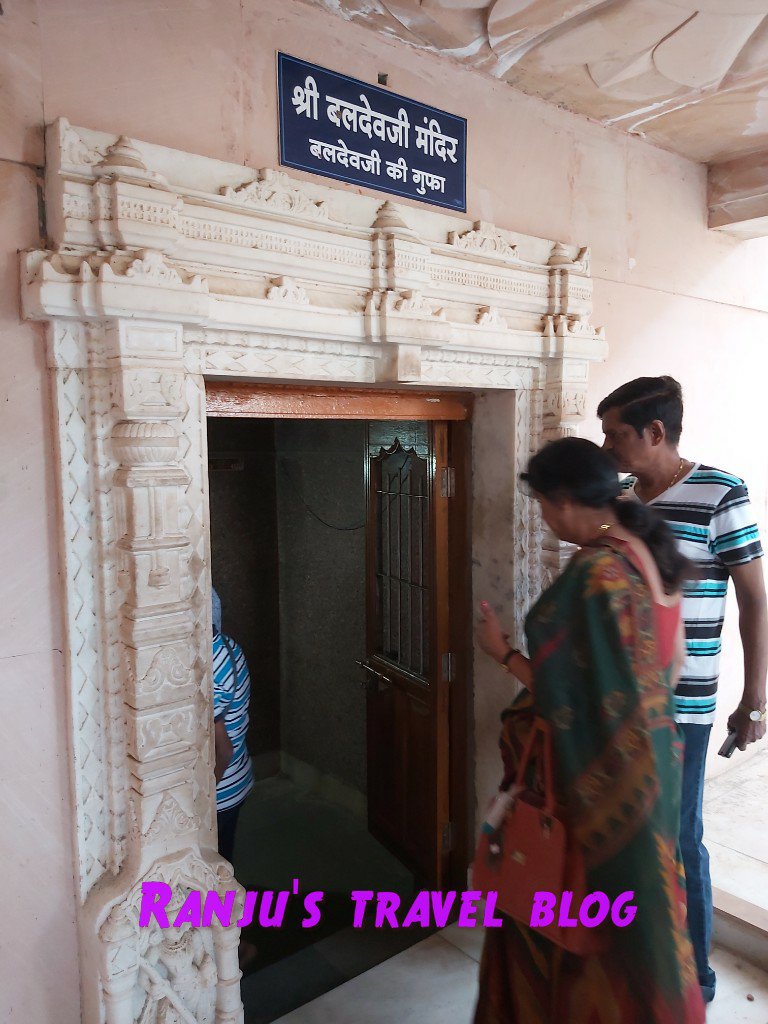
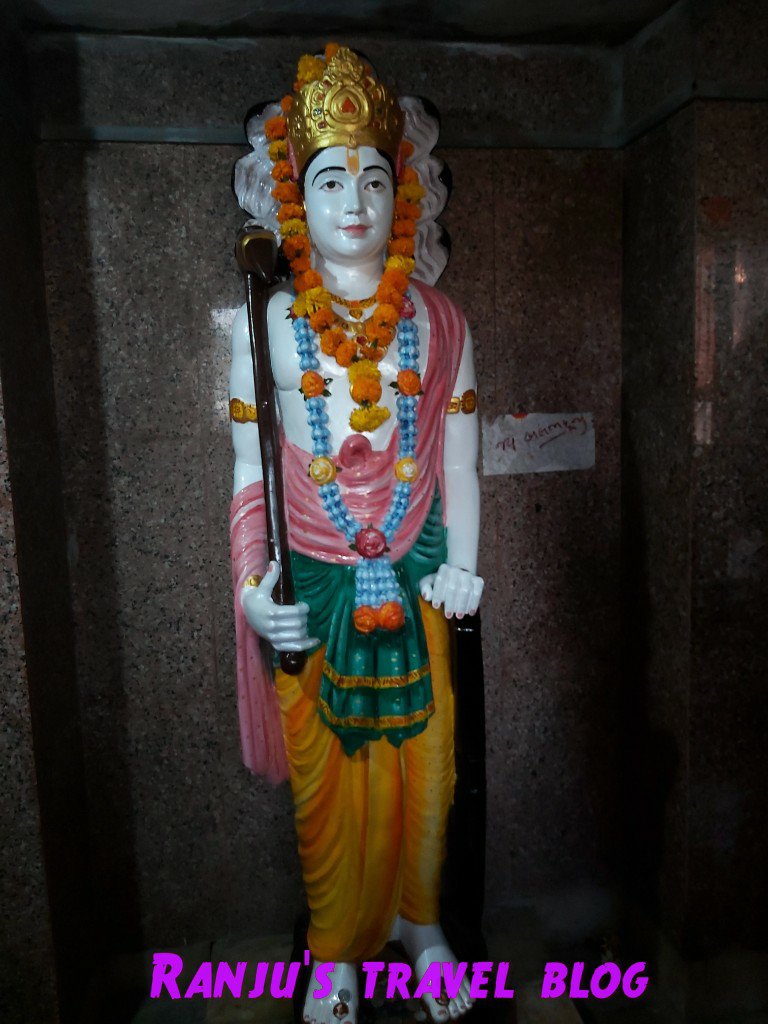
Next to Geetha mandir is Balaramar gufa which u had to get down a few steps to have the dharshan of Lord Balaramar and few more steps down there is a nagar along with Lord Shiva in the lingam form .
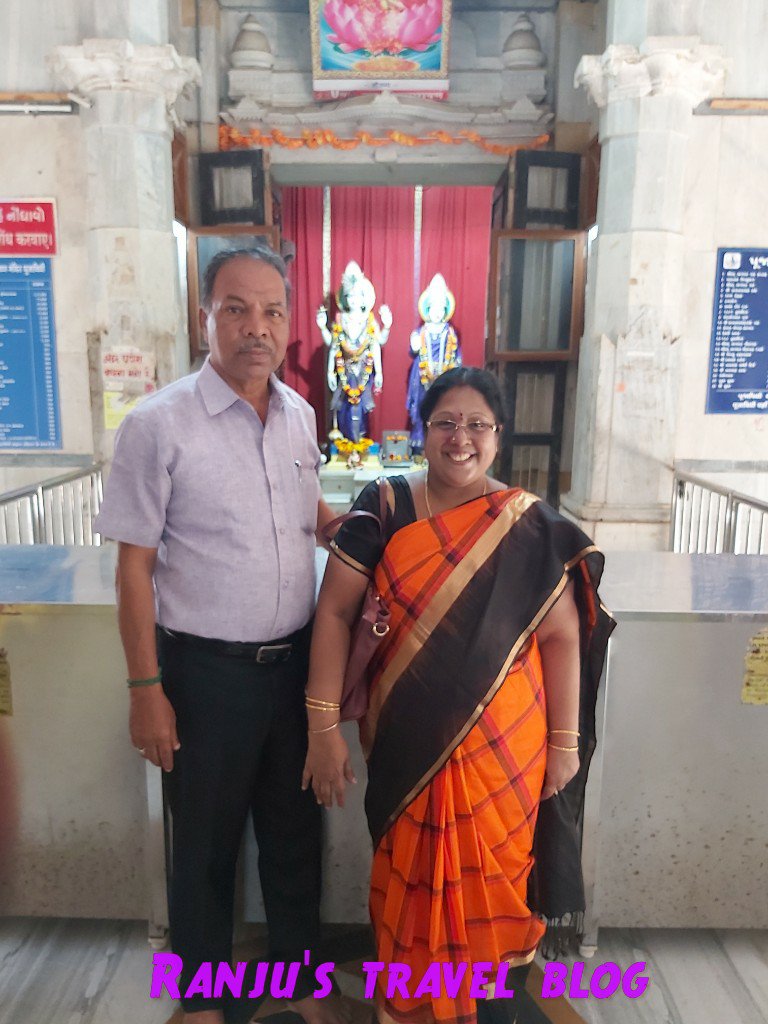
Next to it Lord Lakshmi Narayanan mandir .In this temple all the avatars of Lord Vishnu is kept as photos .
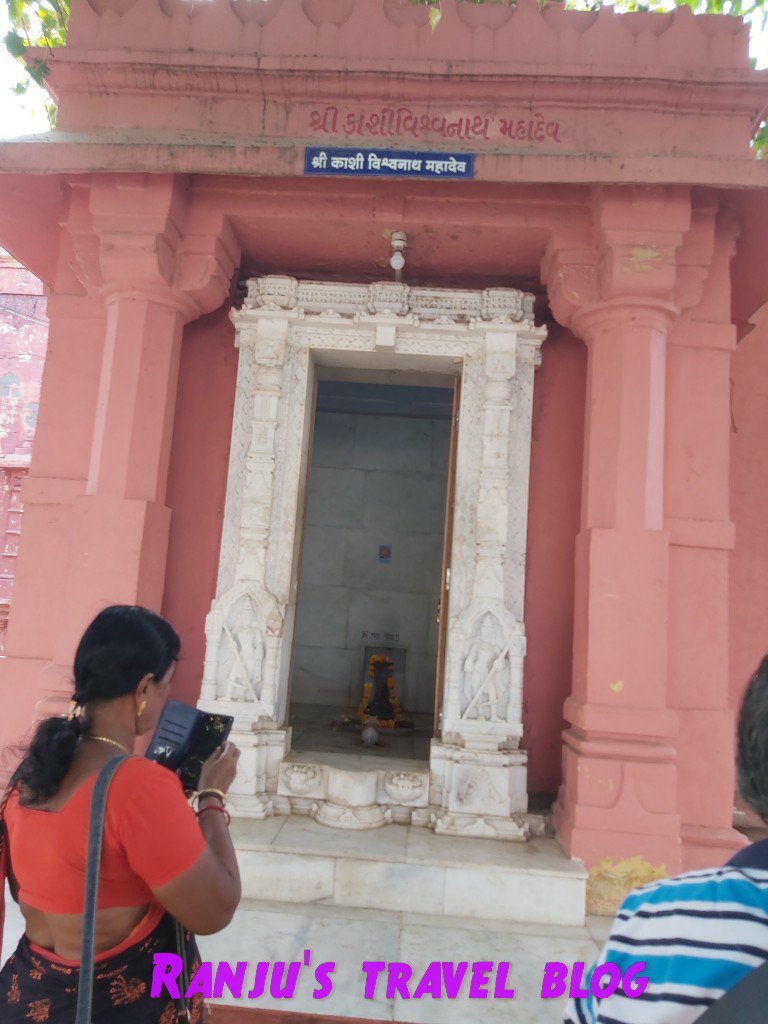
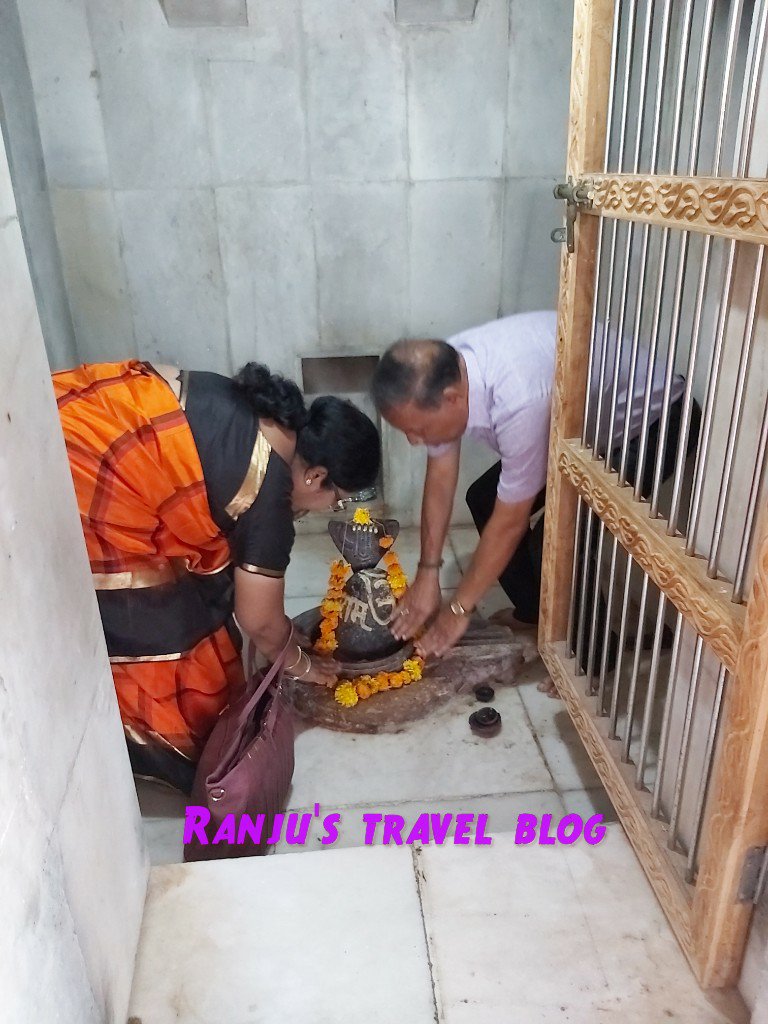
There is a seperate shrines for Kashi Vishwanath and Omkareshwar .
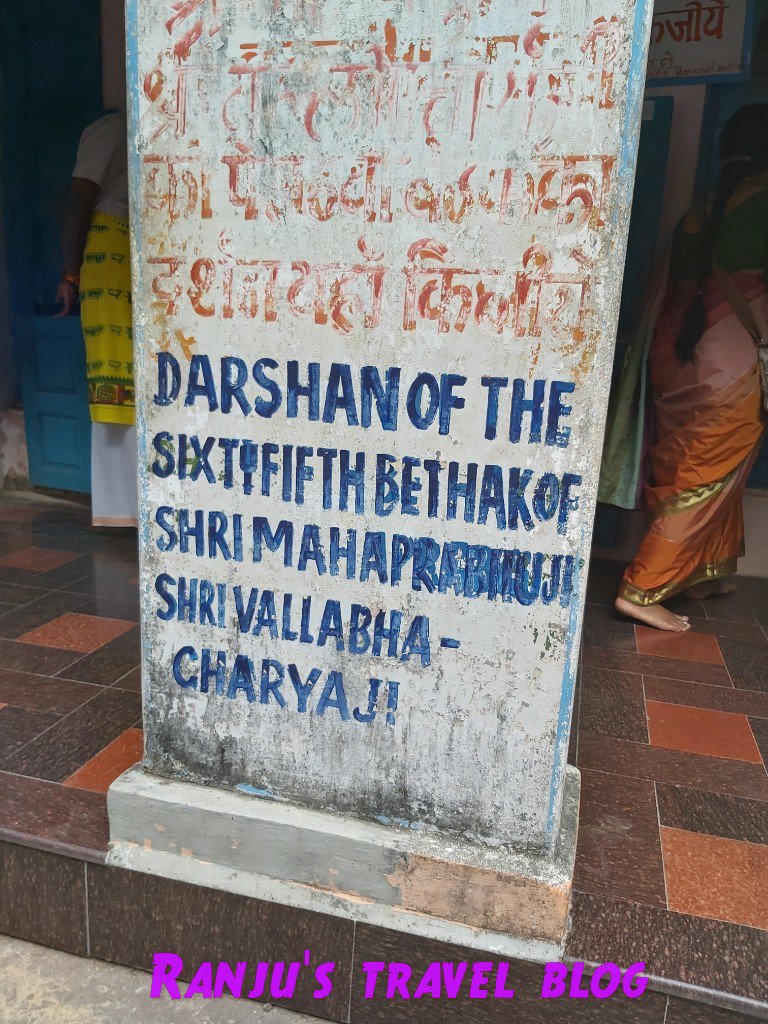
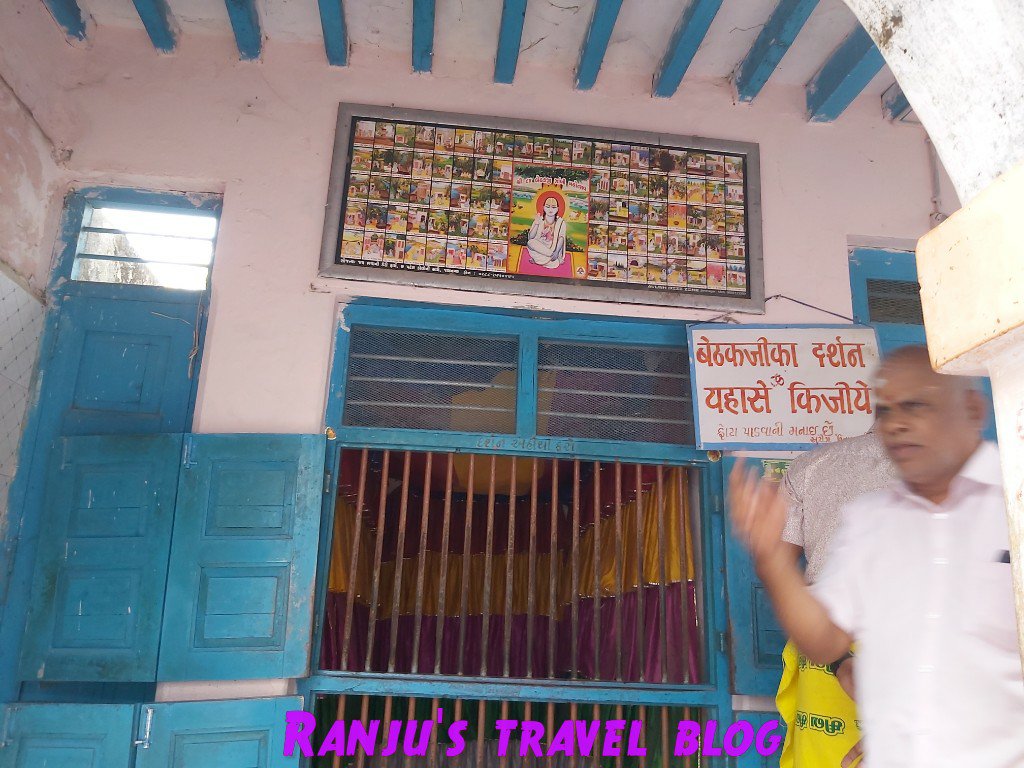
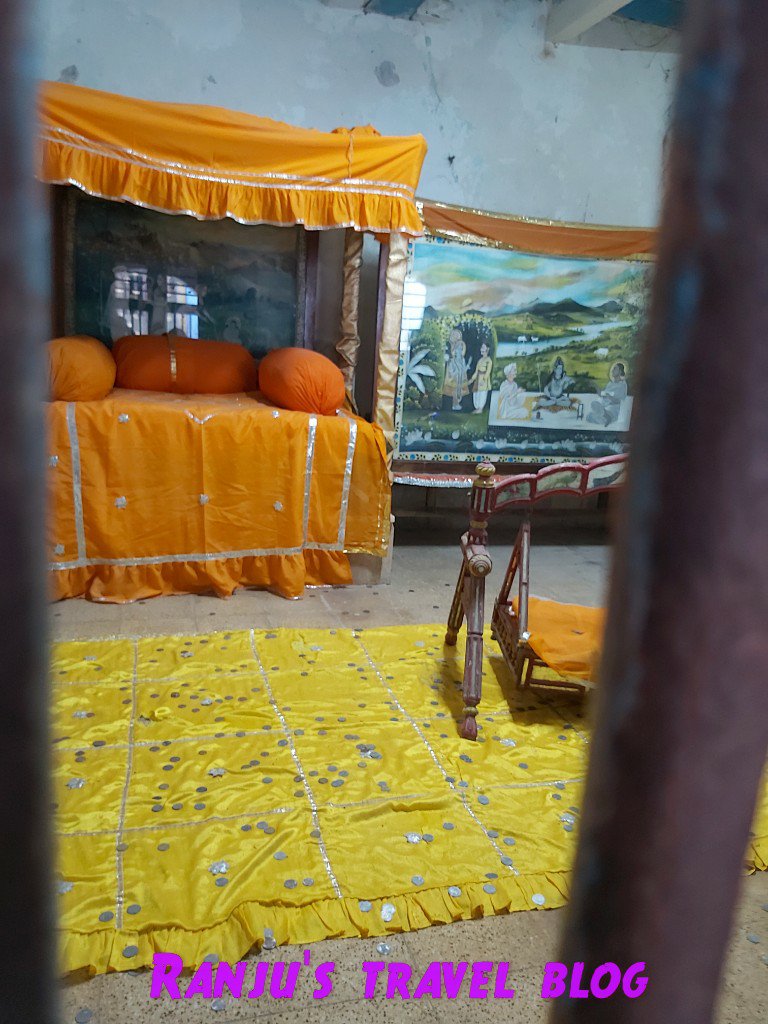
64 th Peeth Vallabhacharya’s Mandir and the used household of His was kept inside a room .
The Padukas of Lord Krishna’s in the middle of the temple complex
Temples within GolokdhamGeetha mandir The main deity Lord Krishna of Geetha mandir Balaram gufaBalaram Nagar with lord Shiva Vallabhacharya’s roomFrom outsideInside the roomGolokdham Kashi Vishwanath Omkareshwar Lakshmi Narayanan temple Lord Krishna’s Padukas Video inside Lakshmi Narayanan temple
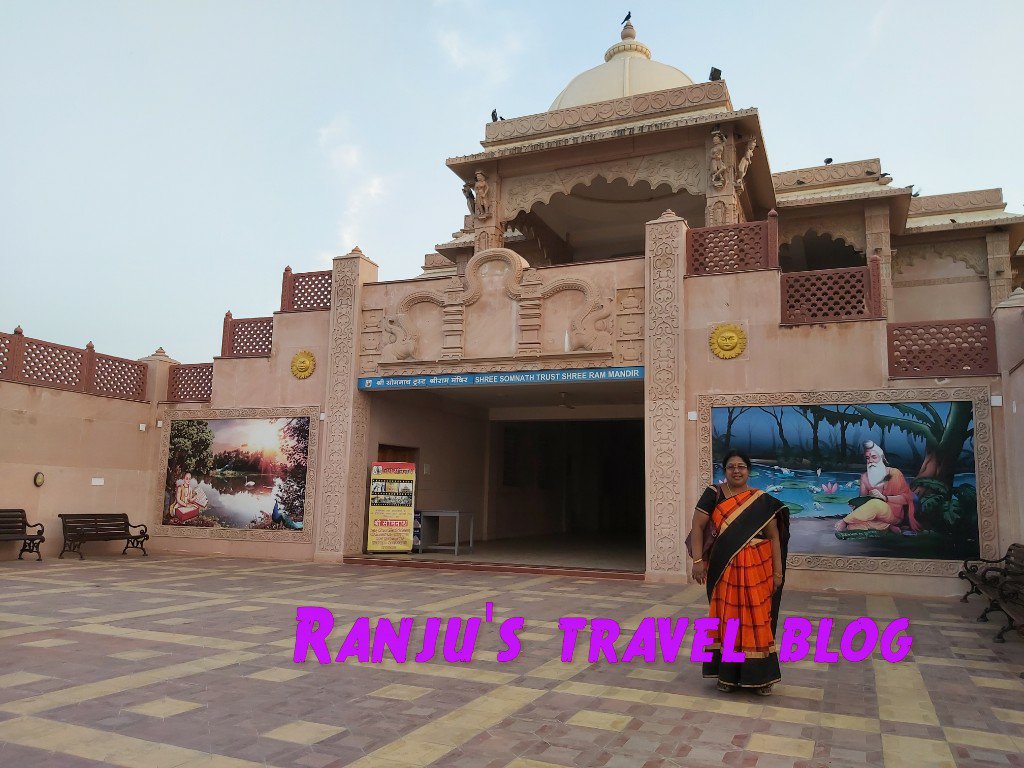
This temple is built and maintained by Somnath trust .
This place is next big to Somnath temple in Somnath. Located hardly a 200 meters from the Somnath Temple junction. People can see here the Somnath Temple from its gate. Almost all other temples and Triveni Sangam are visible from this temple.
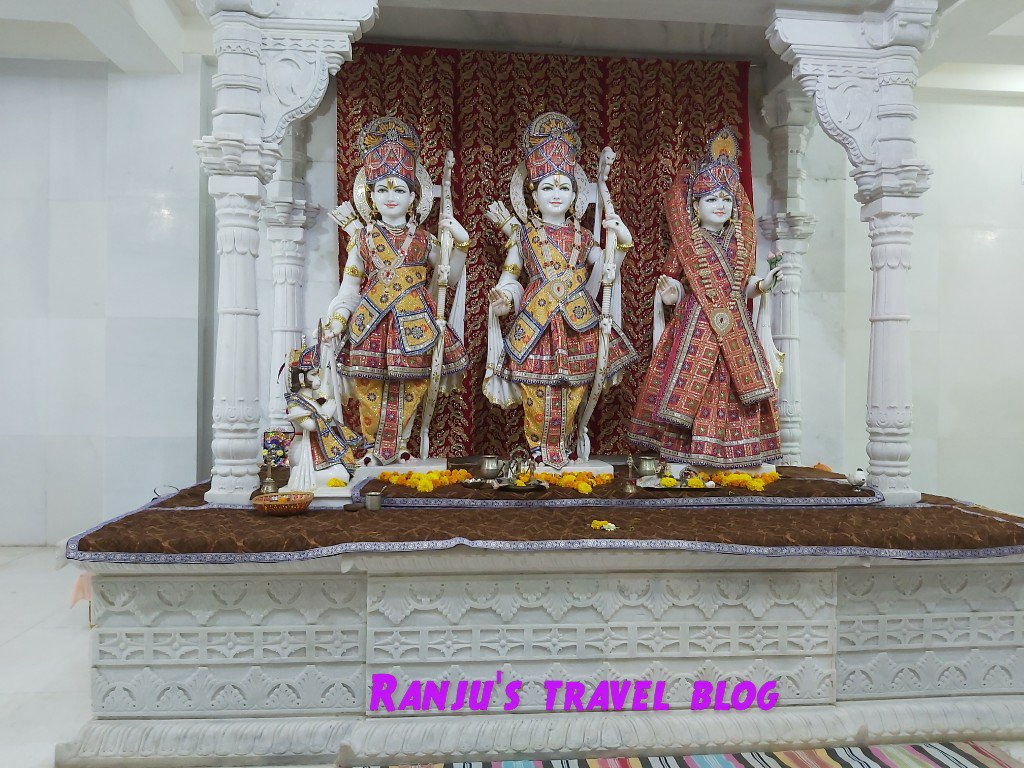
The main deity being Lord Ram with His consort Goddess Seetha and Lakshmana. There are other deities done in marble stone and installed in outer wall of the temple .
The sunset in the Triveni sangam was a awesome view from this temple . The temple is calm and neatly maintained.
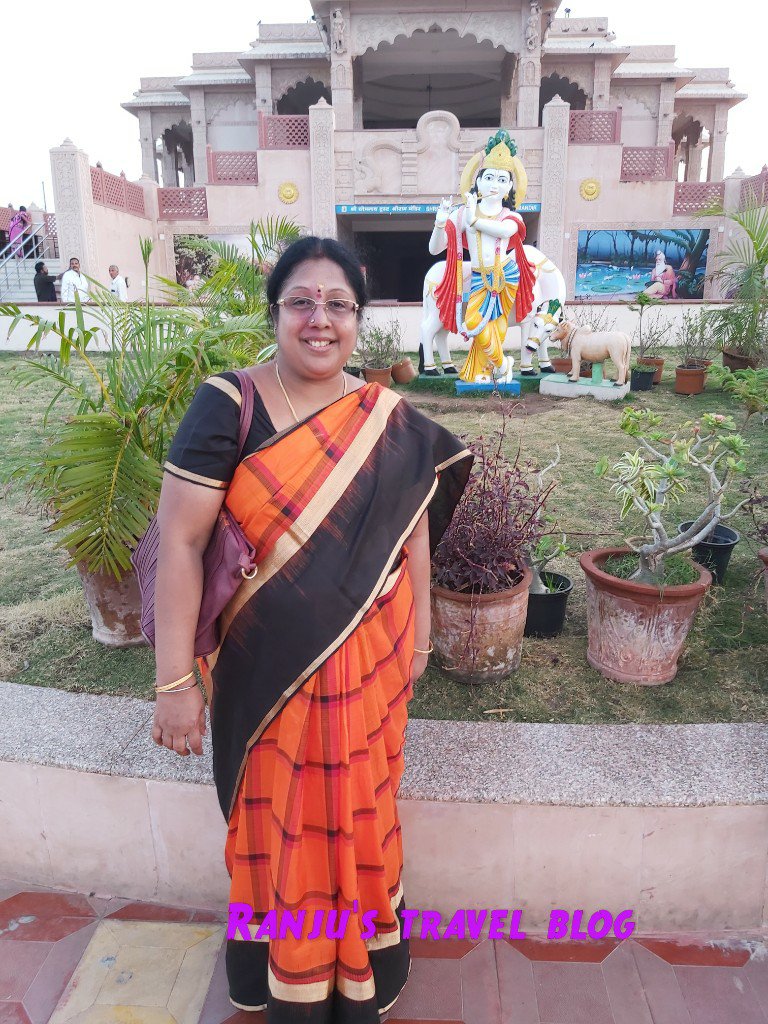
Entrance of Ram mandir Beautiful Krishna idol in front of Ram mandir Lord Ram Seetha and Lakshmana Lord Ganesha Lord Hanuman The view from backside of the temple
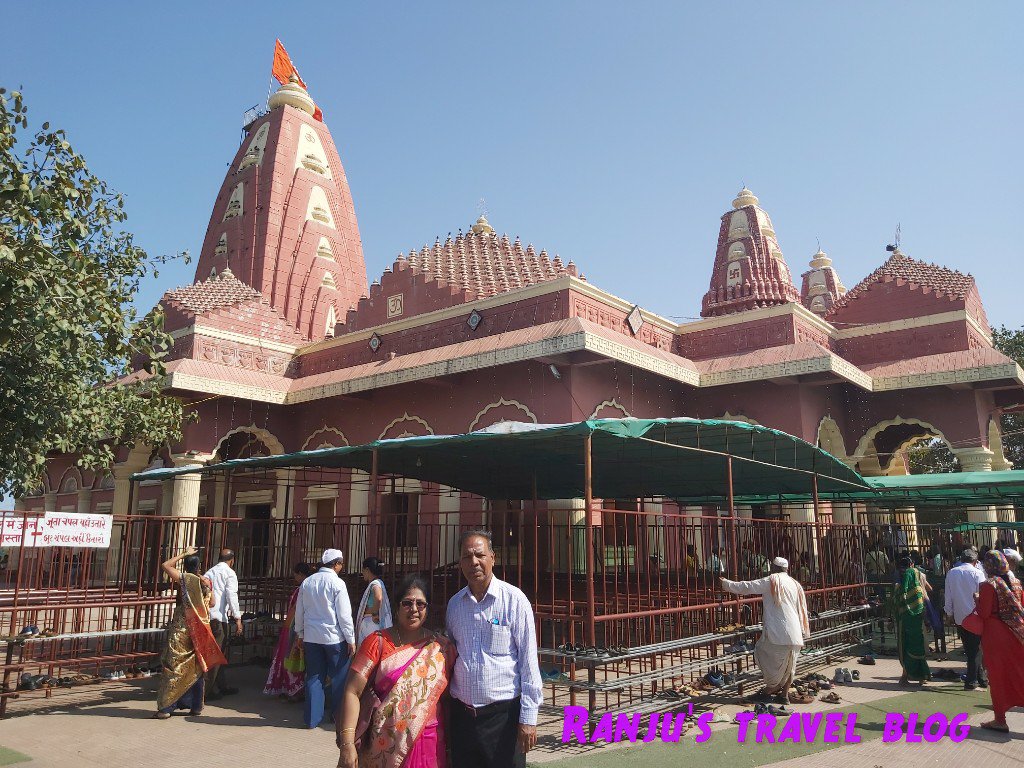
The Somnath temple located in Prabhas Patan near Junagadh in Saurashtra on the western coast of Gujarat . It is an important pilgrimage and tourist spot of Gujarat. Somnath temple is the first among the 12 jothirlingams .
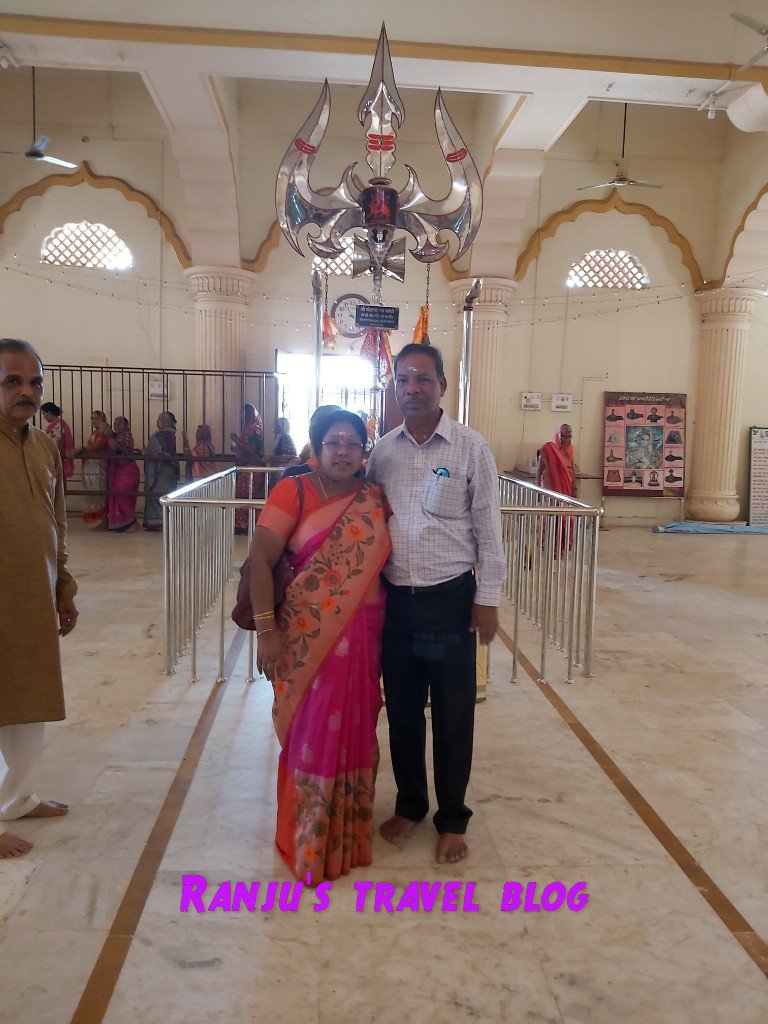
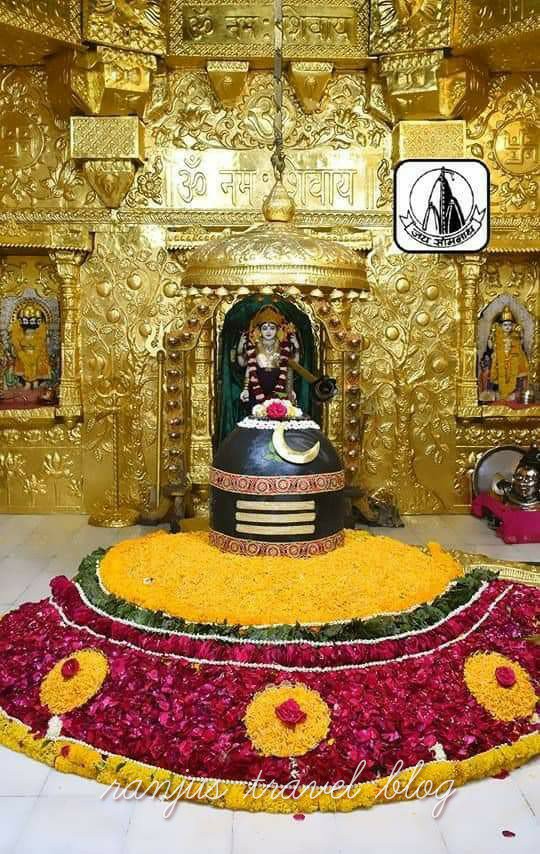
In the Somnath mandir the main deity is the huge lingam well decorated with chandan and kumkum with his consort Goddess Parvathi backside of the lingam , Lord Ganesha and Lord Murugar on both sides .
The site of Somnath has been a pilgrimage site from ancient times on account of being a Triveni sangam (the confluence of three rivers: Kapila, Hiran and Saraswathi).
The architect of the temple is amazing and it is said to be ruined several times and has been rebuilt again .
New mandir has main deity Somnath lingam and Goddess Parvathi back of the lingam and Lord Vishnu inside the main sanctum . We couldn’t come around the temple as light and sound shows has started only those having the shows tickets were allowed , we returned back and collected our bags mobiles and photos .
Soma, the Moon god, is believed to have lost his lustre due to a curse, and he bathed in the Saraswathi River at this site to regain it. The result is the waxing and waning of the moon, no doubt an allusion to the waxing and waning of the tides at this seashore location. The name of the town Prabhas, meaning lustre, as well as the alternative names Someshvar and Somnath (“The lord of the moon” or “the moon god”) arise from this tradition .
Legend goes that the moon was married to the 27 daughters of Daksha Prajapati. He was partial to Rohini, his favorite and neglected the others. An angered Daksha cursed him to wane into nothingness. A disturbed Chandra, came down to Prabhasa with Rohini and worshipped the Sparsa Linga of Somnath after which he was blessed by Shiva to grow and shine in the bright half. As the moon regained his light here, this town came to be known as Prabhasa. Bhrama, one of the trinity, installed the Bhramasila, and paved way for the construction of the temple.
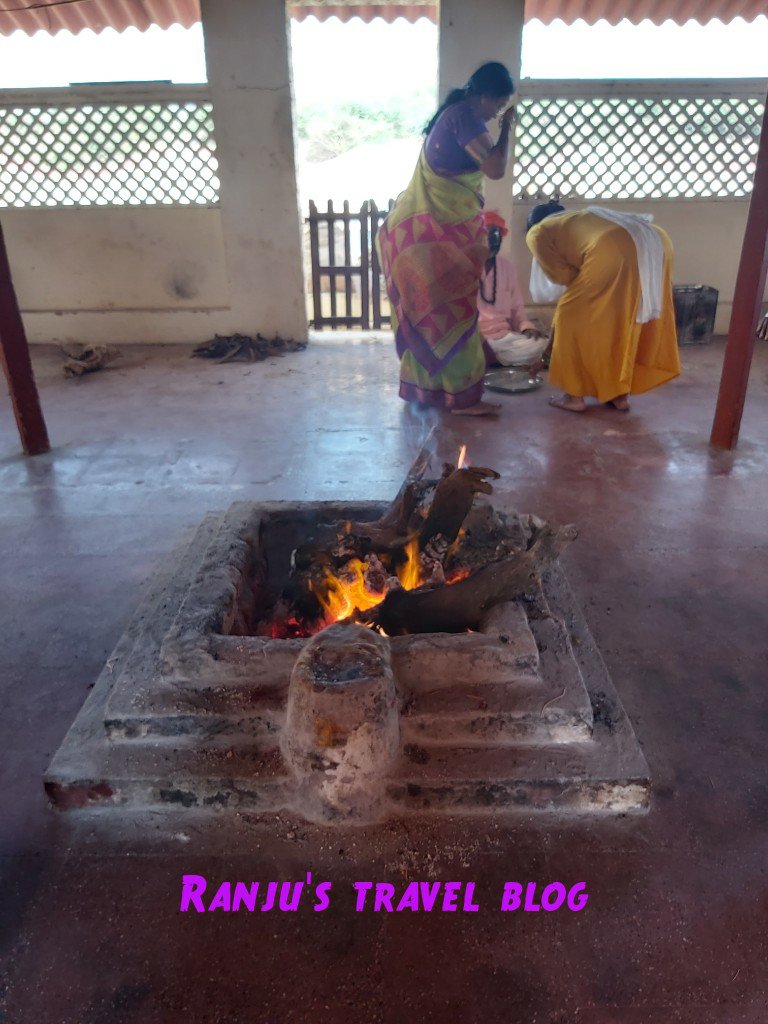
The old Somnath mandir is opposite to the new Somnath mandir . Inside the main sanctum is the lingam of 3 feet height along with Saraswathy Ganga matha Mahalakshmi and Parvathi. There is a seperate shrine for Goddess annapoorni. In old Somnath mandir we were allowed inside the main sanctum and allowed to touch the lingam and do milk abhishegam.
Beyt Dwarka, an island in the Arabian sea off the coast of Dwarka. Considered the original residence of Krishna .Here Lord Krishna is named as Kesavaraiji .
Beyt Dwarka was the old port during the ancient times of Krishna before the Okha port was developed in Dwarka.
The temple built here is credited to the religious Guru Vallabhacharya of the “Pushtimarg Sampradaya”.
Rice is the traditional offering here to the deity as it is believe that Sudama offered rice to his childhood friend Krishna.
There are also smaller shrines on Beyt Dwarka which are dedicated to Shiva, Vishnu, Hanuman and Devi.
According to a legend, Vishnu killed the demon Shankhasura on this island. There are temples of Vishnu in the incarnation of matsya, or fish. Other shrines here are of Goddess Rukmini, Trivikramaji, Devaki, Radha, Lakshmi, Satyabhama, Jambavati, Goddess Ambaji , Madhavaraiji . Lakshmi Narayan, and many other gods.
There is a mantap where people offer money for rice and next to it is a mantap where people offer gold and silver to the temple and they officially give receipt.
There is a pillar which people hug and make a desire and it is believed their desires are fulfilled by the Lord Dwarakadesh.
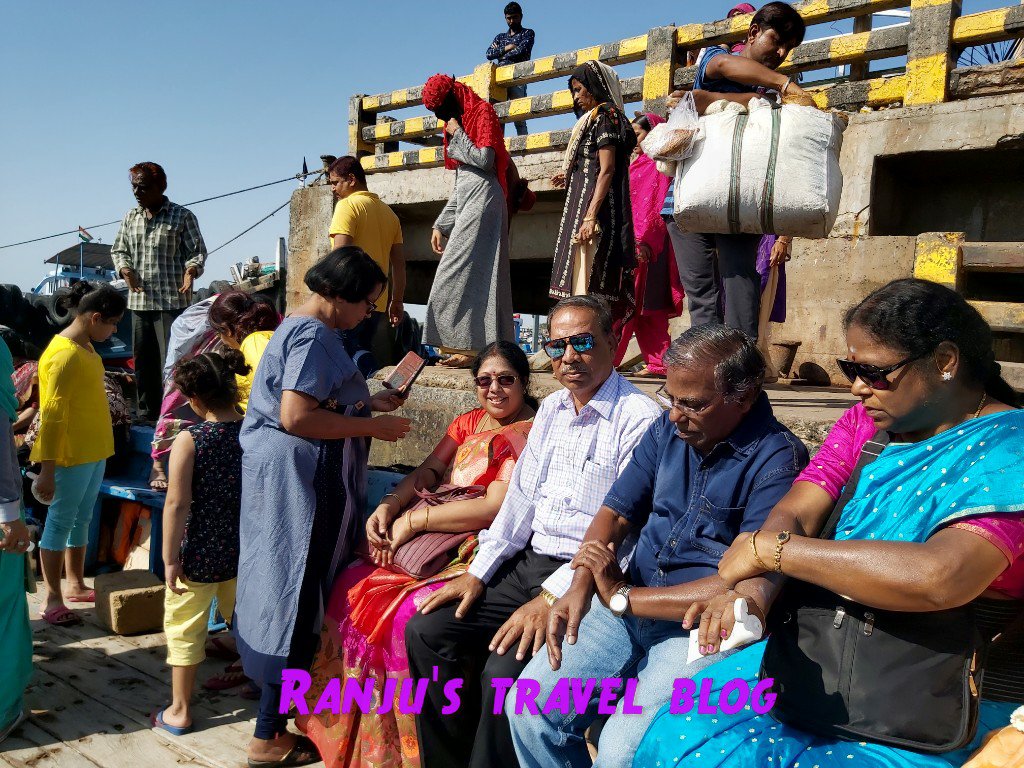
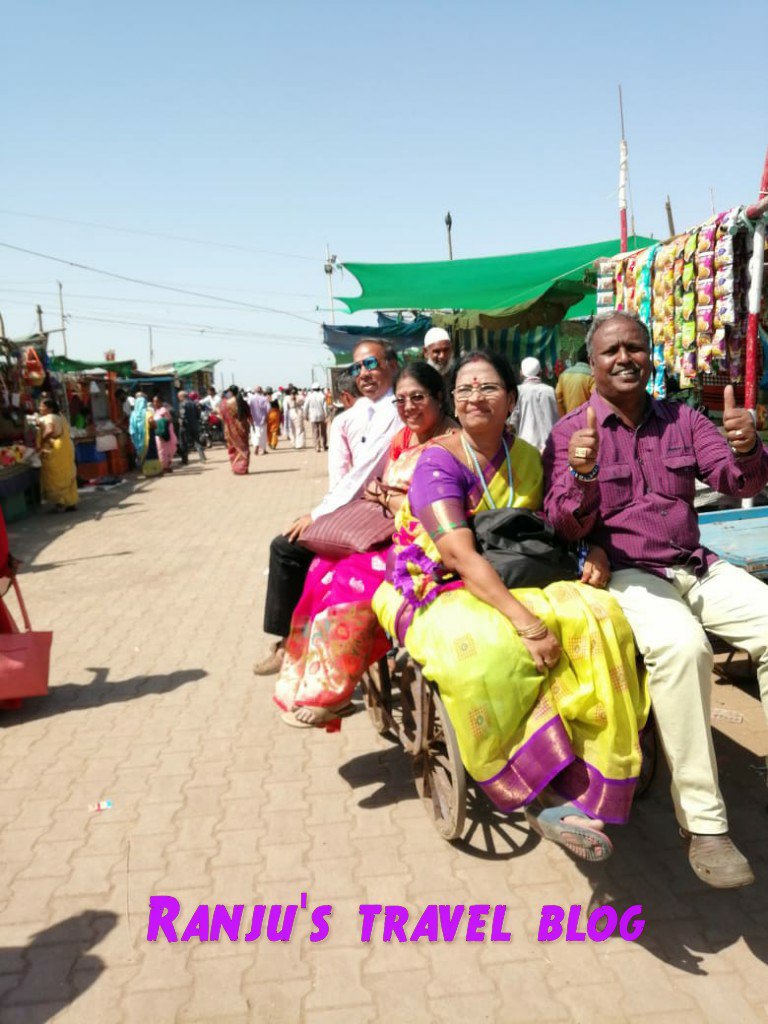
Boat travelling takes about 20 minutes to this island and had to walk about a km to reach the temple . For boat they collect Rs. 20 per person and for return again Rs. 20 we have to pay . There are cart pushed by men those who cant walk can make use of it , they charge 50 per person .
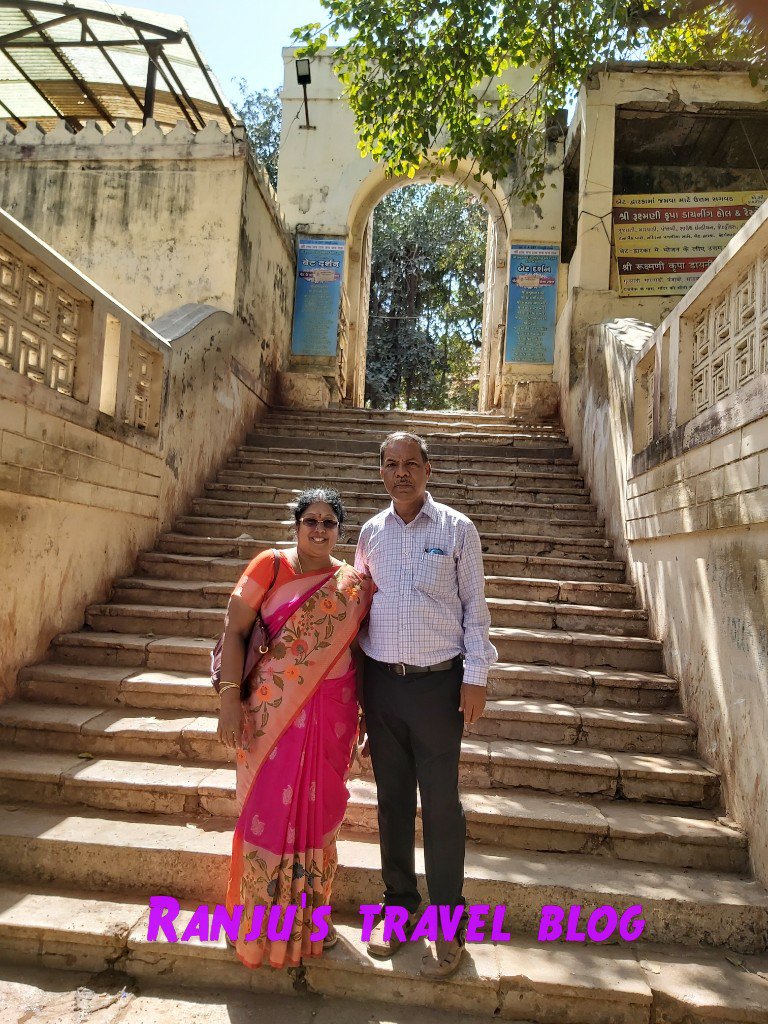
At the entrance there are about 20 steps , here too we had the arathy dharshan of Lord Keshavaraiji .
Travelling in boat to Beyt Dwaraka While returning Cart travel to Beyt Dwaraka Entrance of Beyt Dwaraka Boat travelling to Beyt Dwaraka


















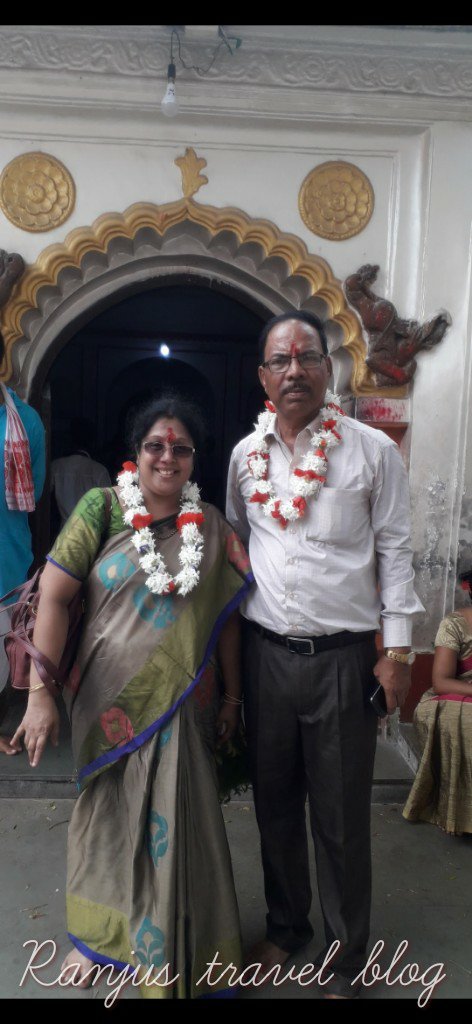

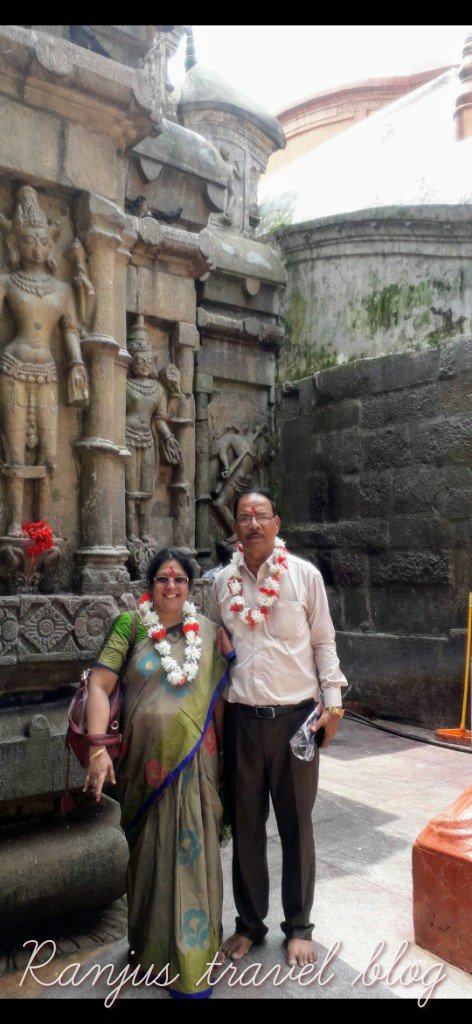

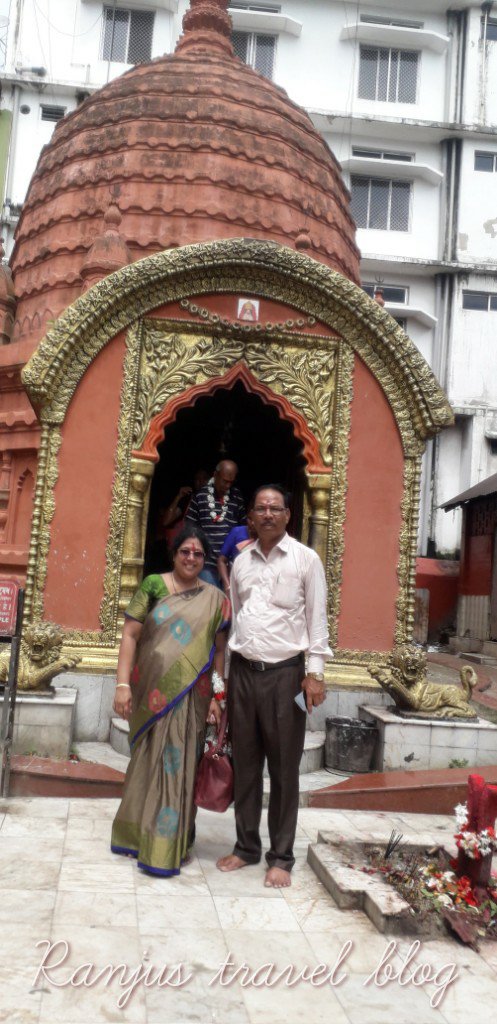
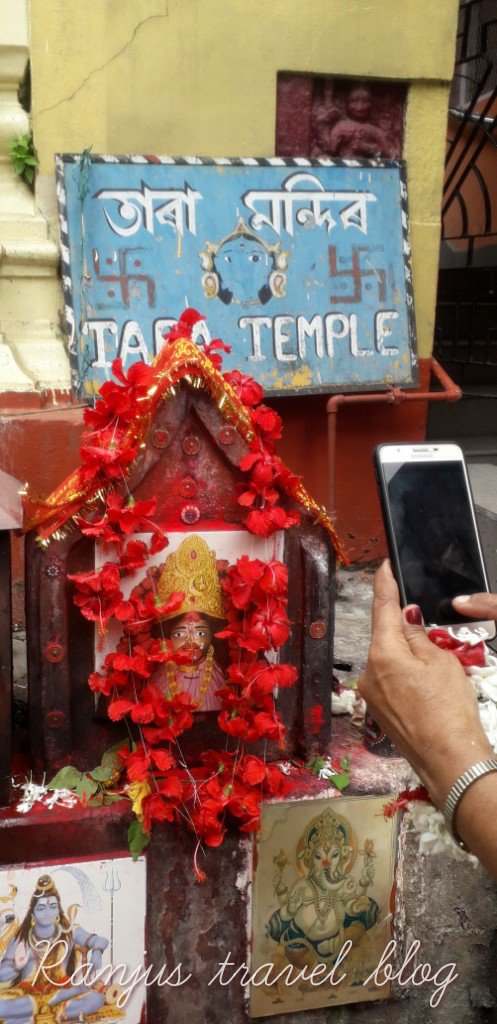


















































 Ranjus travel blog
You must be logged in to post a comment.